

332
J. Handzlik
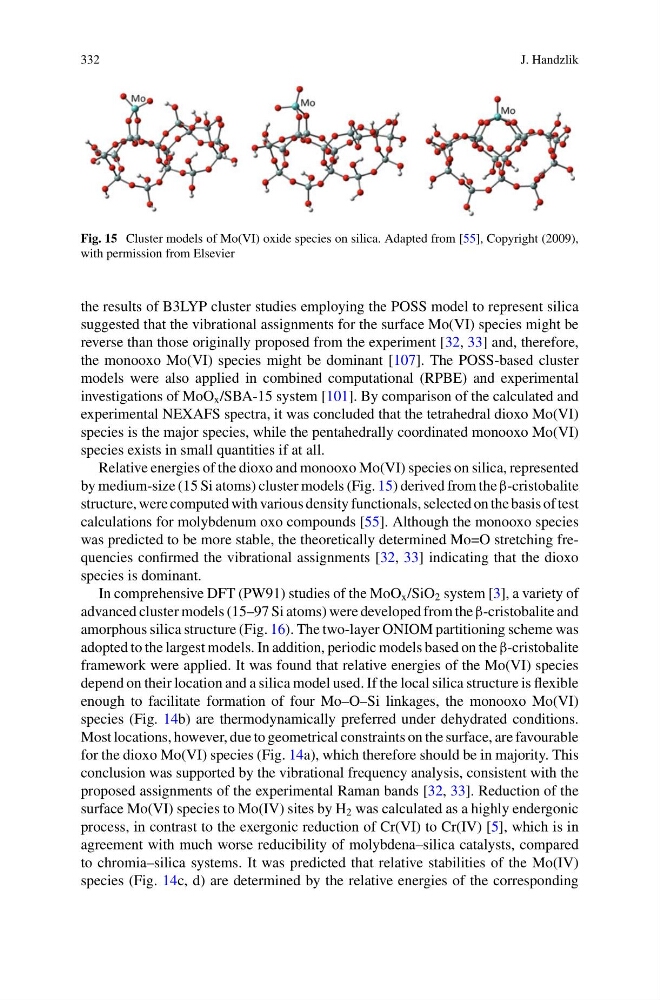
Fig. 15 Cluster models of Mo(VI) oxide species on silica. Adapted from [55], Copyright (2009),
with permission from Elsevier
the results of B3LYP cluster studies employing the POSS model to represent silica
suggested that the vibrational assignments for the surface Mo(VI) species might be
reverse than those originally proposed from the experiment [32, 33] and, therefore,
the monooxo Mo(VI) species might be dominant [107]. The POSS-based cluster
models were also applied in combined computational (RPBE) and experimental
investigations of MoO x /SBA-15 system [101]. By comparison of the calculated and
experimental NEXAFS spectra, it was concluded that the tetrahedral dioxo Mo(VI)
species is the major species, while the pentahedrally coordinated monooxo Mo(VI)
species exists in small quantities if at all.
Relative energies of the dioxo and monooxo Mo(VI) species on silica, represented
by medium-size (15 Si atoms) cluster models (Fig. 15) derived from the β-cristobalite
structure, were computed with various density functionals, selected on the basis of test
calculations for molybdenum oxo compounds [55]. Although the monooxo species
was predicted to be more stable, the theoretically determined Mo=O stretching frequencies confirmed the vibrational assignments [32, 33] indicating that the dioxo
species is dominant.
In comprehensive DFT (PW91) studies of the MoO x /SiO 2 system [3], a variety of
advanced cluster models (15–97 Si atoms) were developed from the β-cristobalite and
amorphous silica structure (Fig. 16). The two-layer ONIOM partitioning scheme was
adopted to the largest models. In addition, periodic models based on the β-cristobalite
framework were applied. It was found that relative energies of the Mo(VI) species
depend on their location and a silica model used. If the local silica structure is flexible
enough to facilitate formation of four Mo–O–Si linkages, the monooxo Mo(VI)
species (Fig. 14b) are thermodynamically preferred under dehydrated conditions.
Most locations, however, due to geometrical constraints on the surface, are favourable
for the dioxo Mo(VI) species (Fig. 14a), which therefore should be in majority. This
conclusion was supported by the vibrational frequency analysis, consistent with the
proposed assignments of the experimental Raman bands [32, 33]. Reduction of the
surface Mo(VI) species to Mo(IV) sites by H 2 was calculated as a highly endergonic
process, in contrast to the exergonic reduction of Cr(VI) to Cr(IV) [5], which is in
agreement with much worse reducibility of molybdena–silica catalysts, compared
to chromia–silica systems. It was predicted that relative stabilities of the Mo(IV)
species (Fig. 14c, d) are determined by the relative energies of the corresponding
J. Handzlik
Fig. 15 Cluster models of Mo(VI) oxide species on silica. Adapted from [55], Copyright (2009),
with permission from Elsevier
the results of B3LYP cluster studies employing the POSS model to represent silica
suggested that the vibrational assignments for the surface Mo(VI) species might be
reverse than those originally proposed from the experiment [32, 33] and, therefore,
the monooxo Mo(VI) species might be dominant [107]. The POSS-based cluster
models were also applied in combined computational (RPBE) and experimental
investigations of MoO x /SBA-15 system [101]. By comparison of the calculated and
experimental NEXAFS spectra, it was concluded that the tetrahedral dioxo Mo(VI)
species is the major species, while the pentahedrally coordinated monooxo Mo(VI)
species exists in small quantities if at all.
Relative energies of the dioxo and monooxo Mo(VI) species on silica, represented
by medium-size (15 Si atoms) cluster models (Fig. 15) derived from the β-cristobalite
structure, were computed with various density functionals, selected on the basis of test
calculations for molybdenum oxo compounds [55]. Although the monooxo species
was predicted to be more stable, the theoretically determined Mo=O stretching frequencies confirmed the vibrational assignments [32, 33] indicating that the dioxo
species is dominant.
In comprehensive DFT (PW91) studies of the MoO x /SiO 2 system [3], a variety of
advanced cluster models (15–97 Si atoms) were developed from the β-cristobalite and
amorphous silica structure (Fig. 16). The two-layer ONIOM partitioning scheme was
adopted to the largest models. In addition, periodic models based on the β-cristobalite
framework were applied. It was found that relative energies of the Mo(VI) species
depend on their location and a silica model used. If the local silica structure is flexible
enough to facilitate formation of four Mo–O–Si linkages, the monooxo Mo(VI)
species (Fig. 14b) are thermodynamically preferred under dehydrated conditions.
Most locations, however, due to geometrical constraints on the surface, are favourable
for the dioxo Mo(VI) species (Fig. 14a), which therefore should be in majority. This
conclusion was supported by the vibrational frequency analysis, consistent with the
proposed assignments of the experimental Raman bands [32, 33]. Reduction of the
surface Mo(VI) species to Mo(IV) sites by H 2 was calculated as a highly endergonic
process, in contrast to the exergonic reduction of Cr(VI) to Cr(IV) [5], which is in
agreement with much worse reducibility of molybdena–silica catalysts, compared
to chromia–silica systems. It was predicted that relative stabilities of the Mo(IV)
species (Fig. 14c, d) are determined by the relative energies of the corresponding