

Computational Modelling of Structure and Catalytic Properties …
331
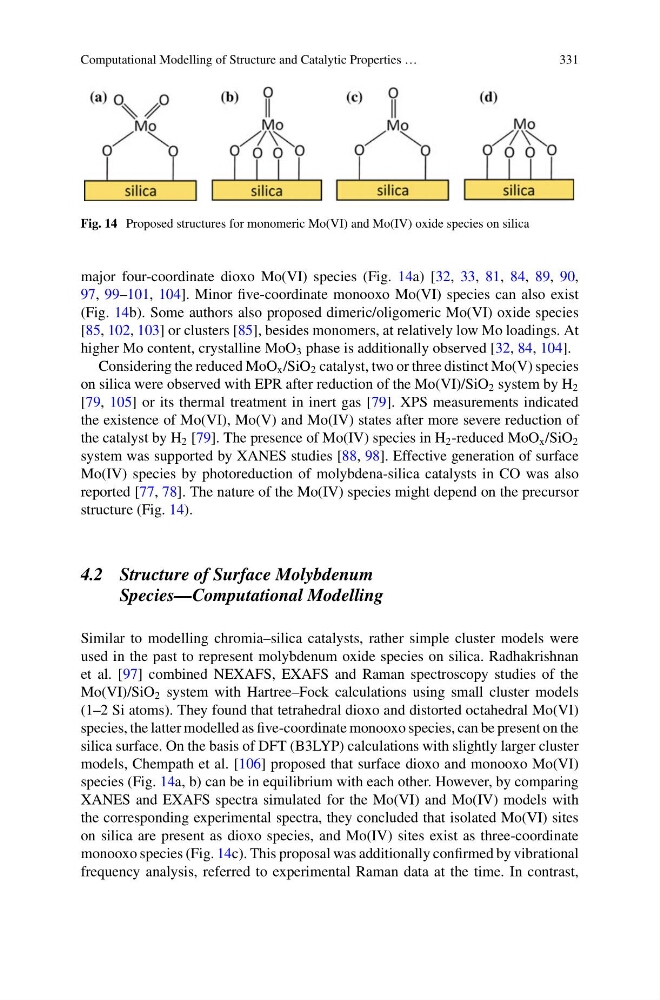
Fig. 14 Proposed structures for monomeric Mo(VI) and Mo(IV) oxide species on silica
major four-coordinate dioxo Mo(VI) species (Fig. 14a) [32, 33, 81, 84, 89, 90,
97, 99–101, 104]. Minor five-coordinate monooxo Mo(VI) species can also exist
(Fig. 14b). Some authors also proposed dimeric/oligomeric Mo(VI) oxide species
[85, 102, 103] or clusters [85], besides monomers, at relatively low Mo loadings. At
higher Mo content, crystalline MoO 3 phase is additionally observed [32, 84, 104].
Considering the reduced MoO x /SiO 2 catalyst, two or three distinct Mo(V) species
on silica were observed with EPR after reduction of the Mo(VI)/SiO 2 system by H 2
[79, 105] or its thermal treatment in inert gas [79]. XPS measurements indicated
the existence of Mo(VI), Mo(V) and Mo(IV) states after more severe reduction of
the catalyst by H 2 [79]. The presence of Mo(IV) species in H 2 -reduced MoO x /SiO 2
system was supported by XANES studies [88, 98]. Effective generation of surface
Mo(IV) species by photoreduction of molybdena-silica catalysts in CO was also
reported [77, 78]. The nature of the Mo(IV) species might depend on the precursor
structure (Fig. 14).
4.2 Structure of Surface Molybdenum
Species—Computational Modelling
Similar to modelling chromia–silica catalysts, rather simple cluster models were
used in the past to represent molybdenum oxide species on silica. Radhakrishnan
et al. [97] combined NEXAFS, EXAFS and Raman spectroscopy studies of the
Mo(VI)/SiO 2 system with Hartree–Fock calculations using small cluster models
(1–2 Si atoms). They found that tetrahedral dioxo and distorted octahedral Mo(VI)
species, the latter modelled as five-coordinate monooxo species, can be present on the
silica surface. On the basis of DFT (B3LYP) calculations with slightly larger cluster
models, Chempath et al. [106] proposed that surface dioxo and monooxo Mo(VI)
species (Fig. 14a, b) can be in equilibrium with each other. However, by comparing
XANES and EXAFS spectra simulated for the Mo(VI) and Mo(IV) models with
the corresponding experimental spectra, they concluded that isolated Mo(VI) sites
on silica are present as dioxo species, and Mo(IV) sites exist as three-coordinate
monooxo species (Fig. 14c). This proposal was additionally confirmed by vibrational
frequency analysis, referred to experimental Raman data at the time. In contrast,
331
Fig. 14 Proposed structures for monomeric Mo(VI) and Mo(IV) oxide species on silica
major four-coordinate dioxo Mo(VI) species (Fig. 14a) [32, 33, 81, 84, 89, 90,
97, 99–101, 104]. Minor five-coordinate monooxo Mo(VI) species can also exist
(Fig. 14b). Some authors also proposed dimeric/oligomeric Mo(VI) oxide species
[85, 102, 103] or clusters [85], besides monomers, at relatively low Mo loadings. At
higher Mo content, crystalline MoO 3 phase is additionally observed [32, 84, 104].
Considering the reduced MoO x /SiO 2 catalyst, two or three distinct Mo(V) species
on silica were observed with EPR after reduction of the Mo(VI)/SiO 2 system by H 2
[79, 105] or its thermal treatment in inert gas [79]. XPS measurements indicated
the existence of Mo(VI), Mo(V) and Mo(IV) states after more severe reduction of
the catalyst by H 2 [79]. The presence of Mo(IV) species in H 2 -reduced MoO x /SiO 2
system was supported by XANES studies [88, 98]. Effective generation of surface
Mo(IV) species by photoreduction of molybdena-silica catalysts in CO was also
reported [77, 78]. The nature of the Mo(IV) species might depend on the precursor
structure (Fig. 14).
4.2 Structure of Surface Molybdenum
Species—Computational Modelling
Similar to modelling chromia–silica catalysts, rather simple cluster models were
used in the past to represent molybdenum oxide species on silica. Radhakrishnan
et al. [97] combined NEXAFS, EXAFS and Raman spectroscopy studies of the
Mo(VI)/SiO 2 system with Hartree–Fock calculations using small cluster models
(1–2 Si atoms). They found that tetrahedral dioxo and distorted octahedral Mo(VI)
species, the latter modelled as five-coordinate monooxo species, can be present on the
silica surface. On the basis of DFT (B3LYP) calculations with slightly larger cluster
models, Chempath et al. [106] proposed that surface dioxo and monooxo Mo(VI)
species (Fig. 14a, b) can be in equilibrium with each other. However, by comparing
XANES and EXAFS spectra simulated for the Mo(VI) and Mo(IV) models with
the corresponding experimental spectra, they concluded that isolated Mo(VI) sites
on silica are present as dioxo species, and Mo(IV) sites exist as three-coordinate
monooxo species (Fig. 14c). This proposal was additionally confirmed by vibrational
frequency analysis, referred to experimental Raman data at the time. In contrast,