

330
J. Handzlik
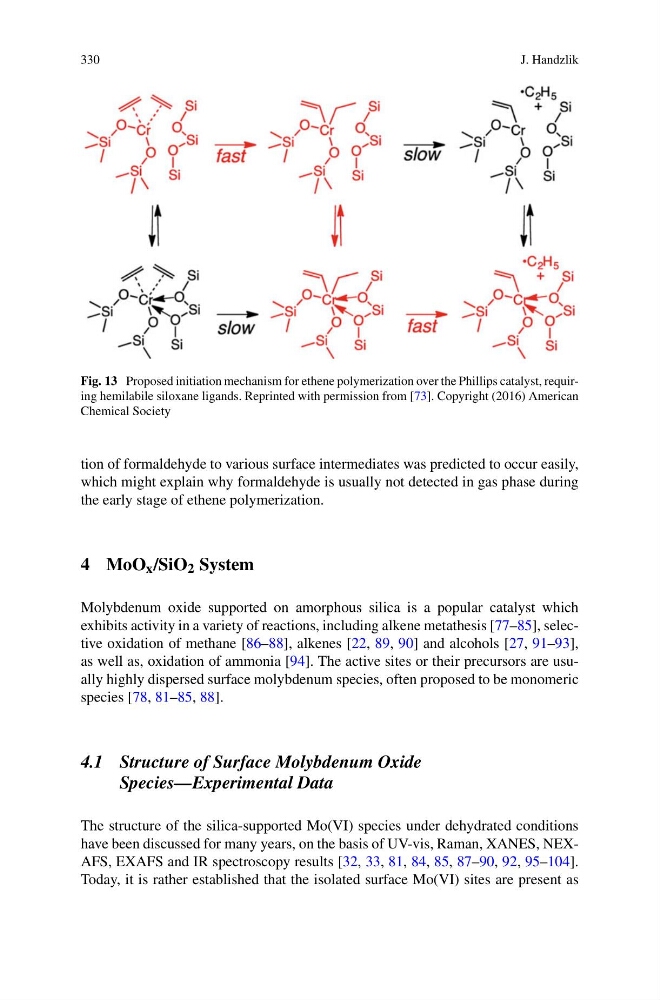
Fig. 13 Proposed initiation mechanism for ethene polymerization over the Phillips catalyst, requiring hemilabile siloxane ligands. Reprinted with permission from [73]. Copyright (2016) American
Chemical Society
tion of formaldehyde to various surface intermediates was predicted to occur easily,
which might explain why formaldehyde is usually not detected in gas phase during
the early stage of ethene polymerization.
4 MoO x /SiO 2 System
Molybdenum oxide supported on amorphous silica is a popular catalyst which
exhibits activity in a variety of reactions, including alkene metathesis [77–85], selective oxidation of methane [86–88], alkenes [22, 89, 90] and alcohols [27, 91–93],
as well as, oxidation of ammonia [94]. The active sites or their precursors are usually highly dispersed surface molybdenum species, often proposed to be monomeric
species [78, 81–85, 88].
4.1 Structure of Surface Molybdenum Oxide
Species—Experimental Data
The structure of the silica-supported Mo(VI) species under dehydrated conditions
have been discussed for many years, on the basis of UV-vis, Raman, XANES, NEXAFS, EXAFS and IR spectroscopy results [32, 33, 81, 84, 85, 87–90, 92, 95–104].
Today, it is rather established that the isolated surface Mo(VI) sites are present as
J. Handzlik
Fig. 13 Proposed initiation mechanism for ethene polymerization over the Phillips catalyst, requiring hemilabile siloxane ligands. Reprinted with permission from [73]. Copyright (2016) American
Chemical Society
tion of formaldehyde to various surface intermediates was predicted to occur easily,
which might explain why formaldehyde is usually not detected in gas phase during
the early stage of ethene polymerization.
4 MoO x /SiO 2 System
Molybdenum oxide supported on amorphous silica is a popular catalyst which
exhibits activity in a variety of reactions, including alkene metathesis [77–85], selective oxidation of methane [86–88], alkenes [22, 89, 90] and alcohols [27, 91–93],
as well as, oxidation of ammonia [94]. The active sites or their precursors are usually highly dispersed surface molybdenum species, often proposed to be monomeric
species [78, 81–85, 88].
4.1 Structure of Surface Molybdenum Oxide
Species—Experimental Data
The structure of the silica-supported Mo(VI) species under dehydrated conditions
have been discussed for many years, on the basis of UV-vis, Raman, XANES, NEXAFS, EXAFS and IR spectroscopy results [32, 33, 81, 84, 85, 87–90, 92, 95–104].
Today, it is rather established that the isolated surface Mo(VI) sites are present as