

Computational Modelling of Structure and Catalytic Properties …
329
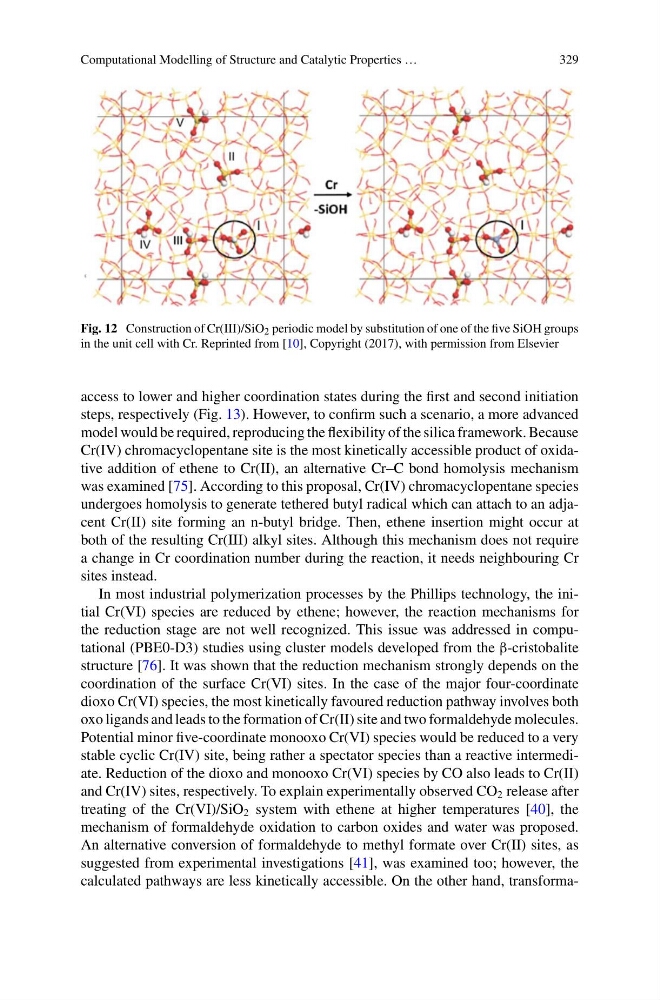
Fig. 12 Construction of Cr(III)/SiO 2 periodic model by substitution of one of the five SiOH groups
in the unit cell with Cr. Reprinted from [10], Copyright (2017), with permission from Elsevier
access to lower and higher coordination states during the first and second initiation
steps, respectively (Fig. 13). However, to confirm such a scenario, a more advanced
model would be required, reproducing the flexibility of the silica framework. Because
Cr(IV) chromacyclopentane site is the most kinetically accessible product of oxidative addition of ethene to Cr(II), an alternative Cr–C bond homolysis mechanism
was examined [75]. According to this proposal, Cr(IV) chromacyclopentane species
undergoes homolysis to generate tethered butyl radical which can attach to an adjacent Cr(II) site forming an n-butyl bridge. Then, ethene insertion might occur at
both of the resulting Cr(III) alkyl sites. Although this mechanism does not require
a change in Cr coordination number during the reaction, it needs neighbouring Cr
sites instead.
In most industrial polymerization processes by the Phillips technology, the initial Cr(VI) species are reduced by ethene; however, the reaction mechanisms for
the reduction stage are not well recognized. This issue was addressed in computational (PBE0-D3) studies using cluster models developed from the β-cristobalite
structure [76]. It was shown that the reduction mechanism strongly depends on the
coordination of the surface Cr(VI) sites. In the case of the major four-coordinate
dioxo Cr(VI) species, the most kinetically favoured reduction pathway involves both
oxo ligands and leads to the formation of Cr(II) site and two formaldehyde molecules.
Potential minor five-coordinate monooxo Cr(VI) species would be reduced to a very
stable cyclic Cr(IV) site, being rather a spectator species than a reactive intermediate. Reduction of the dioxo and monooxo Cr(VI) species by CO also leads to Cr(II)
and Cr(IV) sites, respectively. To explain experimentally observed CO 2 release after
treating of the Cr(VI)/SiO 2 system with ethene at higher temperatures [40], the
mechanism of formaldehyde oxidation to carbon oxides and water was proposed.
An alternative conversion of formaldehyde to methyl formate over Cr(II) sites, as
suggested from experimental investigations [41], was examined too; however, the
calculated pathways are less kinetically accessible. On the other hand, transforma-
329
Fig. 12 Construction of Cr(III)/SiO 2 periodic model by substitution of one of the five SiOH groups
in the unit cell with Cr. Reprinted from [10], Copyright (2017), with permission from Elsevier
access to lower and higher coordination states during the first and second initiation
steps, respectively (Fig. 13). However, to confirm such a scenario, a more advanced
model would be required, reproducing the flexibility of the silica framework. Because
Cr(IV) chromacyclopentane site is the most kinetically accessible product of oxidative addition of ethene to Cr(II), an alternative Cr–C bond homolysis mechanism
was examined [75]. According to this proposal, Cr(IV) chromacyclopentane species
undergoes homolysis to generate tethered butyl radical which can attach to an adjacent Cr(II) site forming an n-butyl bridge. Then, ethene insertion might occur at
both of the resulting Cr(III) alkyl sites. Although this mechanism does not require
a change in Cr coordination number during the reaction, it needs neighbouring Cr
sites instead.
In most industrial polymerization processes by the Phillips technology, the initial Cr(VI) species are reduced by ethene; however, the reaction mechanisms for
the reduction stage are not well recognized. This issue was addressed in computational (PBE0-D3) studies using cluster models developed from the β-cristobalite
structure [76]. It was shown that the reduction mechanism strongly depends on the
coordination of the surface Cr(VI) sites. In the case of the major four-coordinate
dioxo Cr(VI) species, the most kinetically favoured reduction pathway involves both
oxo ligands and leads to the formation of Cr(II) site and two formaldehyde molecules.
Potential minor five-coordinate monooxo Cr(VI) species would be reduced to a very
stable cyclic Cr(IV) site, being rather a spectator species than a reactive intermediate. Reduction of the dioxo and monooxo Cr(VI) species by CO also leads to Cr(II)
and Cr(IV) sites, respectively. To explain experimentally observed CO 2 release after
treating of the Cr(VI)/SiO 2 system with ethene at higher temperatures [40], the
mechanism of formaldehyde oxidation to carbon oxides and water was proposed.
An alternative conversion of formaldehyde to methyl formate over Cr(II) sites, as
suggested from experimental investigations [41], was examined too; however, the
calculated pathways are less kinetically accessible. On the other hand, transforma-