

328
J. Handzlik
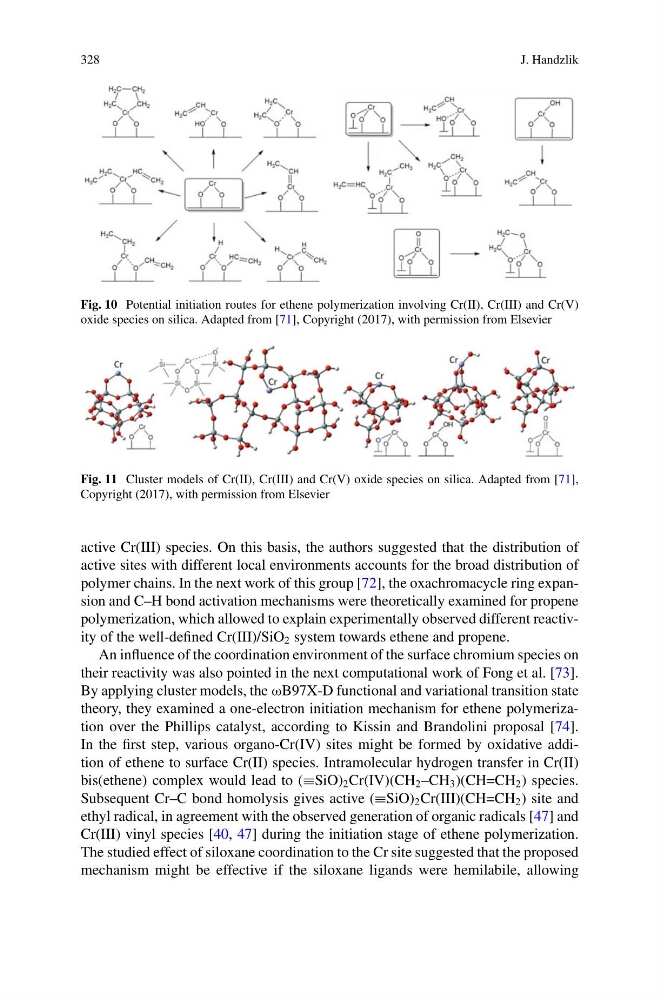
Fig. 10 Potential initiation routes for ethene polymerization involving Cr(II), Cr(III) and Cr(V)
oxide species on silica. Adapted from [71], Copyright (2017), with permission from Elsevier
Fig. 11 Cluster models of Cr(II), Cr(III) and Cr(V) oxide species on silica. Adapted from [71],
Copyright (2017), with permission from Elsevier
active Cr(III) species. On this basis, the authors suggested that the distribution of
active sites with different local environments accounts for the broad distribution of
polymer chains. In the next work of this group [72], the oxachromacycle ring expansion and C–H bond activation mechanisms were theoretically examined for propene
polymerization, which allowed to explain experimentally observed different reactivity of the well-defined Cr(III)/SiO 2 system towards ethene and propene.
An influence of the coordination environment of the surface chromium species on
their reactivity was also pointed in the next computational work of Fong et al. [73].
By applying cluster models, the ωB97X-D functional and variational transition state
theory, they examined a one-electron initiation mechanism for ethene polymerization over the Phillips catalyst, according to Kissin and Brandolini proposal [74].
In the first step, various organo-Cr(IV) sites might be formed by oxidative addition of ethene to surface Cr(II) species. Intramolecular hydrogen transfer in Cr(II)
bis(ethene) complex would lead to (≡SiO) 2 Cr(IV)(CH 2 –CH 3 )(CH=CH 2 ) species.
Subsequent Cr–C bond homolysis gives active (≡SiO) 2 Cr(III)(CH=CH 2 ) site and
ethyl radical, in agreement with the observed generation of organic radicals [47] and
Cr(III) vinyl species [40, 47] during the initiation stage of ethene polymerization.
The studied effect of siloxane coordination to the Cr site suggested that the proposed
mechanism might be effective if the siloxane ligands were hemilabile, allowing
J. Handzlik
Fig. 10 Potential initiation routes for ethene polymerization involving Cr(II), Cr(III) and Cr(V)
oxide species on silica. Adapted from [71], Copyright (2017), with permission from Elsevier
Fig. 11 Cluster models of Cr(II), Cr(III) and Cr(V) oxide species on silica. Adapted from [71],
Copyright (2017), with permission from Elsevier
active Cr(III) species. On this basis, the authors suggested that the distribution of
active sites with different local environments accounts for the broad distribution of
polymer chains. In the next work of this group [72], the oxachromacycle ring expansion and C–H bond activation mechanisms were theoretically examined for propene
polymerization, which allowed to explain experimentally observed different reactivity of the well-defined Cr(III)/SiO 2 system towards ethene and propene.
An influence of the coordination environment of the surface chromium species on
their reactivity was also pointed in the next computational work of Fong et al. [73].
By applying cluster models, the ωB97X-D functional and variational transition state
theory, they examined a one-electron initiation mechanism for ethene polymerization over the Phillips catalyst, according to Kissin and Brandolini proposal [74].
In the first step, various organo-Cr(IV) sites might be formed by oxidative addition of ethene to surface Cr(II) species. Intramolecular hydrogen transfer in Cr(II)
bis(ethene) complex would lead to (≡SiO) 2 Cr(IV)(CH 2 –CH 3 )(CH=CH 2 ) species.
Subsequent Cr–C bond homolysis gives active (≡SiO) 2 Cr(III)(CH=CH 2 ) site and
ethyl radical, in agreement with the observed generation of organic radicals [47] and
Cr(III) vinyl species [40, 47] during the initiation stage of ethene polymerization.
The studied effect of siloxane coordination to the Cr site suggested that the proposed
mechanism might be effective if the siloxane ligands were hemilabile, allowing