

Computational Modelling of Structure and Catalytic Properties …
327
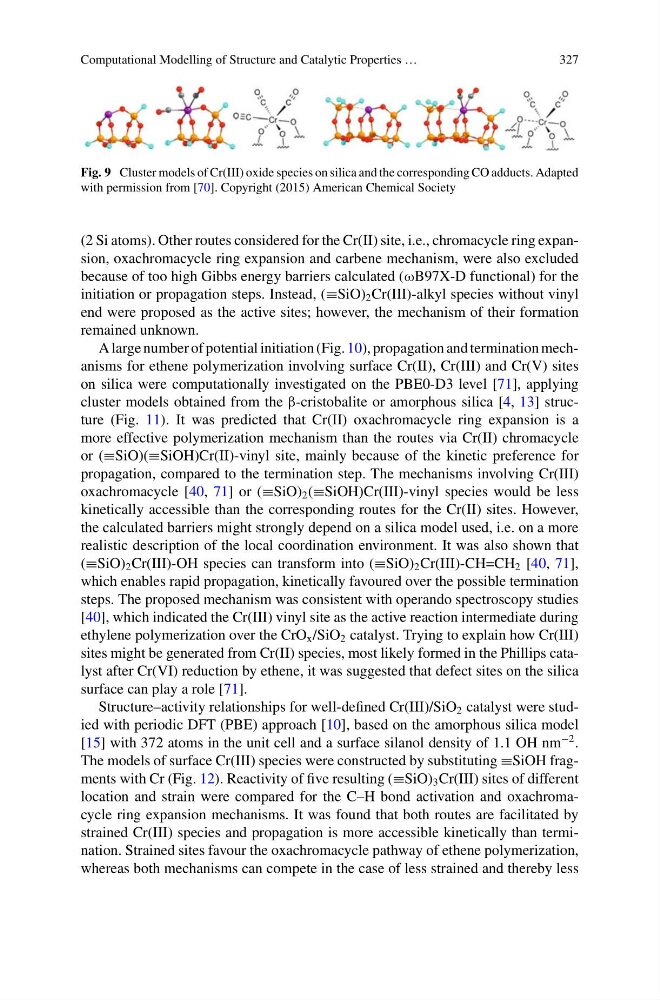
Fig. 9 Cluster models of Cr(III) oxide species on silica and the corresponding CO adducts. Adapted
with permission from [70]. Copyright (2015) American Chemical Society
(2 Si atoms). Other routes considered for the Cr(II) site, i.e., chromacycle ring expansion, oxachromacycle ring expansion and carbene mechanism, were also excluded
because of too high Gibbs energy barriers calculated (ωB97X-D functional) for the
initiation or propagation steps. Instead, (≡SiO) 2 Cr(III)-alkyl species without vinyl
end were proposed as the active sites; however, the mechanism of their formation
remained unknown.
A large number of potential initiation (Fig. 10), propagation and termination mechanisms for ethene polymerization involving surface Cr(II), Cr(III) and Cr(V) sites
on silica were computationally investigated on the PBE0-D3 level [71], applying
cluster models obtained from the β-cristobalite or amorphous silica [4, 13] structure (Fig. 11). It was predicted that Cr(II) oxachromacycle ring expansion is a
more effective polymerization mechanism than the routes via Cr(II) chromacycle
or (≡SiO)(≡SiOH)Cr(II)-vinyl site, mainly because of the kinetic preference for
propagation, compared to the termination step. The mechanisms involving Cr(III)
oxachromacycle [40, 71] or (≡SiO) 2 (≡SiOH)Cr(III)-vinyl species would be less
kinetically accessible than the corresponding routes for the Cr(II) sites. However,
the calculated barriers might strongly depend on a silica model used, i.e. on a more
realistic description of the local coordination environment. It was also shown that
(≡SiO) 2 Cr(III)-OH species can transform into (≡SiO) 2 Cr(III)-CH=CH 2 [40, 71],
which enables rapid propagation, kinetically favoured over the possible termination
steps. The proposed mechanism was consistent with operando spectroscopy studies
[40], which indicated the Cr(III) vinyl site as the active reaction intermediate during
ethylene polymerization over the CrO x /SiO 2 catalyst. Trying to explain how Cr(III)
sites might be generated from Cr(II) species, most likely formed in the Phillips catalyst after Cr(VI) reduction by ethene, it was suggested that defect sites on the silica
surface can play a role [71].
Structure–activity relationships for well-defined Cr(III)/SiO 2 catalyst were studied with periodic DFT (PBE) approach [10], based on the amorphous silica model
[15] with 372 atoms in the unit cell and a surface silanol density of 1.1 OH nm
−2 .
The models of surface Cr(III) species were constructed by substituting ≡SiOH fragments with Cr (Fig. 12). Reactivity of five resulting (≡SiO) 3 Cr(III) sites of different
location and strain were compared for the C–H bond activation and oxachromacycle ring expansion mechanisms. It was found that both routes are facilitated by
strained Cr(III) species and propagation is more accessible kinetically than termination. Strained sites favour the oxachromacycle pathway of ethene polymerization,
whereas both mechanisms can compete in the case of less strained and thereby less
327
Fig. 9 Cluster models of Cr(III) oxide species on silica and the corresponding CO adducts. Adapted
with permission from [70]. Copyright (2015) American Chemical Society
(2 Si atoms). Other routes considered for the Cr(II) site, i.e., chromacycle ring expansion, oxachromacycle ring expansion and carbene mechanism, were also excluded
because of too high Gibbs energy barriers calculated (ωB97X-D functional) for the
initiation or propagation steps. Instead, (≡SiO) 2 Cr(III)-alkyl species without vinyl
end were proposed as the active sites; however, the mechanism of their formation
remained unknown.
A large number of potential initiation (Fig. 10), propagation and termination mechanisms for ethene polymerization involving surface Cr(II), Cr(III) and Cr(V) sites
on silica were computationally investigated on the PBE0-D3 level [71], applying
cluster models obtained from the β-cristobalite or amorphous silica [4, 13] structure (Fig. 11). It was predicted that Cr(II) oxachromacycle ring expansion is a
more effective polymerization mechanism than the routes via Cr(II) chromacycle
or (≡SiO)(≡SiOH)Cr(II)-vinyl site, mainly because of the kinetic preference for
propagation, compared to the termination step. The mechanisms involving Cr(III)
oxachromacycle [40, 71] or (≡SiO) 2 (≡SiOH)Cr(III)-vinyl species would be less
kinetically accessible than the corresponding routes for the Cr(II) sites. However,
the calculated barriers might strongly depend on a silica model used, i.e. on a more
realistic description of the local coordination environment. It was also shown that
(≡SiO) 2 Cr(III)-OH species can transform into (≡SiO) 2 Cr(III)-CH=CH 2 [40, 71],
which enables rapid propagation, kinetically favoured over the possible termination
steps. The proposed mechanism was consistent with operando spectroscopy studies
[40], which indicated the Cr(III) vinyl site as the active reaction intermediate during
ethylene polymerization over the CrO x /SiO 2 catalyst. Trying to explain how Cr(III)
sites might be generated from Cr(II) species, most likely formed in the Phillips catalyst after Cr(VI) reduction by ethene, it was suggested that defect sites on the silica
surface can play a role [71].
Structure–activity relationships for well-defined Cr(III)/SiO 2 catalyst were studied with periodic DFT (PBE) approach [10], based on the amorphous silica model
[15] with 372 atoms in the unit cell and a surface silanol density of 1.1 OH nm
−2 .
The models of surface Cr(III) species were constructed by substituting ≡SiOH fragments with Cr (Fig. 12). Reactivity of five resulting (≡SiO) 3 Cr(III) sites of different
location and strain were compared for the C–H bond activation and oxachromacycle ring expansion mechanisms. It was found that both routes are facilitated by
strained Cr(III) species and propagation is more accessible kinetically than termination. Strained sites favour the oxachromacycle pathway of ethene polymerization,
whereas both mechanisms can compete in the case of less strained and thereby less