

Computational Modelling of Structure and Catalytic Properties …
333
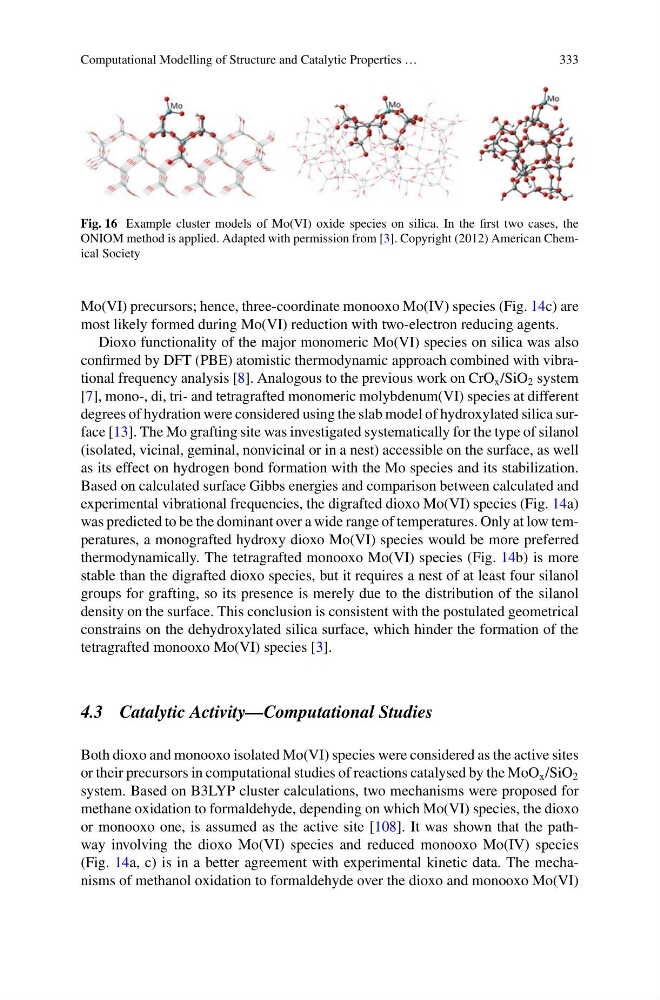
Fig. 16 Example cluster models of Mo(VI) oxide species on silica. In the first two cases, the
ONIOM method is applied. Adapted with permission from [3]. Copyright (2012) American Chemical Society
Mo(VI) precursors; hence, three-coordinate monooxo Mo(IV) species (Fig. 14c) are
most likely formed during Mo(VI) reduction with two-electron reducing agents.
Dioxo functionality of the major monomeric Mo(VI) species on silica was also
confirmed by DFT (PBE) atomistic thermodynamic approach combined with vibrational frequency analysis [8]. Analogous to the previous work on CrO x /SiO 2 system
[7], mono-, di, tri- and tetragrafted monomeric molybdenum(VI) species at different
degrees of hydration were considered using the slab model of hydroxylated silica surface [13]. The Mo grafting site was investigated systematically for the type of silanol
(isolated, vicinal, geminal, nonvicinal or in a nest) accessible on the surface, as well
as its effect on hydrogen bond formation with the Mo species and its stabilization.
Based on calculated surface Gibbs energies and comparison between calculated and
experimental vibrational frequencies, the digrafted dioxo Mo(VI) species (Fig. 14a)
was predicted to be the dominant over a wide range of temperatures. Only at low temperatures, a monografted hydroxy dioxo Mo(VI) species would be more preferred
thermodynamically. The tetragrafted monooxo Mo(VI) species (Fig. 14b) is more
stable than the digrafted dioxo species, but it requires a nest of at least four silanol
groups for grafting, so its presence is merely due to the distribution of the silanol
density on the surface. This conclusion is consistent with the postulated geometrical
constrains on the dehydroxylated silica surface, which hinder the formation of the
tetragrafted monooxo Mo(VI) species [3].
4.3 Catalytic Activity—Computational Studies
Both dioxo and monooxo isolated Mo(VI) species were considered as the active sites
or their precursors in computational studies of reactions catalysed by the MoO x /SiO 2
system. Based on B3LYP cluster calculations, two mechanisms were proposed for
methane oxidation to formaldehyde, depending on which Mo(VI) species, the dioxo
or monooxo one, is assumed as the active site [108]. It was shown that the pathway involving the dioxo Mo(VI) species and reduced monooxo Mo(IV) species
(Fig. 14a, c) is in a better agreement with experimental kinetic data. The mechanisms of methanol oxidation to formaldehyde over the dioxo and monooxo Mo(VI)
333
Fig. 16 Example cluster models of Mo(VI) oxide species on silica. In the first two cases, the
ONIOM method is applied. Adapted with permission from [3]. Copyright (2012) American Chemical Society
Mo(VI) precursors; hence, three-coordinate monooxo Mo(IV) species (Fig. 14c) are
most likely formed during Mo(VI) reduction with two-electron reducing agents.
Dioxo functionality of the major monomeric Mo(VI) species on silica was also
confirmed by DFT (PBE) atomistic thermodynamic approach combined with vibrational frequency analysis [8]. Analogous to the previous work on CrO x /SiO 2 system
[7], mono-, di, tri- and tetragrafted monomeric molybdenum(VI) species at different
degrees of hydration were considered using the slab model of hydroxylated silica surface [13]. The Mo grafting site was investigated systematically for the type of silanol
(isolated, vicinal, geminal, nonvicinal or in a nest) accessible on the surface, as well
as its effect on hydrogen bond formation with the Mo species and its stabilization.
Based on calculated surface Gibbs energies and comparison between calculated and
experimental vibrational frequencies, the digrafted dioxo Mo(VI) species (Fig. 14a)
was predicted to be the dominant over a wide range of temperatures. Only at low temperatures, a monografted hydroxy dioxo Mo(VI) species would be more preferred
thermodynamically. The tetragrafted monooxo Mo(VI) species (Fig. 14b) is more
stable than the digrafted dioxo species, but it requires a nest of at least four silanol
groups for grafting, so its presence is merely due to the distribution of the silanol
density on the surface. This conclusion is consistent with the postulated geometrical
constrains on the dehydroxylated silica surface, which hinder the formation of the
tetragrafted monooxo Mo(VI) species [3].
4.3 Catalytic Activity—Computational Studies
Both dioxo and monooxo isolated Mo(VI) species were considered as the active sites
or their precursors in computational studies of reactions catalysed by the MoO x /SiO 2
system. Based on B3LYP cluster calculations, two mechanisms were proposed for
methane oxidation to formaldehyde, depending on which Mo(VI) species, the dioxo
or monooxo one, is assumed as the active site [108]. It was shown that the pathway involving the dioxo Mo(VI) species and reduced monooxo Mo(IV) species
(Fig. 14a, c) is in a better agreement with experimental kinetic data. The mechanisms of methanol oxidation to formaldehyde over the dioxo and monooxo Mo(VI)