

324
J. Handzlik
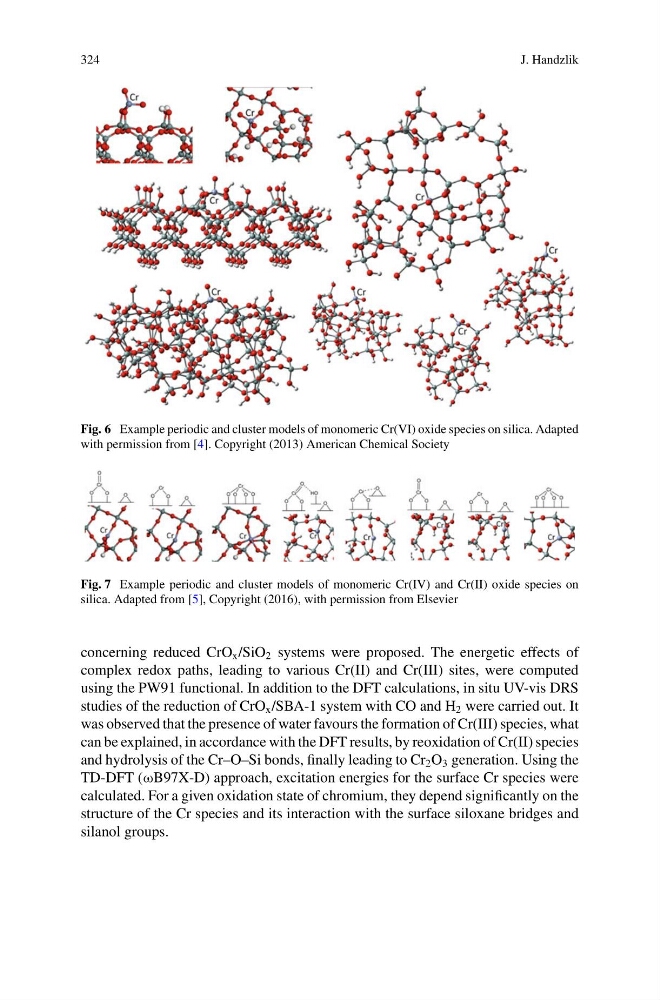
Fig. 6 Example periodic and cluster models of monomeric Cr(VI) oxide species on silica. Adapted
with permission from [4]. Copyright (2013) American Chemical Society
Fig. 7 Example periodic and cluster models of monomeric Cr(IV) and Cr(II) oxide species on
silica. Adapted from [5], Copyright (2016), with permission from Elsevier
concerning reduced CrO x /SiO 2 systems were proposed. The energetic effects of
complex redox paths, leading to various Cr(II) and Cr(III) sites, were computed
using the PW91 functional. In addition to the DFT calculations, in situ UV-vis DRS
studies of the reduction of CrO x /SBA-1 system with CO and H 2 were carried out. It
was observed that the presence of water favours the formation of Cr(III) species, what
can be explained, in accordance with the DFT results, by reoxidation of Cr(II) species
and hydrolysis of the Cr–O–Si bonds, finally leading to Cr 2 O 3 generation. Using the
TD-DFT (ωB97X-D) approach, excitation energies for the surface Cr species were
calculated. For a given oxidation state of chromium, they depend significantly on the
structure of the Cr species and its interaction with the surface siloxane bridges and
silanol groups.
J. Handzlik
Fig. 6 Example periodic and cluster models of monomeric Cr(VI) oxide species on silica. Adapted
with permission from [4]. Copyright (2013) American Chemical Society
Fig. 7 Example periodic and cluster models of monomeric Cr(IV) and Cr(II) oxide species on
silica. Adapted from [5], Copyright (2016), with permission from Elsevier
concerning reduced CrO x /SiO 2 systems were proposed. The energetic effects of
complex redox paths, leading to various Cr(II) and Cr(III) sites, were computed
using the PW91 functional. In addition to the DFT calculations, in situ UV-vis DRS
studies of the reduction of CrO x /SBA-1 system with CO and H 2 were carried out. It
was observed that the presence of water favours the formation of Cr(III) species, what
can be explained, in accordance with the DFT results, by reoxidation of Cr(II) species
and hydrolysis of the Cr–O–Si bonds, finally leading to Cr 2 O 3 generation. Using the
TD-DFT (ωB97X-D) approach, excitation energies for the surface Cr species were
calculated. For a given oxidation state of chromium, they depend significantly on the
structure of the Cr species and its interaction with the surface siloxane bridges and
silanol groups.