

Computational Modelling of Structure and Catalytic Properties …
323
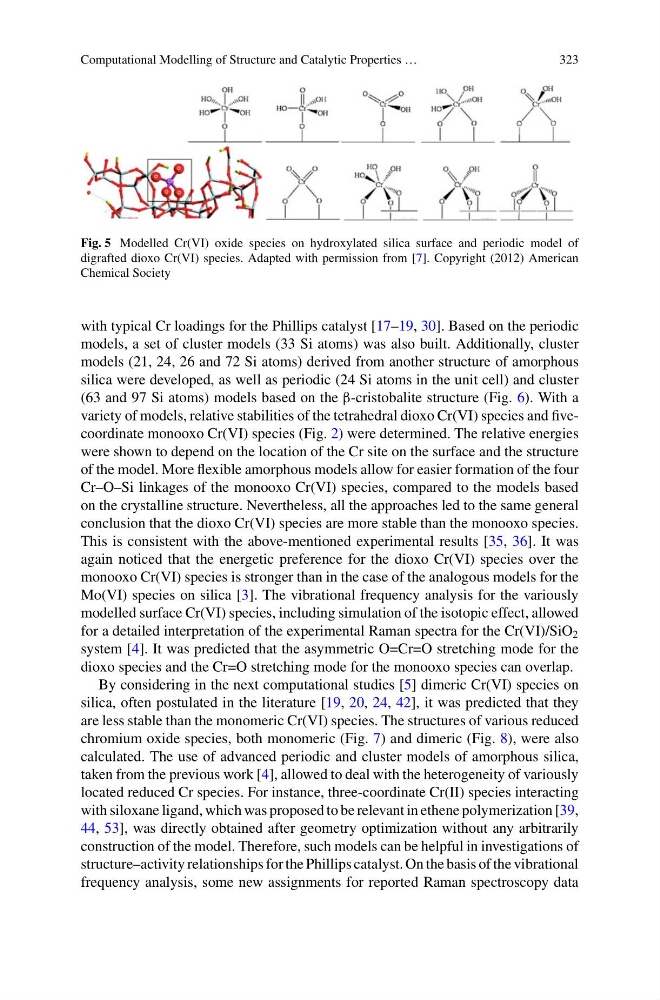
Fig. 5 Modelled Cr(VI) oxide species on hydroxylated silica surface and periodic model of
digrafted dioxo Cr(VI) species. Adapted with permission from [7]. Copyright (2012) American
Chemical Society
with typical Cr loadings for the Phillips catalyst [17–19, 30]. Based on the periodic
models, a set of cluster models (33 Si atoms) was also built. Additionally, cluster
models (21, 24, 26 and 72 Si atoms) derived from another structure of amorphous
silica were developed, as well as periodic (24 Si atoms in the unit cell) and cluster
(63 and 97 Si atoms) models based on the β-cristobalite structure (Fig. 6). With a
variety of models, relative stabilities of the tetrahedral dioxo Cr(VI) species and fivecoordinate monooxo Cr(VI) species (Fig. 2) were determined. The relative energies
were shown to depend on the location of the Cr site on the surface and the structure
of the model. More flexible amorphous models allow for easier formation of the four
Cr–O–Si linkages of the monooxo Cr(VI) species, compared to the models based
on the crystalline structure. Nevertheless, all the approaches led to the same general
conclusion that the dioxo Cr(VI) species are more stable than the monooxo species.
This is consistent with the above-mentioned experimental results [35, 36]. It was
again noticed that the energetic preference for the dioxo Cr(VI) species over the
monooxo Cr(VI) species is stronger than in the case of the analogous models for the
Mo(VI) species on silica [3]. The vibrational frequency analysis for the variously
modelled surface Cr(VI) species, including simulation of the isotopic effect, allowed
for a detailed interpretation of the experimental Raman spectra for the Cr(VI)/SiO 2
system [4]. It was predicted that the asymmetric O=Cr=O stretching mode for the
dioxo species and the Cr=O stretching mode for the monooxo species can overlap.
By considering in the next computational studies [5] dimeric Cr(VI) species on
silica, often postulated in the literature [19, 20, 24, 42], it was predicted that they
are less stable than the monomeric Cr(VI) species. The structures of various reduced
chromium oxide species, both monomeric (Fig. 7) and dimeric (Fig. 8), were also
calculated. The use of advanced periodic and cluster models of amorphous silica,
taken from the previous work [4], allowed to deal with the heterogeneity of variously
located reduced Cr species. For instance, three-coordinate Cr(II) species interacting
with siloxane ligand, which was proposed to be relevant in ethene polymerization [39,
44, 53], was directly obtained after geometry optimization without any arbitrarily
construction of the model. Therefore, such models can be helpful in investigations of
structure–activity relationships for the Phillips catalyst. On the basis of the vibrational
frequency analysis, some new assignments for reported Raman spectroscopy data
323
Fig. 5 Modelled Cr(VI) oxide species on hydroxylated silica surface and periodic model of
digrafted dioxo Cr(VI) species. Adapted with permission from [7]. Copyright (2012) American
Chemical Society
with typical Cr loadings for the Phillips catalyst [17–19, 30]. Based on the periodic
models, a set of cluster models (33 Si atoms) was also built. Additionally, cluster
models (21, 24, 26 and 72 Si atoms) derived from another structure of amorphous
silica were developed, as well as periodic (24 Si atoms in the unit cell) and cluster
(63 and 97 Si atoms) models based on the β-cristobalite structure (Fig. 6). With a
variety of models, relative stabilities of the tetrahedral dioxo Cr(VI) species and fivecoordinate monooxo Cr(VI) species (Fig. 2) were determined. The relative energies
were shown to depend on the location of the Cr site on the surface and the structure
of the model. More flexible amorphous models allow for easier formation of the four
Cr–O–Si linkages of the monooxo Cr(VI) species, compared to the models based
on the crystalline structure. Nevertheless, all the approaches led to the same general
conclusion that the dioxo Cr(VI) species are more stable than the monooxo species.
This is consistent with the above-mentioned experimental results [35, 36]. It was
again noticed that the energetic preference for the dioxo Cr(VI) species over the
monooxo Cr(VI) species is stronger than in the case of the analogous models for the
Mo(VI) species on silica [3]. The vibrational frequency analysis for the variously
modelled surface Cr(VI) species, including simulation of the isotopic effect, allowed
for a detailed interpretation of the experimental Raman spectra for the Cr(VI)/SiO 2
system [4]. It was predicted that the asymmetric O=Cr=O stretching mode for the
dioxo species and the Cr=O stretching mode for the monooxo species can overlap.
By considering in the next computational studies [5] dimeric Cr(VI) species on
silica, often postulated in the literature [19, 20, 24, 42], it was predicted that they
are less stable than the monomeric Cr(VI) species. The structures of various reduced
chromium oxide species, both monomeric (Fig. 7) and dimeric (Fig. 8), were also
calculated. The use of advanced periodic and cluster models of amorphous silica,
taken from the previous work [4], allowed to deal with the heterogeneity of variously
located reduced Cr species. For instance, three-coordinate Cr(II) species interacting
with siloxane ligand, which was proposed to be relevant in ethene polymerization [39,
44, 53], was directly obtained after geometry optimization without any arbitrarily
construction of the model. Therefore, such models can be helpful in investigations of
structure–activity relationships for the Phillips catalyst. On the basis of the vibrational
frequency analysis, some new assignments for reported Raman spectroscopy data