

Computational Modelling of Structure and Catalytic Properties …
325
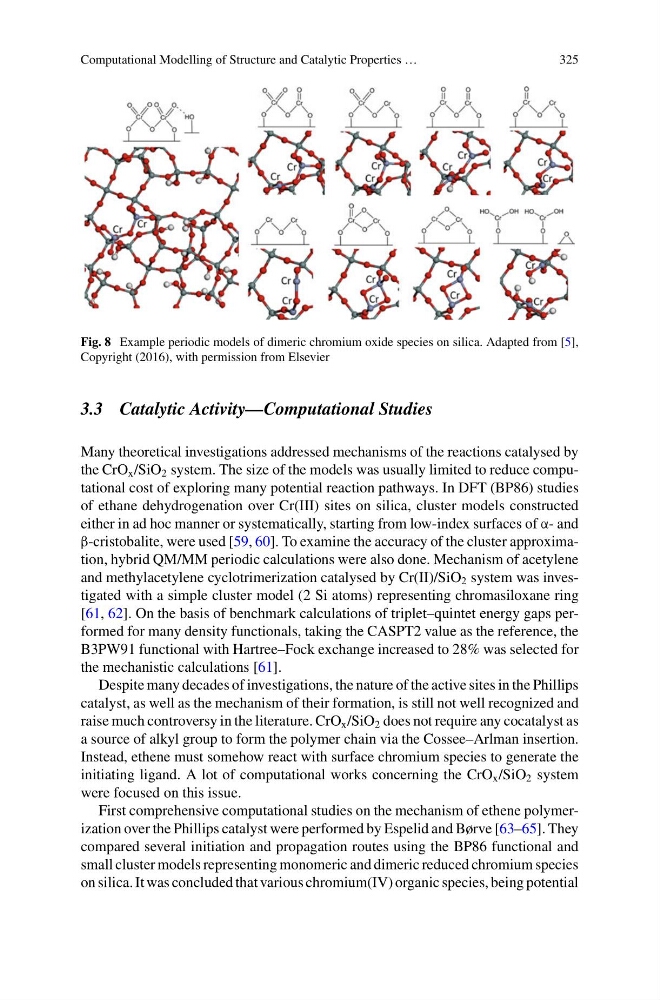
Fig. 8 Example periodic models of dimeric chromium oxide species on silica. Adapted from [5],
Copyright (2016), with permission from Elsevier
3.3 Catalytic Activity—Computational Studies
Many theoretical investigations addressed mechanisms of the reactions catalysed by
the CrO x /SiO 2 system. The size of the models was usually limited to reduce computational cost of exploring many potential reaction pathways. In DFT (BP86) studies
of ethane dehydrogenation over Cr(III) sites on silica, cluster models constructed
either in ad hoc manner or systematically, starting from low-index surfaces of α- and
β-cristobalite, were used [59, 60]. To examine the accuracy of the cluster approximation, hybrid QM/MM periodic calculations were also done. Mechanism of acetylene
and methylacetylene cyclotrimerization catalysed by Cr(II)/SiO 2 system was investigated with a simple cluster model (2 Si atoms) representing chromasiloxane ring
[61, 62]. On the basis of benchmark calculations of triplet–quintet energy gaps performed for many density functionals, taking the CASPT2 value as the reference, the
B3PW91 functional with Hartree–Fock exchange increased to 28% was selected for
the mechanistic calculations [61].
Despite many decades of investigations, the nature of the active sites in the Phillips
catalyst, as well as the mechanism of their formation, is still not well recognized and
raise much controversy in the literature. CrO x /SiO 2 does not require any cocatalyst as
a source of alkyl group to form the polymer chain via the Cossee–Arlman insertion.
Instead, ethene must somehow react with surface chromium species to generate the
initiating ligand. A lot of computational works concerning the CrO x /SiO 2 system
were focused on this issue.
First comprehensive computational studies on the mechanism of ethene polymerization over the Phillips catalyst were performed by Espelid and Børve [63–65]. They
compared several initiation and propagation routes using the BP86 functional and
small cluster models representing monomeric and dimeric reduced chromium species
on silica. It was concluded that various chromium(IV) organic species, being potential
325
Fig. 8 Example periodic models of dimeric chromium oxide species on silica. Adapted from [5],
Copyright (2016), with permission from Elsevier
3.3 Catalytic Activity—Computational Studies
Many theoretical investigations addressed mechanisms of the reactions catalysed by
the CrO x /SiO 2 system. The size of the models was usually limited to reduce computational cost of exploring many potential reaction pathways. In DFT (BP86) studies
of ethane dehydrogenation over Cr(III) sites on silica, cluster models constructed
either in ad hoc manner or systematically, starting from low-index surfaces of α- and
β-cristobalite, were used [59, 60]. To examine the accuracy of the cluster approximation, hybrid QM/MM periodic calculations were also done. Mechanism of acetylene
and methylacetylene cyclotrimerization catalysed by Cr(II)/SiO 2 system was investigated with a simple cluster model (2 Si atoms) representing chromasiloxane ring
[61, 62]. On the basis of benchmark calculations of triplet–quintet energy gaps performed for many density functionals, taking the CASPT2 value as the reference, the
B3PW91 functional with Hartree–Fock exchange increased to 28% was selected for
the mechanistic calculations [61].
Despite many decades of investigations, the nature of the active sites in the Phillips
catalyst, as well as the mechanism of their formation, is still not well recognized and
raise much controversy in the literature. CrO x /SiO 2 does not require any cocatalyst as
a source of alkyl group to form the polymer chain via the Cossee–Arlman insertion.
Instead, ethene must somehow react with surface chromium species to generate the
initiating ligand. A lot of computational works concerning the CrO x /SiO 2 system
were focused on this issue.
First comprehensive computational studies on the mechanism of ethene polymerization over the Phillips catalyst were performed by Espelid and Børve [63–65]. They
compared several initiation and propagation routes using the BP86 functional and
small cluster models representing monomeric and dimeric reduced chromium species
on silica. It was concluded that various chromium(IV) organic species, being potential