

320
J. Handzlik
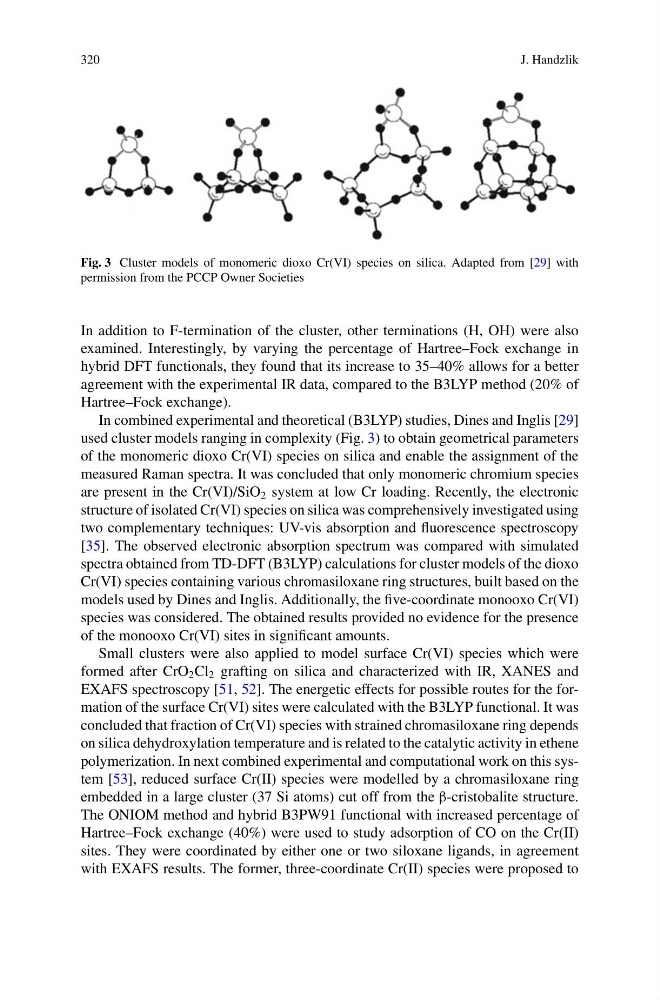
Fig. 3 Cluster models of monomeric dioxo Cr(VI) species on silica. Adapted from [29] with
permission from the PCCP Owner Societies
In addition to F-termination of the cluster, other terminations (H, OH) were also
examined. Interestingly, by varying the percentage of Hartree–Fock exchange in
hybrid DFT functionals, they found that its increase to 35–40% allows for a better
agreement with the experimental IR data, compared to the B3LYP method (20% of
Hartree–Fock exchange).
In combined experimental and theoretical (B3LYP) studies, Dines and Inglis [29]
used cluster models ranging in complexity (Fig. 3) to obtain geometrical parameters
of the monomeric dioxo Cr(VI) species on silica and enable the assignment of the
measured Raman spectra. It was concluded that only monomeric chromium species
are present in the Cr(VI)/SiO 2 system at low Cr loading. Recently, the electronic
structure of isolated Cr(VI) species on silica was comprehensively investigated using
two complementary techniques: UV-vis absorption and fluorescence spectroscopy
[35]. The observed electronic absorption spectrum was compared with simulated
spectra obtained from TD-DFT (B3LYP) calculations for cluster models of the dioxo
Cr(VI) species containing various chromasiloxane ring structures, built based on the
models used by Dines and Inglis. Additionally, the five-coordinate monooxo Cr(VI)
species was considered. The obtained results provided no evidence for the presence
of the monooxo Cr(VI) sites in significant amounts.
Small clusters were also applied to model surface Cr(VI) species which were
formed after CrO 2 Cl 2 grafting on silica and characterized with IR, XANES and
EXAFS spectroscopy [51, 52]. The energetic effects for possible routes for the formation of the surface Cr(VI) sites were calculated with the B3LYP functional. It was
concluded that fraction of Cr(VI) species with strained chromasiloxane ring depends
on silica dehydroxylation temperature and is related to the catalytic activity in ethene
polymerization. In next combined experimental and computational work on this system [53], reduced surface Cr(II) species were modelled by a chromasiloxane ring
embedded in a large cluster (37 Si atoms) cut off from the β-cristobalite structure.
The ONIOM method and hybrid B3PW91 functional with increased percentage of
Hartree–Fock exchange (40%) were used to study adsorption of CO on the Cr(II)
sites. They were coordinated by either one or two siloxane ligands, in agreement
with EXAFS results. The former, three-coordinate Cr(II) species were proposed to
J. Handzlik
Fig. 3 Cluster models of monomeric dioxo Cr(VI) species on silica. Adapted from [29] with
permission from the PCCP Owner Societies
In addition to F-termination of the cluster, other terminations (H, OH) were also
examined. Interestingly, by varying the percentage of Hartree–Fock exchange in
hybrid DFT functionals, they found that its increase to 35–40% allows for a better
agreement with the experimental IR data, compared to the B3LYP method (20% of
Hartree–Fock exchange).
In combined experimental and theoretical (B3LYP) studies, Dines and Inglis [29]
used cluster models ranging in complexity (Fig. 3) to obtain geometrical parameters
of the monomeric dioxo Cr(VI) species on silica and enable the assignment of the
measured Raman spectra. It was concluded that only monomeric chromium species
are present in the Cr(VI)/SiO 2 system at low Cr loading. Recently, the electronic
structure of isolated Cr(VI) species on silica was comprehensively investigated using
two complementary techniques: UV-vis absorption and fluorescence spectroscopy
[35]. The observed electronic absorption spectrum was compared with simulated
spectra obtained from TD-DFT (B3LYP) calculations for cluster models of the dioxo
Cr(VI) species containing various chromasiloxane ring structures, built based on the
models used by Dines and Inglis. Additionally, the five-coordinate monooxo Cr(VI)
species was considered. The obtained results provided no evidence for the presence
of the monooxo Cr(VI) sites in significant amounts.
Small clusters were also applied to model surface Cr(VI) species which were
formed after CrO 2 Cl 2 grafting on silica and characterized with IR, XANES and
EXAFS spectroscopy [51, 52]. The energetic effects for possible routes for the formation of the surface Cr(VI) sites were calculated with the B3LYP functional. It was
concluded that fraction of Cr(VI) species with strained chromasiloxane ring depends
on silica dehydroxylation temperature and is related to the catalytic activity in ethene
polymerization. In next combined experimental and computational work on this system [53], reduced surface Cr(II) species were modelled by a chromasiloxane ring
embedded in a large cluster (37 Si atoms) cut off from the β-cristobalite structure.
The ONIOM method and hybrid B3PW91 functional with increased percentage of
Hartree–Fock exchange (40%) were used to study adsorption of CO on the Cr(II)
sites. They were coordinated by either one or two siloxane ligands, in agreement
with EXAFS results. The former, three-coordinate Cr(II) species were proposed to