

Computational Modelling of Structure and Catalytic Properties …
319
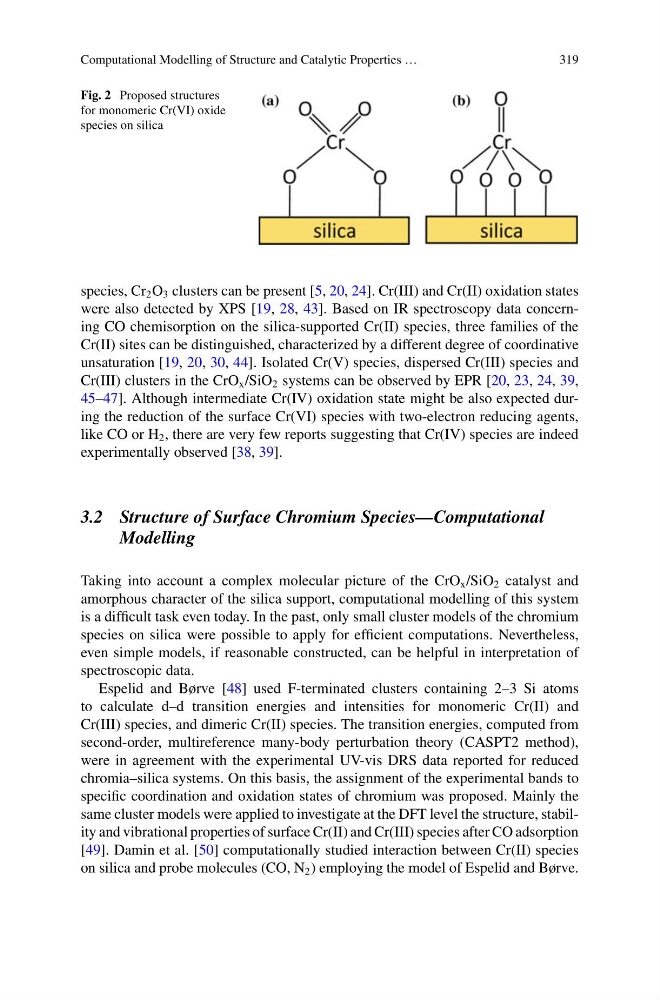
Fig. 2 Proposed structures
for monomeric Cr(VI) oxide
species on silica
species, Cr 2 O 3 clusters can be present [5, 20, 24]. Cr(III) and Cr(II) oxidation states
were also detected by XPS [19, 28, 43]. Based on IR spectroscopy data concerning CO chemisorption on the silica-supported Cr(II) species, three families of the
Cr(II) sites can be distinguished, characterized by a different degree of coordinative
unsaturation [19, 20, 30, 44]. Isolated Cr(V) species, dispersed Cr(III) species and
Cr(III) clusters in the CrO x /SiO 2 systems can be observed by EPR [20, 23, 24, 39,
45–47]. Although intermediate Cr(IV) oxidation state might be also expected during the reduction of the surface Cr(VI) species with two-electron reducing agents,
like CO or H 2 , there are very few reports suggesting that Cr(IV) species are indeed
experimentally observed [38, 39].
3.2 Structure of Surface Chromium Species—Computational
Modelling
Taking into account a complex molecular picture of the CrO x /SiO 2 catalyst and
amorphous character of the silica support, computational modelling of this system
is a difficult task even today. In the past, only small cluster models of the chromium
species on silica were possible to apply for efficient computations. Nevertheless,
even simple models, if reasonable constructed, can be helpful in interpretation of
spectroscopic data.
Espelid and Børve [48] used F-terminated clusters containing 2–3 Si atoms
to calculate d–d transition energies and intensities for monomeric Cr(II) and
Cr(III) species, and dimeric Cr(II) species. The transition energies, computed from
second-order, multireference many-body perturbation theory (CASPT2 method),
were in agreement with the experimental UV-vis DRS data reported for reduced
chromia–silica systems. On this basis, the assignment of the experimental bands to
specific coordination and oxidation states of chromium was proposed. Mainly the
same cluster models were applied to investigate at the DFT level the structure, stability and vibrational properties of surface Cr(II) and Cr(III) species after CO adsorption
[49]. Damin et al. [50] computationally studied interaction between Cr(II) species
on silica and probe molecules (CO, N 2 ) employing the model of Espelid and Børve.
319
Fig. 2 Proposed structures
for monomeric Cr(VI) oxide
species on silica
species, Cr 2 O 3 clusters can be present [5, 20, 24]. Cr(III) and Cr(II) oxidation states
were also detected by XPS [19, 28, 43]. Based on IR spectroscopy data concerning CO chemisorption on the silica-supported Cr(II) species, three families of the
Cr(II) sites can be distinguished, characterized by a different degree of coordinative
unsaturation [19, 20, 30, 44]. Isolated Cr(V) species, dispersed Cr(III) species and
Cr(III) clusters in the CrO x /SiO 2 systems can be observed by EPR [20, 23, 24, 39,
45–47]. Although intermediate Cr(IV) oxidation state might be also expected during the reduction of the surface Cr(VI) species with two-electron reducing agents,
like CO or H 2 , there are very few reports suggesting that Cr(IV) species are indeed
experimentally observed [38, 39].
3.2 Structure of Surface Chromium Species—Computational
Modelling
Taking into account a complex molecular picture of the CrO x /SiO 2 catalyst and
amorphous character of the silica support, computational modelling of this system
is a difficult task even today. In the past, only small cluster models of the chromium
species on silica were possible to apply for efficient computations. Nevertheless,
even simple models, if reasonable constructed, can be helpful in interpretation of
spectroscopic data.
Espelid and Børve [48] used F-terminated clusters containing 2–3 Si atoms
to calculate d–d transition energies and intensities for monomeric Cr(II) and
Cr(III) species, and dimeric Cr(II) species. The transition energies, computed from
second-order, multireference many-body perturbation theory (CASPT2 method),
were in agreement with the experimental UV-vis DRS data reported for reduced
chromia–silica systems. On this basis, the assignment of the experimental bands to
specific coordination and oxidation states of chromium was proposed. Mainly the
same cluster models were applied to investigate at the DFT level the structure, stability and vibrational properties of surface Cr(II) and Cr(III) species after CO adsorption
[49]. Damin et al. [50] computationally studied interaction between Cr(II) species
on silica and probe molecules (CO, N 2 ) employing the model of Espelid and Børve.