

Computational Modelling of Structure and Catalytic Properties …
321
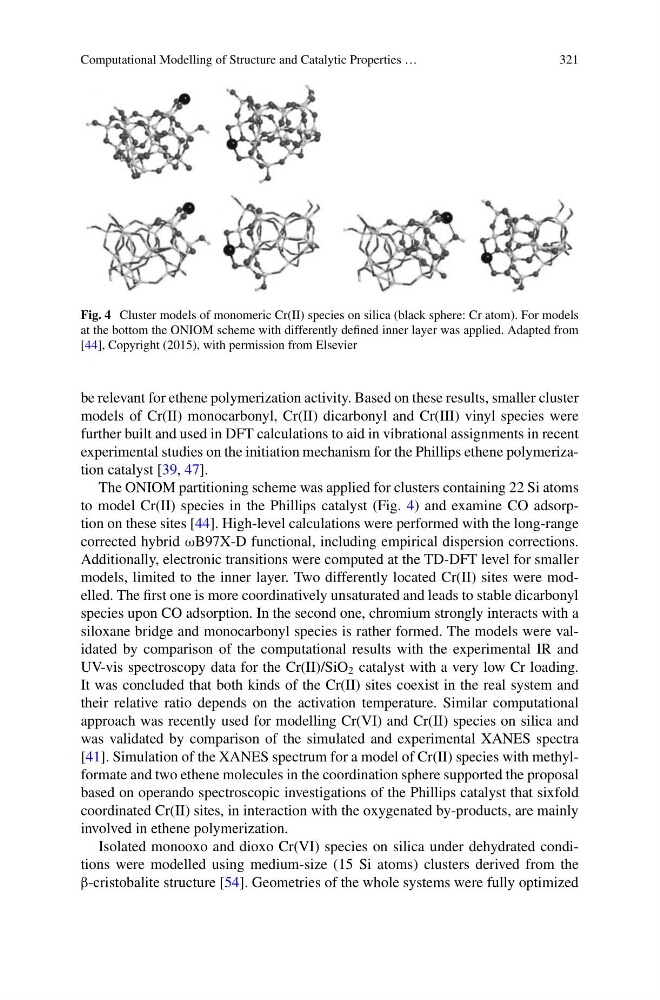
Fig. 4 Cluster models of monomeric Cr(II) species on silica (black sphere: Cr atom). For models
at the bottom the ONIOM scheme with differently defined inner layer was applied. Adapted from
[44], Copyright (2015), with permission from Elsevier
be relevant for ethene polymerization activity. Based on these results, smaller cluster
models of Cr(II) monocarbonyl, Cr(II) dicarbonyl and Cr(III) vinyl species were
further built and used in DFT calculations to aid in vibrational assignments in recent
experimental studies on the initiation mechanism for the Phillips ethene polymerization catalyst [39, 47].
The ONIOM partitioning scheme was applied for clusters containing 22 Si atoms
to model Cr(II) species in the Phillips catalyst (Fig. 4) and examine CO adsorption on these sites [44]. High-level calculations were performed with the long-range
corrected hybrid ωB97X-D functional, including empirical dispersion corrections.
Additionally, electronic transitions were computed at the TD-DFT level for smaller
models, limited to the inner layer. Two differently located Cr(II) sites were modelled. The first one is more coordinatively unsaturated and leads to stable dicarbonyl
species upon CO adsorption. In the second one, chromium strongly interacts with a
siloxane bridge and monocarbonyl species is rather formed. The models were validated by comparison of the computational results with the experimental IR and
UV-vis spectroscopy data for the Cr(II)/SiO 2 catalyst with a very low Cr loading.
It was concluded that both kinds of the Cr(II) sites coexist in the real system and
their relative ratio depends on the activation temperature. Similar computational
approach was recently used for modelling Cr(VI) and Cr(II) species on silica and
was validated by comparison of the simulated and experimental XANES spectra
[41]. Simulation of the XANES spectrum for a model of Cr(II) species with methylformate and two ethene molecules in the coordination sphere supported the proposal
based on operando spectroscopic investigations of the Phillips catalyst that sixfold
coordinated Cr(II) sites, in interaction with the oxygenated by-products, are mainly
involved in ethene polymerization.
Isolated monooxo and dioxo Cr(VI) species on silica under dehydrated conditions were modelled using medium-size (15 Si atoms) clusters derived from the
β-cristobalite structure [54]. Geometries of the whole systems were fully optimized
321
Fig. 4 Cluster models of monomeric Cr(II) species on silica (black sphere: Cr atom). For models
at the bottom the ONIOM scheme with differently defined inner layer was applied. Adapted from
[44], Copyright (2015), with permission from Elsevier
be relevant for ethene polymerization activity. Based on these results, smaller cluster
models of Cr(II) monocarbonyl, Cr(II) dicarbonyl and Cr(III) vinyl species were
further built and used in DFT calculations to aid in vibrational assignments in recent
experimental studies on the initiation mechanism for the Phillips ethene polymerization catalyst [39, 47].
The ONIOM partitioning scheme was applied for clusters containing 22 Si atoms
to model Cr(II) species in the Phillips catalyst (Fig. 4) and examine CO adsorption on these sites [44]. High-level calculations were performed with the long-range
corrected hybrid ωB97X-D functional, including empirical dispersion corrections.
Additionally, electronic transitions were computed at the TD-DFT level for smaller
models, limited to the inner layer. Two differently located Cr(II) sites were modelled. The first one is more coordinatively unsaturated and leads to stable dicarbonyl
species upon CO adsorption. In the second one, chromium strongly interacts with a
siloxane bridge and monocarbonyl species is rather formed. The models were validated by comparison of the computational results with the experimental IR and
UV-vis spectroscopy data for the Cr(II)/SiO 2 catalyst with a very low Cr loading.
It was concluded that both kinds of the Cr(II) sites coexist in the real system and
their relative ratio depends on the activation temperature. Similar computational
approach was recently used for modelling Cr(VI) and Cr(II) species on silica and
was validated by comparison of the simulated and experimental XANES spectra
[41]. Simulation of the XANES spectrum for a model of Cr(II) species with methylformate and two ethene molecules in the coordination sphere supported the proposal
based on operando spectroscopic investigations of the Phillips catalyst that sixfold
coordinated Cr(II) sites, in interaction with the oxygenated by-products, are mainly
involved in ethene polymerization.
Isolated monooxo and dioxo Cr(VI) species on silica under dehydrated conditions were modelled using medium-size (15 Si atoms) clusters derived from the
β-cristobalite structure [54]. Geometries of the whole systems were fully optimized