

298
J. N. Harvey
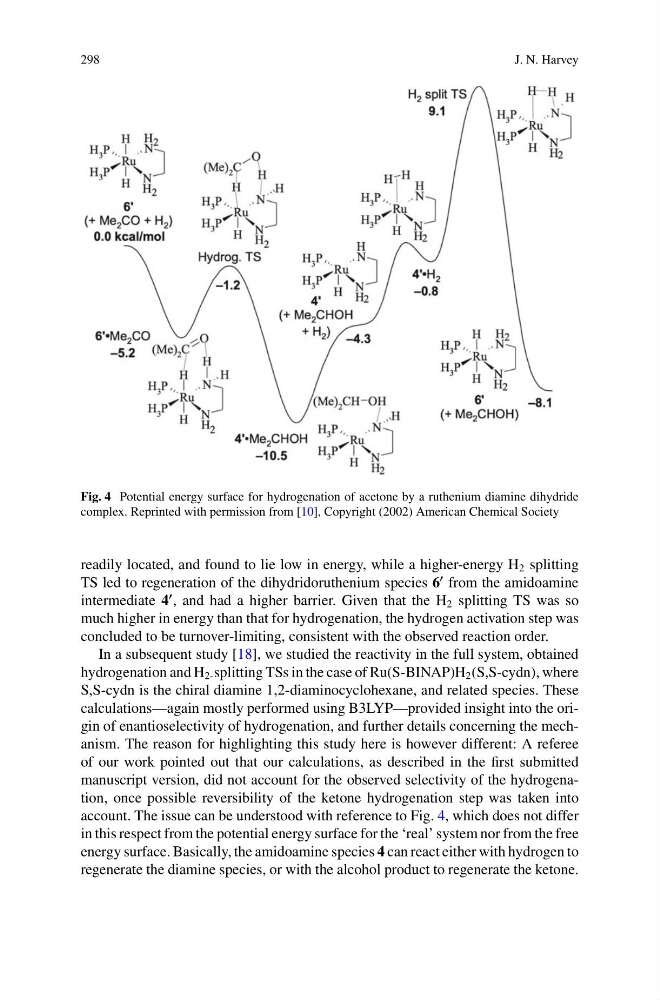
Fig. 4 Potential energy surface for hydrogenation of acetone by a ruthenium diamine dihydride
complex. Reprinted with permission from [10], Copyright (2002) American Chemical Society
readily located, and found to lie low in energy, while a higher-energy H 2 splitting
TS led to regeneration of the dihydridoruthenium species 6
from the amidoamine
intermediate 4
, and had a higher barrier. Given that the H 2 splitting TS was so
much higher in energy than that for hydrogenation, the hydrogen activation step was
concluded to be turnover-limiting, consistent with the observed reaction order.
In a subsequent study [18], we studied the reactivity in the full system, obtained
hydrogenation and H 2- splitting TSs in the case of Ru(S-BINAP)H 2 (S,S-cydn), where
S,S-cydn is the chiral diamine 1,2-diaminocyclohexane, and related species. These
calculations—again mostly performed using B3LYP—provided insight into the origin of enantioselectivity of hydrogenation, and further details concerning the mechanism. The reason for highlighting this study here is however different: A referee
of our work pointed out that our calculations, as described in the first submitted
manuscript version, did not account for the observed selectivity of the hydrogenation, once possible reversibility of the ketone hydrogenation step was taken into
account. The issue can be understood with reference to Fig. 4, which does not differ
in this respect from the potential energy surface for the ‘real’ system nor from the free
energy surface. Basically, the amidoamine species 4 can react either with hydrogen to
regenerate the diamine species, or with the alcohol product to regenerate the ketone.
J. N. Harvey
Fig. 4 Potential energy surface for hydrogenation of acetone by a ruthenium diamine dihydride
complex. Reprinted with permission from [10], Copyright (2002) American Chemical Society
readily located, and found to lie low in energy, while a higher-energy H 2 splitting
TS led to regeneration of the dihydridoruthenium species 6
from the amidoamine
intermediate 4
, and had a higher barrier. Given that the H 2 splitting TS was so
much higher in energy than that for hydrogenation, the hydrogen activation step was
concluded to be turnover-limiting, consistent with the observed reaction order.
In a subsequent study [18], we studied the reactivity in the full system, obtained
hydrogenation and H 2- splitting TSs in the case of Ru(S-BINAP)H 2 (S,S-cydn), where
S,S-cydn is the chiral diamine 1,2-diaminocyclohexane, and related species. These
calculations—again mostly performed using B3LYP—provided insight into the origin of enantioselectivity of hydrogenation, and further details concerning the mechanism. The reason for highlighting this study here is however different: A referee
of our work pointed out that our calculations, as described in the first submitted
manuscript version, did not account for the observed selectivity of the hydrogenation, once possible reversibility of the ketone hydrogenation step was taken into
account. The issue can be understood with reference to Fig. 4, which does not differ
in this respect from the potential energy surface for the ‘real’ system nor from the free
energy surface. Basically, the amidoamine species 4 can react either with hydrogen to
regenerate the diamine species, or with the alcohol product to regenerate the ketone.