

Mechanism and Kinetics in Homogeneous Catalysis …
299
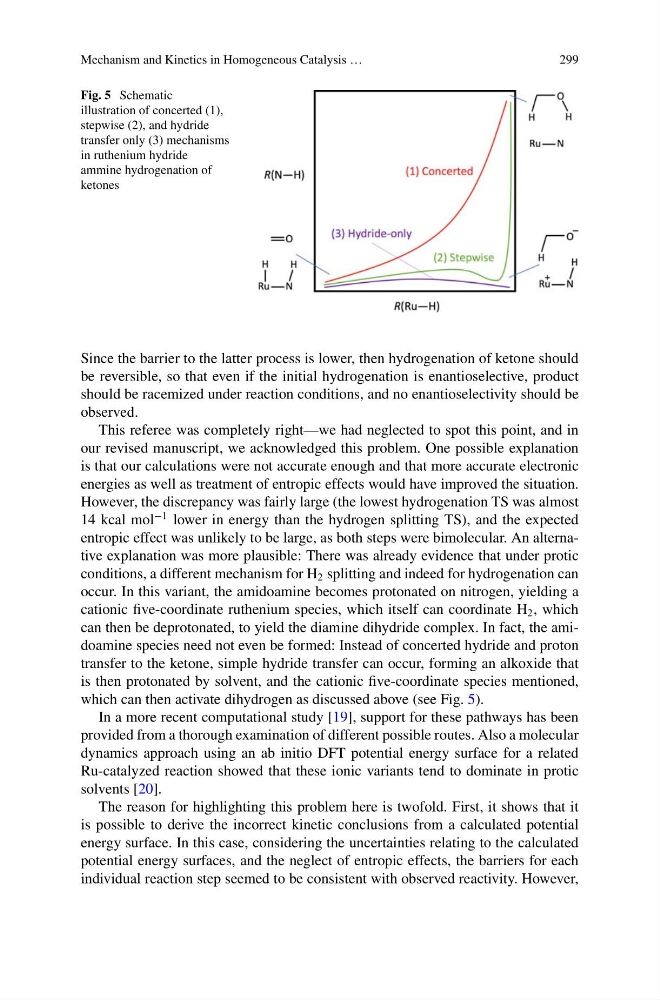
Fig. 5 Schematic
illustration of concerted (1),
stepwise (2), and hydride
transfer only (3) mechanisms
in ruthenium hydride
ammine hydrogenation of
ketones
Since the barrier to the latter process is lower, then hydrogenation of ketone should
be reversible, so that even if the initial hydrogenation is enantioselective, product
should be racemized under reaction conditions, and no enantioselectivity should be
observed.
This referee was completely right—we had neglected to spot this point, and in
our revised manuscript, we acknowledged this problem. One possible explanation
is that our calculations were not accurate enough and that more accurate electronic
energies as well as treatment of entropic effects would have improved the situation.
However, the discrepancy was fairly large (the lowest hydrogenation TS was almost
14 kcal mol
−1 lower in energy than the hydrogen splitting TS), and the expected
entropic effect was unlikely to be large, as both steps were bimolecular. An alternative explanation was more plausible: There was already evidence that under protic
conditions, a different mechanism for H 2 splitting and indeed for hydrogenation can
occur. In this variant, the amidoamine becomes protonated on nitrogen, yielding a
cationic five-coordinate ruthenium species, which itself can coordinate H 2 , which
can then be deprotonated, to yield the diamine dihydride complex. In fact, the amidoamine species need not even be formed: Instead of concerted hydride and proton
transfer to the ketone, simple hydride transfer can occur, forming an alkoxide that
is then protonated by solvent, and the cationic five-coordinate species mentioned,
which can then activate dihydrogen as discussed above (see Fig. 5).
In a more recent computational study [19], support for these pathways has been
provided from a thorough examination of different possible routes. Also a molecular
dynamics approach using an ab initio DFT potential energy surface for a related
Ru-catalyzed reaction showed that these ionic variants tend to dominate in protic
solvents [20].
The reason for highlighting this problem here is twofold. First, it shows that it
is possible to derive the incorrect kinetic conclusions from a calculated potential
energy surface. In this case, considering the uncertainties relating to the calculated
potential energy surfaces, and the neglect of entropic effects, the barriers for each
individual reaction step seemed to be consistent with observed reactivity. However,
299
Fig. 5 Schematic
illustration of concerted (1),
stepwise (2), and hydride
transfer only (3) mechanisms
in ruthenium hydride
ammine hydrogenation of
ketones
Since the barrier to the latter process is lower, then hydrogenation of ketone should
be reversible, so that even if the initial hydrogenation is enantioselective, product
should be racemized under reaction conditions, and no enantioselectivity should be
observed.
This referee was completely right—we had neglected to spot this point, and in
our revised manuscript, we acknowledged this problem. One possible explanation
is that our calculations were not accurate enough and that more accurate electronic
energies as well as treatment of entropic effects would have improved the situation.
However, the discrepancy was fairly large (the lowest hydrogenation TS was almost
14 kcal mol
−1 lower in energy than the hydrogen splitting TS), and the expected
entropic effect was unlikely to be large, as both steps were bimolecular. An alternative explanation was more plausible: There was already evidence that under protic
conditions, a different mechanism for H 2 splitting and indeed for hydrogenation can
occur. In this variant, the amidoamine becomes protonated on nitrogen, yielding a
cationic five-coordinate ruthenium species, which itself can coordinate H 2 , which
can then be deprotonated, to yield the diamine dihydride complex. In fact, the amidoamine species need not even be formed: Instead of concerted hydride and proton
transfer to the ketone, simple hydride transfer can occur, forming an alkoxide that
is then protonated by solvent, and the cationic five-coordinate species mentioned,
which can then activate dihydrogen as discussed above (see Fig. 5).
In a more recent computational study [19], support for these pathways has been
provided from a thorough examination of different possible routes. Also a molecular
dynamics approach using an ab initio DFT potential energy surface for a related
Ru-catalyzed reaction showed that these ionic variants tend to dominate in protic
solvents [20].
The reason for highlighting this problem here is twofold. First, it shows that it
is possible to derive the incorrect kinetic conclusions from a calculated potential
energy surface. In this case, considering the uncertainties relating to the calculated
potential energy surfaces, and the neglect of entropic effects, the barriers for each
individual reaction step seemed to be consistent with observed reactivity. However,