

Mechanism and Kinetics in Homogeneous Catalysis …
297
3.2 Ketone Hydrogenation by Ruthenium Hydrides
The second case study discussed here is the hydrogenation of ketones by ruthenium diamine diphosphine complexes [10], on which topic our first computational
organometallics mechanisms paper was published, also in 2002. This project arose
again from collaboration with an experimental group, with the aim being to provide
independent structural and bonding insight into a key intermediate, as well as clues to
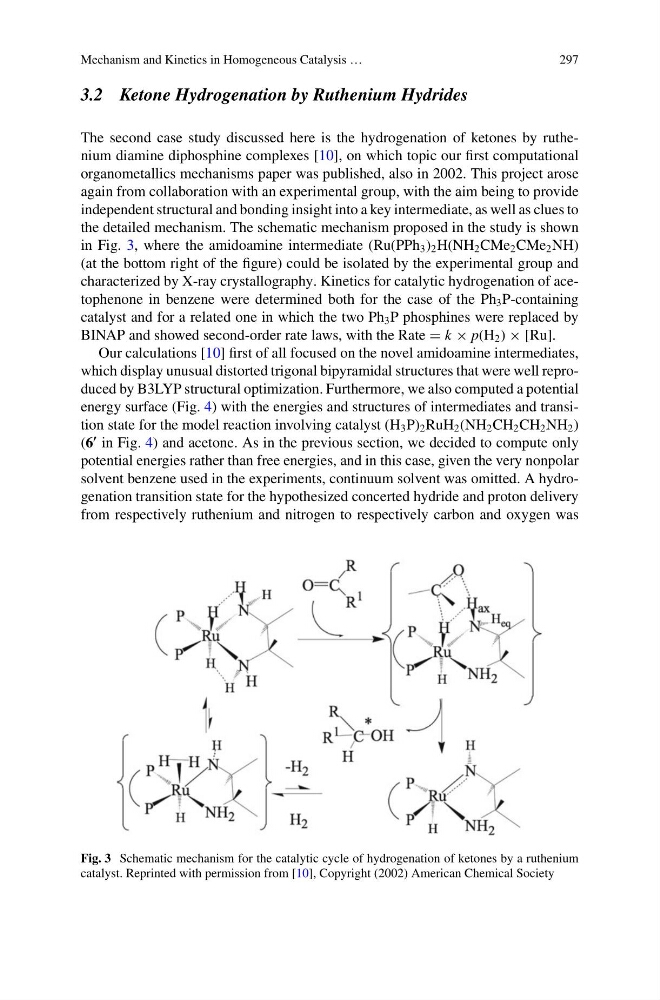
the detailed mechanism. The schematic mechanism proposed in the study is shown
in Fig. 3, where the amidoamine intermediate (Ru(PPh 3 ) 2 H(NH 2 CMe 2 CMe 2 NH)
(at the bottom right of the figure) could be isolated by the experimental group and
characterized by X-ray crystallography. Kinetics for catalytic hydrogenation of acetophenone in benzene were determined both for the case of the Ph 3 P-containing
catalyst and for a related one in which the two Ph 3 P phosphines were replaced by
BINAP and showed second-order rate laws, with the Rate k × p(H 2 ) × [Ru].
Our calculations [10] first of all focused on the novel amidoamine intermediates,
which display unusual distorted trigonal bipyramidal structures that were well reproduced by B3LYP structural optimization. Furthermore, we also computed a potential
energy surface (Fig. 4) with the energies and structures of intermediates and transition state for the model reaction involving catalyst (H 3 P) 2 RuH 2 (NH 2 CH 2 CH 2 NH 2 )
(6
in Fig. 4) and acetone. As in the previous section, we decided to compute only
potential energies rather than free energies, and in this case, given the very nonpolar
solvent benzene used in the experiments, continuum solvent was omitted. A hydrogenation transition state for the hypothesized concerted hydride and proton delivery
from respectively ruthenium and nitrogen to respectively carbon and oxygen was
Fig. 3 Schematic mechanism for the catalytic cycle of hydrogenation of ketones by a ruthenium
catalyst. Reprinted with permission from [10], Copyright (2002) American Chemical Society
297
3.2 Ketone Hydrogenation by Ruthenium Hydrides
The second case study discussed here is the hydrogenation of ketones by ruthenium diamine diphosphine complexes [10], on which topic our first computational
organometallics mechanisms paper was published, also in 2002. This project arose
again from collaboration with an experimental group, with the aim being to provide
independent structural and bonding insight into a key intermediate, as well as clues to
the detailed mechanism. The schematic mechanism proposed in the study is shown
in Fig. 3, where the amidoamine intermediate (Ru(PPh 3 ) 2 H(NH 2 CMe 2 CMe 2 NH)
(at the bottom right of the figure) could be isolated by the experimental group and
characterized by X-ray crystallography. Kinetics for catalytic hydrogenation of acetophenone in benzene were determined both for the case of the Ph 3 P-containing
catalyst and for a related one in which the two Ph 3 P phosphines were replaced by
BINAP and showed second-order rate laws, with the Rate k × p(H 2 ) × [Ru].
Our calculations [10] first of all focused on the novel amidoamine intermediates,
which display unusual distorted trigonal bipyramidal structures that were well reproduced by B3LYP structural optimization. Furthermore, we also computed a potential
energy surface (Fig. 4) with the energies and structures of intermediates and transition state for the model reaction involving catalyst (H 3 P) 2 RuH 2 (NH 2 CH 2 CH 2 NH 2 )
(6
in Fig. 4) and acetone. As in the previous section, we decided to compute only
potential energies rather than free energies, and in this case, given the very nonpolar
solvent benzene used in the experiments, continuum solvent was omitted. A hydrogenation transition state for the hypothesized concerted hydride and proton delivery
from respectively ruthenium and nitrogen to respectively carbon and oxygen was
Fig. 3 Schematic mechanism for the catalytic cycle of hydrogenation of ketones by a ruthenium
catalyst. Reprinted with permission from [10], Copyright (2002) American Chemical Society