

296
J. N. Harvey
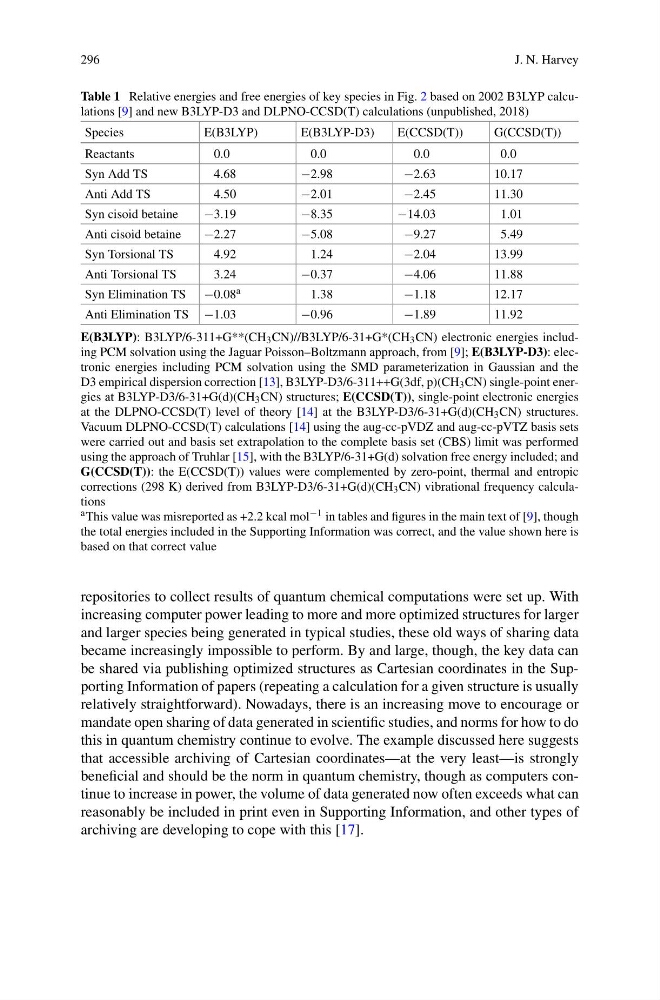
Table 1 Relative energies and free energies of key species in Fig. 2 based on 2002 B3LYP calculations [9] and new B3LYP-D3 and DLPNO-CCSD(T) calculations (unpublished, 2018)
Species
E(B3LYP)
E(B3LYP-D3)
E(CCSD(T))
G(CCSD(T))
Reactants
0.0
0.0
0.0
0.0
Syn Add TS
4.68
−2.98
−2.63
10.17
Anti Add TS
4.50
−2.01
−2.45
11.30
Syn cisoid betaine
−3.19
−8.35
−14.03
1.01
Anti cisoid betaine
−2.27
−5.08
−9.27
5.49
Syn Torsional TS
4.92
1.24
−2.04
13.99
Anti Torsional TS
3.24
−0.37
−4.06
11.88
Syn Elimination TS −0.08 a
1.38
−1.18
12.17
Anti Elimination TS −1.03
−0.96
−1.89
11.92
E(B3LYP): B3LYP/6-311+G**(CH 3 CN)//B3LYP/6-31+G*(CH 3 CN) electronic energies including PCM solvation using the Jaguar Poisson–Boltzmann approach, from [9]; E(B3LYP-D3): electronic energies including PCM solvation using the SMD parameterization in Gaussian and the
D3 empirical dispersion correction [13], B3LYP-D3/6-311++G(3df, p)(CH 3 CN) single-point energies at B3LYP-D3/6-31+G(d)(CH 3 CN) structures; E(CCSD(T)), single-point electronic energies
at the DLPNO-CCSD(T) level of theory [14] at the B3LYP-D3/6-31+G(d)(CH 3 CN) structures.
Vacuum DLPNO-CCSD(T) calculations [14] using the aug-cc-pVDZ and aug-cc-pVTZ basis sets
were carried out and basis set extrapolation to the complete basis set (CBS) limit was performed
using the approach of Truhlar [15], with the B3LYP/6-31+G(d) solvation free energy included; and
G(CCSD(T)): the E(CCSD(T)) values were complemented by zero-point, thermal and entropic
corrections (298 K) derived from B3LYP-D3/6-31+G(d)(CH 3 CN) vibrational frequency calculations
a This value was misreported as +2.2 kcal mol −1 in tables and figures in the main text of [9], though
the total energies included in the Supporting Information was correct, and the value shown here is
based on that correct value
repositories to collect results of quantum chemical computations were set up. With
increasing computer power leading to more and more optimized structures for larger
and larger species being generated in typical studies, these old ways of sharing data
became increasingly impossible to perform. By and large, though, the key data can
be shared via publishing optimized structures as Cartesian coordinates in the Supporting Information of papers (repeating a calculation for a given structure is usually
relatively straightforward). Nowadays, there is an increasing move to encourage or
mandate open sharing of data generated in scientific studies, and norms for how to do
this in quantum chemistry continue to evolve. The example discussed here suggests
that accessible archiving of Cartesian coordinates—at the very least—is strongly
beneficial and should be the norm in quantum chemistry, though as computers continue to increase in power, the volume of data generated now often exceeds what can
reasonably be included in print even in Supporting Information, and other types of
archiving are developing to cope with this [17].
J. N. Harvey
Table 1 Relative energies and free energies of key species in Fig. 2 based on 2002 B3LYP calculations [9] and new B3LYP-D3 and DLPNO-CCSD(T) calculations (unpublished, 2018)
Species
E(B3LYP)
E(B3LYP-D3)
E(CCSD(T))
G(CCSD(T))
Reactants
0.0
0.0
0.0
0.0
Syn Add TS
4.68
−2.98
−2.63
10.17
Anti Add TS
4.50
−2.01
−2.45
11.30
Syn cisoid betaine
−3.19
−8.35
−14.03
1.01
Anti cisoid betaine
−2.27
−5.08
−9.27
5.49
Syn Torsional TS
4.92
1.24
−2.04
13.99
Anti Torsional TS
3.24
−0.37
−4.06
11.88
Syn Elimination TS −0.08 a
1.38
−1.18
12.17
Anti Elimination TS −1.03
−0.96
−1.89
11.92
E(B3LYP): B3LYP/6-311+G**(CH 3 CN)//B3LYP/6-31+G*(CH 3 CN) electronic energies including PCM solvation using the Jaguar Poisson–Boltzmann approach, from [9]; E(B3LYP-D3): electronic energies including PCM solvation using the SMD parameterization in Gaussian and the
D3 empirical dispersion correction [13], B3LYP-D3/6-311++G(3df, p)(CH 3 CN) single-point energies at B3LYP-D3/6-31+G(d)(CH 3 CN) structures; E(CCSD(T)), single-point electronic energies
at the DLPNO-CCSD(T) level of theory [14] at the B3LYP-D3/6-31+G(d)(CH 3 CN) structures.
Vacuum DLPNO-CCSD(T) calculations [14] using the aug-cc-pVDZ and aug-cc-pVTZ basis sets
were carried out and basis set extrapolation to the complete basis set (CBS) limit was performed
using the approach of Truhlar [15], with the B3LYP/6-31+G(d) solvation free energy included; and
G(CCSD(T)): the E(CCSD(T)) values were complemented by zero-point, thermal and entropic
corrections (298 K) derived from B3LYP-D3/6-31+G(d)(CH 3 CN) vibrational frequency calculations
a This value was misreported as +2.2 kcal mol −1 in tables and figures in the main text of [9], though
the total energies included in the Supporting Information was correct, and the value shown here is
based on that correct value
repositories to collect results of quantum chemical computations were set up. With
increasing computer power leading to more and more optimized structures for larger
and larger species being generated in typical studies, these old ways of sharing data
became increasingly impossible to perform. By and large, though, the key data can
be shared via publishing optimized structures as Cartesian coordinates in the Supporting Information of papers (repeating a calculation for a given structure is usually
relatively straightforward). Nowadays, there is an increasing move to encourage or
mandate open sharing of data generated in scientific studies, and norms for how to do
this in quantum chemistry continue to evolve. The example discussed here suggests
that accessible archiving of Cartesian coordinates—at the very least—is strongly
beneficial and should be the norm in quantum chemistry, though as computers continue to increase in power, the volume of data generated now often exceeds what can
reasonably be included in print even in Supporting Information, and other types of
archiving are developing to cope with this [17].