

202
M. Lundberg and M. G. Delcey
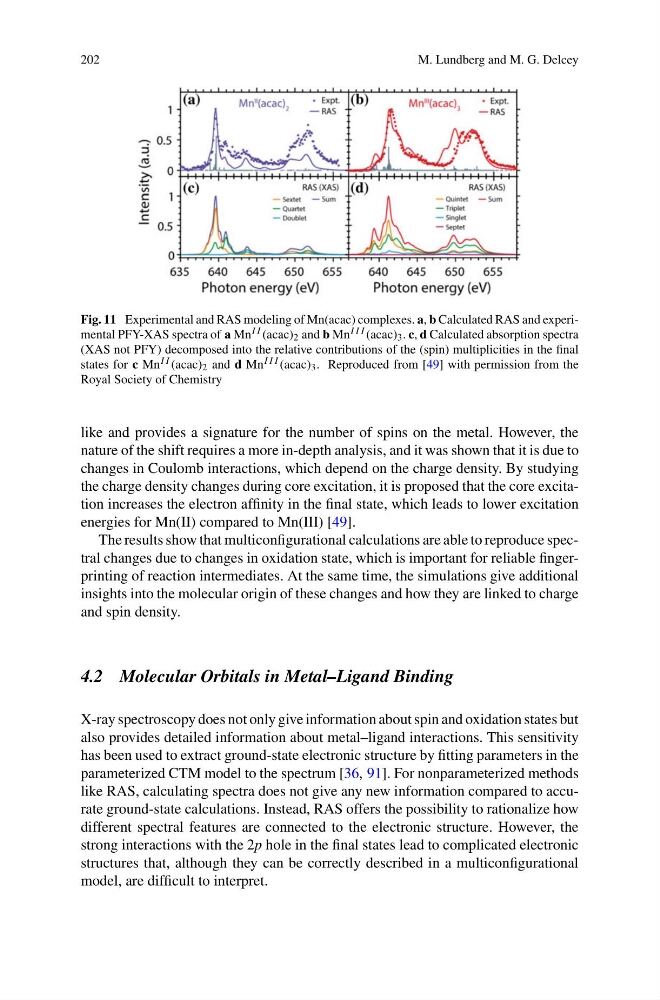
Fig. 11 Experimental and RAS modeling of Mn(acac) complexes. a, b Calculated RAS and experimental PFY-XAS spectra of a Mn I I (acac) 2 and b Mn I I I (acac) 3 . c, d Calculated absorption spectra
(XAS not PFY) decomposed into the relative contributions of the (spin) multiplicities in the final
states for c Mn I I (acac) 2 and d Mn I I I (acac) 3 . Reproduced from [49] with permission from the
Royal Society of Chemistry
like and provides a signature for the number of spins on the metal. However, the
nature of the shift requires a more in-depth analysis, and it was shown that it is due to
changes in Coulomb interactions, which depend on the charge density. By studying
the charge density changes during core excitation, it is proposed that the core excitation increases the electron affinity in the final state, which leads to lower excitation
energies for Mn(II) compared to Mn(III) [49].
The results show that multiconfigurational calculations are able to reproduce spectral changes due to changes in oxidation state, which is important for reliable fingerprinting of reaction intermediates. At the same time, the simulations give additional
insights into the molecular origin of these changes and how they are linked to charge
and spin density.
4.2 Molecular Orbitals in Metal–Ligand Binding
X-ray spectroscopy does not only give information about spin and oxidation states but
also provides detailed information about metal–ligand interactions. This sensitivity
has been used to extract ground-state electronic structure by fitting parameters in the
parameterized CTM model to the spectrum [36, 91]. For nonparameterized methods
like RAS, calculating spectra does not give any new information compared to accurate ground-state calculations. Instead, RAS offers the possibility to rationalize how
different spectral features are connected to the electronic structure. However, the
strong interactions with the 2p hole in the final states lead to complicated electronic
structures that, although they can be correctly described in a multiconfigurational
model, are difficult to interpret.
M. Lundberg and M. G. Delcey
Fig. 11 Experimental and RAS modeling of Mn(acac) complexes. a, b Calculated RAS and experimental PFY-XAS spectra of a Mn I I (acac) 2 and b Mn I I I (acac) 3 . c, d Calculated absorption spectra
(XAS not PFY) decomposed into the relative contributions of the (spin) multiplicities in the final
states for c Mn I I (acac) 2 and d Mn I I I (acac) 3 . Reproduced from [49] with permission from the
Royal Society of Chemistry
like and provides a signature for the number of spins on the metal. However, the
nature of the shift requires a more in-depth analysis, and it was shown that it is due to
changes in Coulomb interactions, which depend on the charge density. By studying
the charge density changes during core excitation, it is proposed that the core excitation increases the electron affinity in the final state, which leads to lower excitation
energies for Mn(II) compared to Mn(III) [49].
The results show that multiconfigurational calculations are able to reproduce spectral changes due to changes in oxidation state, which is important for reliable fingerprinting of reaction intermediates. At the same time, the simulations give additional
insights into the molecular origin of these changes and how they are linked to charge
and spin density.
4.2 Molecular Orbitals in Metal–Ligand Binding
X-ray spectroscopy does not only give information about spin and oxidation states but
also provides detailed information about metal–ligand interactions. This sensitivity
has been used to extract ground-state electronic structure by fitting parameters in the
parameterized CTM model to the spectrum [36, 91]. For nonparameterized methods
like RAS, calculating spectra does not give any new information compared to accurate ground-state calculations. Instead, RAS offers the possibility to rationalize how
different spectral features are connected to the electronic structure. However, the
strong interactions with the 2p hole in the final states lead to complicated electronic
structures that, although they can be correctly described in a multiconfigurational
model, are difficult to interpret.