

Computational Versus Experimental Spectroscopy …
175
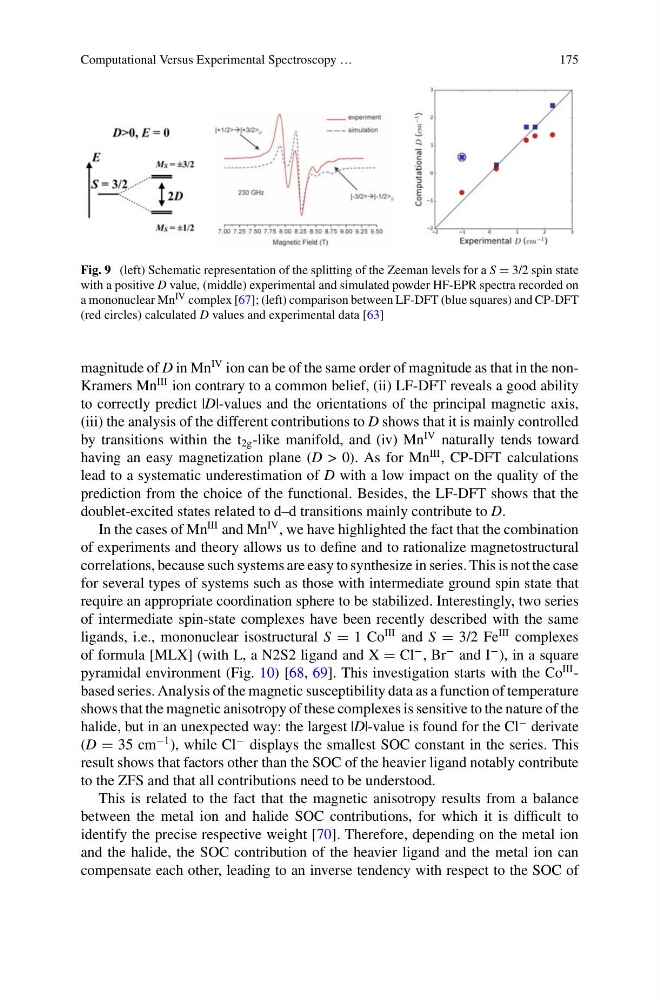
Fig. 9 (left) Schematic representation of the splitting of the Zeeman levels for a S 3/2 spin state
with a positive D value, (middle) experimental and simulated powder HF-EPR spectra recorded on
a mononuclear Mn IV complex [67]; (left) comparison between LF-DFT (blue squares) and CP-DFT
(red circles) calculated D values and experimental data [63]
magnitude of D in Mn
IV ion can be of the same order of magnitude as that in the nonKramers Mn
III ion contrary to a common belief, (ii) LF-DFT reveals a good ability
to correctly predict |D|-values and the orientations of the principal magnetic axis,
(iii) the analysis of the different contributions to D shows that it is mainly controlled
by transitions within the t 2g -like manifold, and (iv) Mn
IV naturally tends toward
having an easy magnetization plane (D > 0). As for Mn
III , CP-DFT calculations
lead to a systematic underestimation of D with a low impact on the quality of the
prediction from the choice of the functional. Besides, the LF-DFT shows that the
doublet-excited states related to d–d transitions mainly contribute to D.
In the cases of Mn
III and Mn
IV , we have highlighted the fact that the combination
of experiments and theory allows us to define and to rationalize magnetostructural
correlations, because such systems are easy to synthesize in series. This is not the case
for several types of systems such as those with intermediate ground spin state that
require an appropriate coordination sphere to be stabilized. Interestingly, two series
of intermediate spin-state complexes have been recently described with the same
ligands, i.e., mononuclear isostructural S 1 Co
III and S 3/2 Fe
III complexes
of formula [MLX] (with L, a N2S2 ligand and X Cl
− , Br
− and I
− ), in a square
pyramidal environment (Fig. 10) [68, 69]. This investigation starts with the Co
III -
based series. Analysis of the magnetic susceptibility data as a function of temperature
shows that the magnetic anisotropy of these complexes is sensitive to the nature of the
halide, but in an unexpected way: the largest |D|-value is found for the Cl
− derivate
(D 35 cm
−1 ), while Cl
− displays the smallest SOC constant in the series. This
result shows that factors other than the SOC of the heavier ligand notably contribute
to the ZFS and that all contributions need to be understood.
This is related to the fact that the magnetic anisotropy results from a balance
between the metal ion and halide SOC contributions, for which it is difficult to
identify the precise respective weight [70]. Therefore, depending on the metal ion
and the halide, the SOC contribution of the heavier ligand and the metal ion can
compensate each other, leading to an inverse tendency with respect to the SOC of
175
Fig. 9 (left) Schematic representation of the splitting of the Zeeman levels for a S 3/2 spin state
with a positive D value, (middle) experimental and simulated powder HF-EPR spectra recorded on
a mononuclear Mn IV complex [67]; (left) comparison between LF-DFT (blue squares) and CP-DFT
(red circles) calculated D values and experimental data [63]
magnitude of D in Mn
IV ion can be of the same order of magnitude as that in the nonKramers Mn
III ion contrary to a common belief, (ii) LF-DFT reveals a good ability
to correctly predict |D|-values and the orientations of the principal magnetic axis,
(iii) the analysis of the different contributions to D shows that it is mainly controlled
by transitions within the t 2g -like manifold, and (iv) Mn
IV naturally tends toward
having an easy magnetization plane (D > 0). As for Mn
III , CP-DFT calculations
lead to a systematic underestimation of D with a low impact on the quality of the
prediction from the choice of the functional. Besides, the LF-DFT shows that the
doublet-excited states related to d–d transitions mainly contribute to D.
In the cases of Mn
III and Mn
IV , we have highlighted the fact that the combination
of experiments and theory allows us to define and to rationalize magnetostructural
correlations, because such systems are easy to synthesize in series. This is not the case
for several types of systems such as those with intermediate ground spin state that
require an appropriate coordination sphere to be stabilized. Interestingly, two series
of intermediate spin-state complexes have been recently described with the same
ligands, i.e., mononuclear isostructural S 1 Co
III and S 3/2 Fe
III complexes
of formula [MLX] (with L, a N2S2 ligand and X Cl
− , Br
− and I
− ), in a square
pyramidal environment (Fig. 10) [68, 69]. This investigation starts with the Co
III -
based series. Analysis of the magnetic susceptibility data as a function of temperature
shows that the magnetic anisotropy of these complexes is sensitive to the nature of the
halide, but in an unexpected way: the largest |D|-value is found for the Cl
− derivate
(D 35 cm
−1 ), while Cl
− displays the smallest SOC constant in the series. This
result shows that factors other than the SOC of the heavier ligand notably contribute
to the ZFS and that all contributions need to be understood.
This is related to the fact that the magnetic anisotropy results from a balance
between the metal ion and halide SOC contributions, for which it is difficult to
identify the precise respective weight [70]. Therefore, depending on the metal ion
and the halide, the SOC contribution of the heavier ligand and the metal ion can
compensate each other, leading to an inverse tendency with respect to the SOC of