

176
M. Gruden et al.
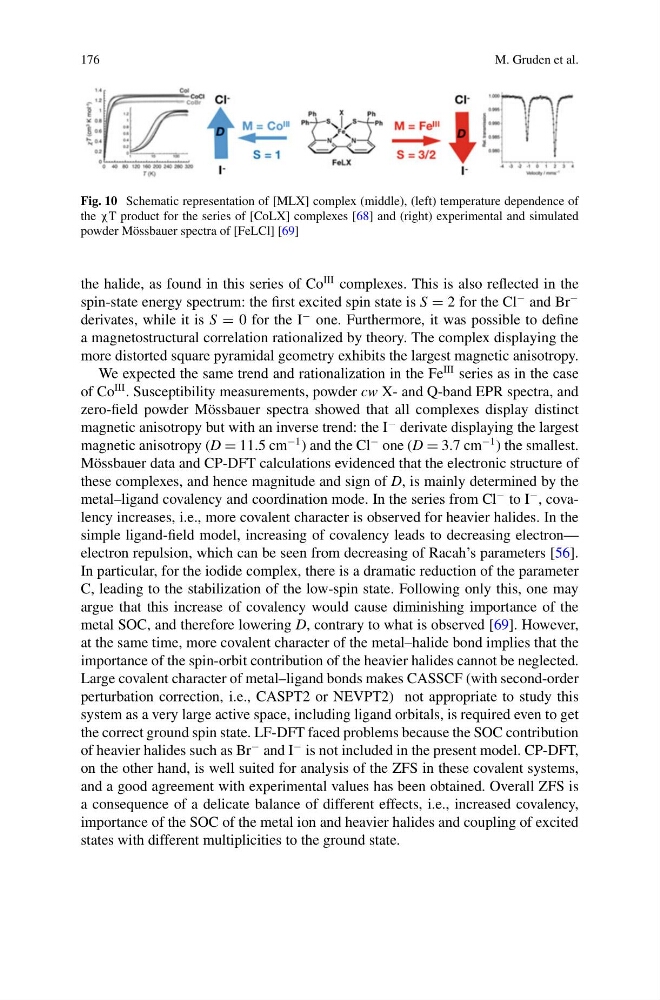
Fig. 10 Schematic representation of [MLX] complex (middle), (left) temperature dependence of
the χT product for the series of [CoLX] complexes [68] and (right) experimental and simulated
powder Mössbauer spectra of [FeLCl] [69]
the halide, as found in this series of Co
III complexes. This is also reflected in the
spin-state energy spectrum: the first excited spin state is S 2 for the Cl
− and Br
−
derivates, while it is S 0 for the I
− one. Furthermore, it was possible to define
a magnetostructural correlation rationalized by theory. The complex displaying the
more distorted square pyramidal geometry exhibits the largest magnetic anisotropy.
We expected the same trend and rationalization in the Fe
III series as in the case
of Co
III . Susceptibility measurements, powder cw X- and Q-band EPR spectra, and
zero-field powder Mössbauer spectra showed that all complexes display distinct
magnetic anisotropy but with an inverse trend: the I
− derivate displaying the largest
magnetic anisotropy (D 11.5 cm
−1 ) and the Cl
− one (D 3.7 cm
−1 ) the smallest.
Mössbauer data and CP-DFT calculations evidenced that the electronic structure of
these complexes, and hence magnitude and sign of D, is mainly determined by the
metal–ligand covalency and coordination mode. In the series from Cl
− to I
− , covalency increases, i.e., more covalent character is observed for heavier halides. In the
simple ligand-field model, increasing of covalency leads to decreasing electron—
electron repulsion, which can be seen from decreasing of Racah’s parameters [56].
In particular, for the iodide complex, there is a dramatic reduction of the parameter
C, leading to the stabilization of the low-spin state. Following only this, one may
argue that this increase of covalency would cause diminishing importance of the
metal SOC, and therefore lowering D, contrary to what is observed [69]. However,
at the same time, more covalent character of the metal–halide bond implies that the
importance of the spin-orbit contribution of the heavier halides cannot be neglected.
Large covalent character of metal–ligand bonds makes CASSCF (with second-order
perturbation correction, i.e., CASPT2 or NEVPT2) not appropriate to study this
system as a very large active space, including ligand orbitals, is required even to get
the correct ground spin state. LF-DFT faced problems because the SOC contribution
of heavier halides such as Br
− and I
− is not included in the present model. CP-DFT,
on the other hand, is well suited for analysis of the ZFS in these covalent systems,
and a good agreement with experimental values has been obtained. Overall ZFS is
a consequence of a delicate balance of different effects, i.e., increased covalency,
importance of the SOC of the metal ion and heavier halides and coupling of excited
states with different multiplicities to the ground state.
M. Gruden et al.
Fig. 10 Schematic representation of [MLX] complex (middle), (left) temperature dependence of
the χT product for the series of [CoLX] complexes [68] and (right) experimental and simulated
powder Mössbauer spectra of [FeLCl] [69]
the halide, as found in this series of Co
III complexes. This is also reflected in the
spin-state energy spectrum: the first excited spin state is S 2 for the Cl
− and Br
−
derivates, while it is S 0 for the I
− one. Furthermore, it was possible to define
a magnetostructural correlation rationalized by theory. The complex displaying the
more distorted square pyramidal geometry exhibits the largest magnetic anisotropy.
We expected the same trend and rationalization in the Fe
III series as in the case
of Co
III . Susceptibility measurements, powder cw X- and Q-band EPR spectra, and
zero-field powder Mössbauer spectra showed that all complexes display distinct
magnetic anisotropy but with an inverse trend: the I
− derivate displaying the largest
magnetic anisotropy (D 11.5 cm
−1 ) and the Cl
− one (D 3.7 cm
−1 ) the smallest.
Mössbauer data and CP-DFT calculations evidenced that the electronic structure of
these complexes, and hence magnitude and sign of D, is mainly determined by the
metal–ligand covalency and coordination mode. In the series from Cl
− to I
− , covalency increases, i.e., more covalent character is observed for heavier halides. In the
simple ligand-field model, increasing of covalency leads to decreasing electron—
electron repulsion, which can be seen from decreasing of Racah’s parameters [56].
In particular, for the iodide complex, there is a dramatic reduction of the parameter
C, leading to the stabilization of the low-spin state. Following only this, one may
argue that this increase of covalency would cause diminishing importance of the
metal SOC, and therefore lowering D, contrary to what is observed [69]. However,
at the same time, more covalent character of the metal–halide bond implies that the
importance of the spin-orbit contribution of the heavier halides cannot be neglected.
Large covalent character of metal–ligand bonds makes CASSCF (with second-order
perturbation correction, i.e., CASPT2 or NEVPT2) not appropriate to study this
system as a very large active space, including ligand orbitals, is required even to get
the correct ground spin state. LF-DFT faced problems because the SOC contribution
of heavier halides such as Br
− and I
− is not included in the present model. CP-DFT,
on the other hand, is well suited for analysis of the ZFS in these covalent systems,
and a good agreement with experimental values has been obtained. Overall ZFS is
a consequence of a delicate balance of different effects, i.e., increased covalency,
importance of the SOC of the metal ion and heavier halides and coupling of excited
states with different multiplicities to the ground state.