

174
M. Gruden et al.
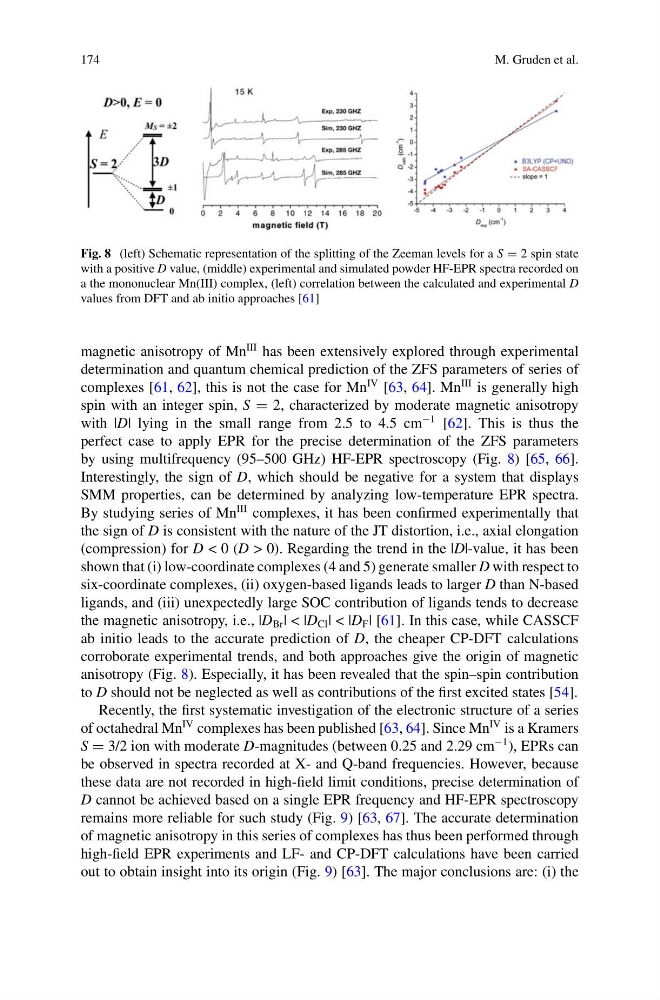
Fig. 8 (left) Schematic representation of the splitting of the Zeeman levels for a S 2 spin state
with a positive D value, (middle) experimental and simulated powder HF-EPR spectra recorded on
a the mononuclear Mn(III) complex, (left) correlation between the calculated and experimental D
values from DFT and ab initio approaches [61]
magnetic anisotropy of Mn
III has been extensively explored through experimental
determination and quantum chemical prediction of the ZFS parameters of series of
complexes [61, 62], this is not the case for Mn
IV [63, 64]. Mn
III is generally high
spin with an integer spin, S 2, characterized by moderate magnetic anisotropy
with |D| lying in the small range from 2.5 to 4.5 cm
−1 [62]. This is thus the
perfect case to apply EPR for the precise determination of the ZFS parameters
by using multifrequency (95–500 GHz) HF-EPR spectroscopy (Fig. 8) [65, 66].
Interestingly, the sign of D, which should be negative for a system that displays
SMM properties, can be determined by analyzing low-temperature EPR spectra.
By studying series of Mn
III complexes, it has been confirmed experimentally that
the sign of D is consistent with the nature of the JT distortion, i.e., axial elongation
(compression) for D < 0 (D > 0). Regarding the trend in the |D|-value, it has been
shown that (i) low-coordinate complexes (4 and 5) generate smaller D with respect to
six-coordinate complexes, (ii) oxygen-based ligands leads to larger D than N-based
ligands, and (iii) unexpectedly large SOC contribution of ligands tends to decrease
the magnetic anisotropy, i.e., |D Br | < |D Cl | < |D F | [61]. In this case, while CASSCF
ab initio leads to the accurate prediction of D, the cheaper CP-DFT calculations
corroborate experimental trends, and both approaches give the origin of magnetic
anisotropy (Fig. 8). Especially, it has been revealed that the spin–spin contribution
to D should not be neglected as well as contributions of the first excited states [54].
Recently, the first systematic investigation of the electronic structure of a series
of octahedral Mn
IV complexes has been published [63, 64]. Since Mn
IV is a Kramers
S 3/2 ion with moderate D-magnitudes (between 0.25 and 2.29 cm
−1 ), EPRs can
be observed in spectra recorded at X- and Q-band frequencies. However, because
these data are not recorded in high-field limit conditions, precise determination of
D cannot be achieved based on a single EPR frequency and HF-EPR spectroscopy
remains more reliable for such study (Fig. 9) [63, 67]. The accurate determination
of magnetic anisotropy in this series of complexes has thus been performed through
high-field EPR experiments and LF- and CP-DFT calculations have been carried
out to obtain insight into its origin (Fig. 9) [63]. The major conclusions are: (i) the
M. Gruden et al.
Fig. 8 (left) Schematic representation of the splitting of the Zeeman levels for a S 2 spin state
with a positive D value, (middle) experimental and simulated powder HF-EPR spectra recorded on
a the mononuclear Mn(III) complex, (left) correlation between the calculated and experimental D
values from DFT and ab initio approaches [61]
magnetic anisotropy of Mn
III has been extensively explored through experimental
determination and quantum chemical prediction of the ZFS parameters of series of
complexes [61, 62], this is not the case for Mn
IV [63, 64]. Mn
III is generally high
spin with an integer spin, S 2, characterized by moderate magnetic anisotropy
with |D| lying in the small range from 2.5 to 4.5 cm
−1 [62]. This is thus the
perfect case to apply EPR for the precise determination of the ZFS parameters
by using multifrequency (95–500 GHz) HF-EPR spectroscopy (Fig. 8) [65, 66].
Interestingly, the sign of D, which should be negative for a system that displays
SMM properties, can be determined by analyzing low-temperature EPR spectra.
By studying series of Mn
III complexes, it has been confirmed experimentally that
the sign of D is consistent with the nature of the JT distortion, i.e., axial elongation
(compression) for D < 0 (D > 0). Regarding the trend in the |D|-value, it has been
shown that (i) low-coordinate complexes (4 and 5) generate smaller D with respect to
six-coordinate complexes, (ii) oxygen-based ligands leads to larger D than N-based
ligands, and (iii) unexpectedly large SOC contribution of ligands tends to decrease
the magnetic anisotropy, i.e., |D Br | < |D Cl | < |D F | [61]. In this case, while CASSCF
ab initio leads to the accurate prediction of D, the cheaper CP-DFT calculations
corroborate experimental trends, and both approaches give the origin of magnetic
anisotropy (Fig. 8). Especially, it has been revealed that the spin–spin contribution
to D should not be neglected as well as contributions of the first excited states [54].
Recently, the first systematic investigation of the electronic structure of a series
of octahedral Mn
IV complexes has been published [63, 64]. Since Mn
IV is a Kramers
S 3/2 ion with moderate D-magnitudes (between 0.25 and 2.29 cm
−1 ), EPRs can
be observed in spectra recorded at X- and Q-band frequencies. However, because
these data are not recorded in high-field limit conditions, precise determination of
D cannot be achieved based on a single EPR frequency and HF-EPR spectroscopy
remains more reliable for such study (Fig. 9) [63, 67]. The accurate determination
of magnetic anisotropy in this series of complexes has thus been performed through
high-field EPR experiments and LF- and CP-DFT calculations have been carried
out to obtain insight into its origin (Fig. 9) [63]. The major conclusions are: (i) the