

166
M. Gruden et al.
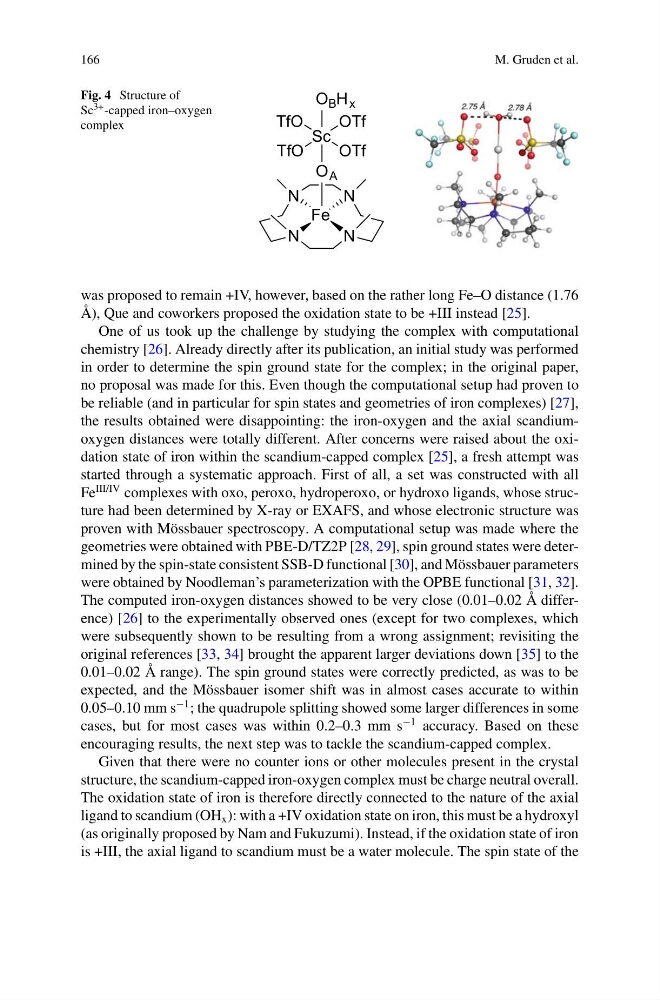
Fig. 4 Structure of
Sc 3+ -capped iron–oxygen
complex
N
N
N
N
Fe
O A
Sc
O B H x
OTf
OTf
TfO
TfO
was proposed to remain +IV, however, based on the rather long Fe–O distance (1.76
Å), Que and coworkers proposed the oxidation state to be +III instead [25].
One of us took up the challenge by studying the complex with computational
chemistry [26]. Already directly after its publication, an initial study was performed
in order to determine the spin ground state for the complex; in the original paper,
no proposal was made for this. Even though the computational setup had proven to
be reliable (and in particular for spin states and geometries of iron complexes) [27],
the results obtained were disappointing: the iron-oxygen and the axial scandiumoxygen distances were totally different. After concerns were raised about the oxidation state of iron within the scandium-capped complex [25], a fresh attempt was
started through a systematic approach. First of all, a set was constructed with all
Fe
III/IV complexes with oxo, peroxo, hydroperoxo, or hydroxo ligands, whose structure had been determined by X-ray or EXAFS, and whose electronic structure was
proven with Mössbauer spectroscopy. A computational setup was made where the
geometries were obtained with PBE-D/TZ2P [28, 29], spin ground states were determined by the spin-state consistent SSB-D functional [30], and Mössbauer parameters
were obtained by Noodleman’s parameterization with the OPBE functional [31, 32].
The computed iron-oxygen distances showed to be very close (0.01–0.02 Å difference) [26] to the experimentally observed ones (except for two complexes, which
were subsequently shown to be resulting from a wrong assignment; revisiting the
original references [33, 34] brought the apparent larger deviations down [35] to the
0.01–0.02 Å range). The spin ground states were correctly predicted, as was to be
expected, and the Mössbauer isomer shift was in almost cases accurate to within
0.05–0.10 mm s
−1 ; the quadrupole splitting showed some larger differences in some
cases, but for most cases was within 0.2–0.3 mm s
−1 accuracy. Based on these
encouraging results, the next step was to tackle the scandium-capped complex.
Given that there were no counter ions or other molecules present in the crystal
structure, the scandium-capped iron-oxygen complex must be charge neutral overall.
The oxidation state of iron is therefore directly connected to the nature of the axial
ligand to scandium (OH x ): with a +IV oxidation state on iron, this must be a hydroxyl
(as originally proposed by Nam and Fukuzumi). Instead, if the oxidation state of iron
is +III, the axial ligand to scandium must be a water molecule. The spin state of the
M. Gruden et al.
Fig. 4 Structure of
Sc 3+ -capped iron–oxygen
complex
N
N
N
N
Fe
O A
Sc
O B H x
OTf
OTf
TfO
TfO
was proposed to remain +IV, however, based on the rather long Fe–O distance (1.76
Å), Que and coworkers proposed the oxidation state to be +III instead [25].
One of us took up the challenge by studying the complex with computational
chemistry [26]. Already directly after its publication, an initial study was performed
in order to determine the spin ground state for the complex; in the original paper,
no proposal was made for this. Even though the computational setup had proven to
be reliable (and in particular for spin states and geometries of iron complexes) [27],
the results obtained were disappointing: the iron-oxygen and the axial scandiumoxygen distances were totally different. After concerns were raised about the oxidation state of iron within the scandium-capped complex [25], a fresh attempt was
started through a systematic approach. First of all, a set was constructed with all
Fe
III/IV complexes with oxo, peroxo, hydroperoxo, or hydroxo ligands, whose structure had been determined by X-ray or EXAFS, and whose electronic structure was
proven with Mössbauer spectroscopy. A computational setup was made where the
geometries were obtained with PBE-D/TZ2P [28, 29], spin ground states were determined by the spin-state consistent SSB-D functional [30], and Mössbauer parameters
were obtained by Noodleman’s parameterization with the OPBE functional [31, 32].
The computed iron-oxygen distances showed to be very close (0.01–0.02 Å difference) [26] to the experimentally observed ones (except for two complexes, which
were subsequently shown to be resulting from a wrong assignment; revisiting the
original references [33, 34] brought the apparent larger deviations down [35] to the
0.01–0.02 Å range). The spin ground states were correctly predicted, as was to be
expected, and the Mössbauer isomer shift was in almost cases accurate to within
0.05–0.10 mm s
−1 ; the quadrupole splitting showed some larger differences in some
cases, but for most cases was within 0.2–0.3 mm s
−1 accuracy. Based on these
encouraging results, the next step was to tackle the scandium-capped complex.
Given that there were no counter ions or other molecules present in the crystal
structure, the scandium-capped iron-oxygen complex must be charge neutral overall.
The oxidation state of iron is therefore directly connected to the nature of the axial
ligand to scandium (OH x ): with a +IV oxidation state on iron, this must be a hydroxyl
(as originally proposed by Nam and Fukuzumi). Instead, if the oxidation state of iron
is +III, the axial ligand to scandium must be a water molecule. The spin state of the