

Computational Versus Experimental Spectroscopy …
165
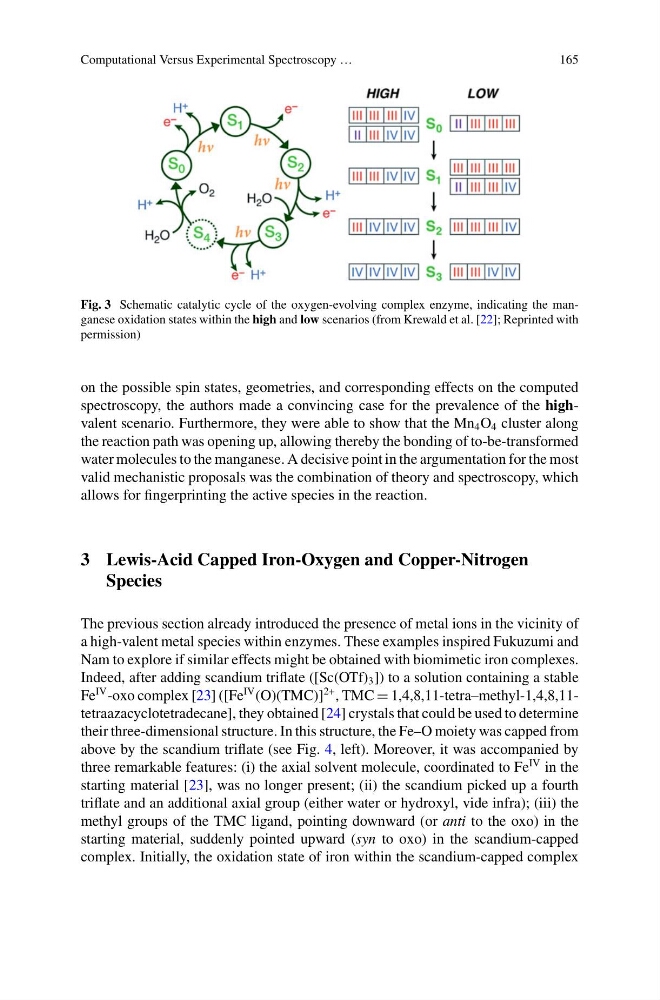
Fig. 3 Schematic catalytic cycle of the oxygen-evolving complex enzyme, indicating the manganese oxidation states within the high and low scenarios (from Krewald et al. [22]; Reprinted with
permission)
on the possible spin states, geometries, and corresponding effects on the computed
spectroscopy, the authors made a convincing case for the prevalence of the highvalent scenario. Furthermore, they were able to show that the Mn 4 O 4 cluster along
the reaction path was opening up, allowing thereby the bonding of to-be-transformed
water molecules to the manganese. A decisive point in the argumentation for the most
valid mechanistic proposals was the combination of theory and spectroscopy, which
allows for fingerprinting the active species in the reaction.
3 Lewis-Acid Capped Iron-Oxygen and Copper-Nitrogen
Species
The previous section already introduced the presence of metal ions in the vicinity of
a high-valent metal species within enzymes. These examples inspired Fukuzumi and
Nam to explore if similar effects might be obtained with biomimetic iron complexes.
Indeed, after adding scandium triflate ([Sc(OTf) 3 ]) to a solution containing a stable
Fe
IV -oxo complex [23] ([Fe
IV (O)(TMC)]
2+ , TMC 1,4,8,11-tetra–methyl-1,4,8,11tetraazacyclotetradecane], they obtained [24] crystals that could be used to determine
their three-dimensional structure. In this structure, the Fe–O moiety was capped from
above by the scandium triflate (see Fig. 4, left). Moreover, it was accompanied by
three remarkable features: (i) the axial solvent molecule, coordinated to Fe
IV in the
starting material [23], was no longer present; (ii) the scandium picked up a fourth
triflate and an additional axial group (either water or hydroxyl, vide infra); (iii) the
methyl groups of the TMC ligand, pointing downward (or anti to the oxo) in the
starting material, suddenly pointed upward (syn to oxo) in the scandium-capped
complex. Initially, the oxidation state of iron within the scandium-capped complex
165
Fig. 3 Schematic catalytic cycle of the oxygen-evolving complex enzyme, indicating the manganese oxidation states within the high and low scenarios (from Krewald et al. [22]; Reprinted with
permission)
on the possible spin states, geometries, and corresponding effects on the computed
spectroscopy, the authors made a convincing case for the prevalence of the highvalent scenario. Furthermore, they were able to show that the Mn 4 O 4 cluster along
the reaction path was opening up, allowing thereby the bonding of to-be-transformed
water molecules to the manganese. A decisive point in the argumentation for the most
valid mechanistic proposals was the combination of theory and spectroscopy, which
allows for fingerprinting the active species in the reaction.
3 Lewis-Acid Capped Iron-Oxygen and Copper-Nitrogen
Species
The previous section already introduced the presence of metal ions in the vicinity of
a high-valent metal species within enzymes. These examples inspired Fukuzumi and
Nam to explore if similar effects might be obtained with biomimetic iron complexes.
Indeed, after adding scandium triflate ([Sc(OTf) 3 ]) to a solution containing a stable
Fe
IV -oxo complex [23] ([Fe
IV (O)(TMC)]
2+ , TMC 1,4,8,11-tetra–methyl-1,4,8,11tetraazacyclotetradecane], they obtained [24] crystals that could be used to determine
their three-dimensional structure. In this structure, the Fe–O moiety was capped from
above by the scandium triflate (see Fig. 4, left). Moreover, it was accompanied by
three remarkable features: (i) the axial solvent molecule, coordinated to Fe
IV in the
starting material [23], was no longer present; (ii) the scandium picked up a fourth
triflate and an additional axial group (either water or hydroxyl, vide infra); (iii) the
methyl groups of the TMC ligand, pointing downward (or anti to the oxo) in the
starting material, suddenly pointed upward (syn to oxo) in the scandium-capped
complex. Initially, the oxidation state of iron within the scandium-capped complex