

New Strategies in Modeling Electronic Structures and Properties …
143
v
emb
[ρ WFT , ρ DFT ] = v
nuc
DFT (r)
+
dr
ρ DFT (r
)
|r − r |
+
δ E
nadd
xc [ρ WFT , ρ DFT ]
δρ WFT
+
δT
nadd
s
[ρ WFT , ρ DFT ]
δρ WFT
.
(46)
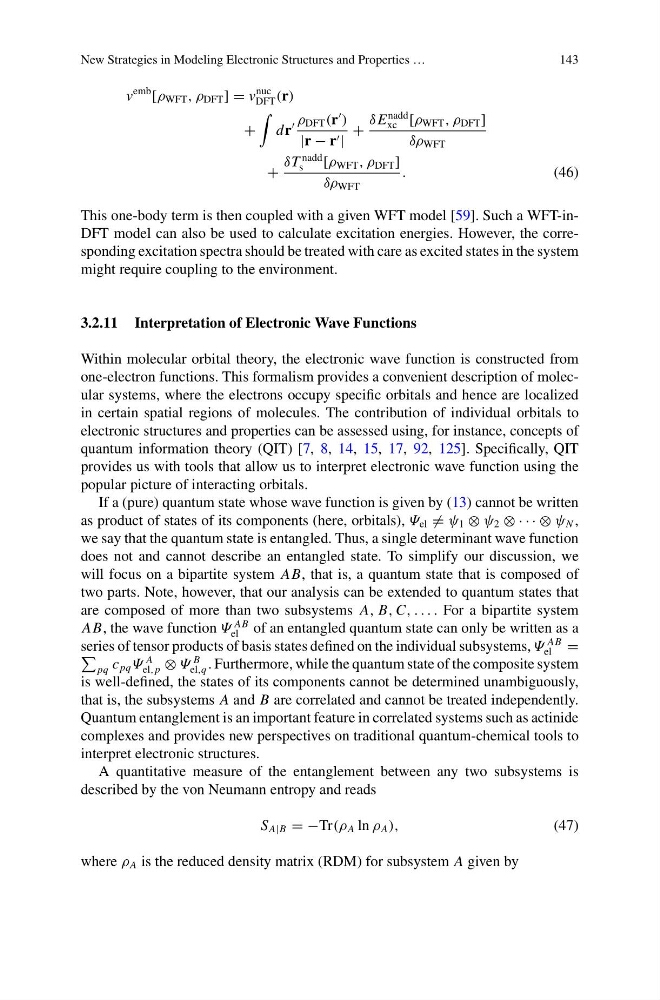
This one-body term is then coupled with a given WFT model [59]. Such a WFT-inDFT model can also be used to calculate excitation energies. However, the corresponding excitation spectra should be treated with care as excited states in the system
might require coupling to the environment.
3.2.11 Interpretation of Electronic Wave Functions
Within molecular orbital theory, the electronic wave function is constructed from
one-electron functions. This formalism provides a convenient description of molecular systems, where the electrons occupy specific orbitals and hence are localized
in certain spatial regions of molecules. The contribution of individual orbitals to
electronic structures and properties can be assessed using, for instance, concepts of
quantum information theory (QIT) [7, 8, 14, 15, 17, 92, 125]. Specifically, QIT
provides us with tools that allow us to interpret electronic wave function using the
popular picture of interacting orbitals.
If a (pure) quantum state whose wave function is given by (13) cannot be written
as product of states of its components (here, orbitals), Ψ el = ψ 1 ⊗ ψ 2 ⊗ · · · ⊗ ψ N ,
we say that the quantum state is entangled. Thus, a single determinant wave function
does not and cannot describe an entangled state. To simplify our discussion, we
will focus on a bipartite system AB, that is, a quantum state that is composed of
two parts. Note, however, that our analysis can be extended to quantum states that
are composed of more than two subsystems A, B, C, . . . . For a bipartite system
AB, the wave function Ψ
AB
el of an entangled quantum state can only be written as a
series of tensor products of basis states defined on the individual subsystems, Ψ
AB
el =
pq c pq Ψ
A
el, p ⊗ Ψ
B
el,q . Furthermore, while the quantum state of the composite system
is well-defined, the states of its components cannot be determined unambiguously,
that is, the subsystems A and B are correlated and cannot be treated independently.
Quantum entanglement is an important feature in correlated systems such as actinide
complexes and provides new perspectives on traditional quantum-chemical tools to
interpret electronic structures.
A quantitative measure of the entanglement between any two subsystems is
described by the von Neumann entropy and reads
S A|B = −Tr(ρ A ln ρ A ),
(47)
where ρ A is the reduced density matrix (RDM) for subsystem A given by
143
v
emb
[ρ WFT , ρ DFT ] = v
nuc
DFT (r)
+
dr
ρ DFT (r
)
|r − r |
+
δ E
nadd
xc [ρ WFT , ρ DFT ]
δρ WFT
+
δT
nadd
s
[ρ WFT , ρ DFT ]
δρ WFT
.
(46)
This one-body term is then coupled with a given WFT model [59]. Such a WFT-inDFT model can also be used to calculate excitation energies. However, the corresponding excitation spectra should be treated with care as excited states in the system
might require coupling to the environment.
3.2.11 Interpretation of Electronic Wave Functions
Within molecular orbital theory, the electronic wave function is constructed from
one-electron functions. This formalism provides a convenient description of molecular systems, where the electrons occupy specific orbitals and hence are localized
in certain spatial regions of molecules. The contribution of individual orbitals to
electronic structures and properties can be assessed using, for instance, concepts of
quantum information theory (QIT) [7, 8, 14, 15, 17, 92, 125]. Specifically, QIT
provides us with tools that allow us to interpret electronic wave function using the
popular picture of interacting orbitals.
If a (pure) quantum state whose wave function is given by (13) cannot be written
as product of states of its components (here, orbitals), Ψ el = ψ 1 ⊗ ψ 2 ⊗ · · · ⊗ ψ N ,
we say that the quantum state is entangled. Thus, a single determinant wave function
does not and cannot describe an entangled state. To simplify our discussion, we
will focus on a bipartite system AB, that is, a quantum state that is composed of
two parts. Note, however, that our analysis can be extended to quantum states that
are composed of more than two subsystems A, B, C, . . . . For a bipartite system
AB, the wave function Ψ
AB
el of an entangled quantum state can only be written as a
series of tensor products of basis states defined on the individual subsystems, Ψ
AB
el =
pq c pq Ψ
A
el, p ⊗ Ψ
B
el,q . Furthermore, while the quantum state of the composite system
is well-defined, the states of its components cannot be determined unambiguously,
that is, the subsystems A and B are correlated and cannot be treated independently.
Quantum entanglement is an important feature in correlated systems such as actinide
complexes and provides new perspectives on traditional quantum-chemical tools to
interpret electronic structures.
A quantitative measure of the entanglement between any two subsystems is
described by the von Neumann entropy and reads
S A|B = −Tr(ρ A ln ρ A ),
(47)
where ρ A is the reduced density matrix (RDM) for subsystem A given by