

142
A. Łachma´ nska et al.
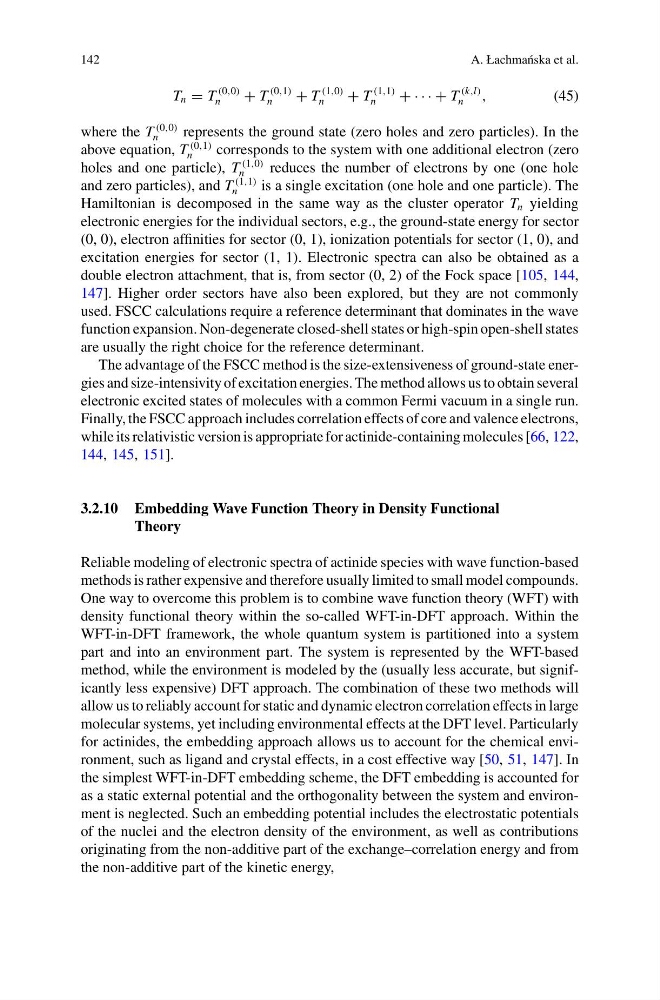
T n = T
(0,0)
n
+ T
(0,1)
n
+ T
(1,0)
n
+ T
(1,1)
n
+ · · · + T
(k,l)
n
,
(45)
where the T
(0,0)
n
represents the ground state (zero holes and zero particles). In the
above equation, T
(0,1)
n
corresponds to the system with one additional electron (zero
holes and one particle), T
(1,0)
n
reduces the number of electrons by one (one hole
and zero particles), and T
(1,1)
n
is a single excitation (one hole and one particle). The
Hamiltonian is decomposed in the same way as the cluster operator T n yielding
electronic energies for the individual sectors, e.g., the ground-state energy for sector
(0, 0), electron affinities for sector (0, 1), ionization potentials for sector (1, 0), and
excitation energies for sector (1, 1). Electronic spectra can also be obtained as a
double electron attachment, that is, from sector (0, 2) of the Fock space [105, 144,
147]. Higher order sectors have also been explored, but they are not commonly
used. FSCC calculations require a reference determinant that dominates in the wave
function expansion. Non-degenerate closed-shell states or high-spin open-shell states
are usually the right choice for the reference determinant.
The advantage of the FSCC method is the size-extensiveness of ground-state energies and size-intensivity of excitation energies. The method allows us to obtain several
electronic excited states of molecules with a common Fermi vacuum in a single run.
Finally, the FSCC approach includes correlation effects of core and valence electrons,
while its relativistic version is appropriate for actinide-containing molecules [66, 122,
144, 145, 151].
3.2.10 Embedding Wave Function Theory in Density Functional
Theory
Reliable modeling of electronic spectra of actinide species with wave function-based
methods is rather expensive and therefore usually limited to small model compounds.
One way to overcome this problem is to combine wave function theory (WFT) with
density functional theory within the so-called WFT-in-DFT approach. Within the
WFT-in-DFT framework, the whole quantum system is partitioned into a system
part and into an environment part. The system is represented by the WFT-based
method, while the environment is modeled by the (usually less accurate, but significantly less expensive) DFT approach. The combination of these two methods will
allow us to reliably account for static and dynamic electron correlation effects in large
molecular systems, yet including environmental effects at the DFT level. Particularly
for actinides, the embedding approach allows us to account for the chemical environment, such as ligand and crystal effects, in a cost effective way [50, 51, 147]. In
the simplest WFT-in-DFT embedding scheme, the DFT embedding is accounted for
as a static external potential and the orthogonality between the system and environment is neglected. Such an embedding potential includes the electrostatic potentials
of the nuclei and the electron density of the environment, as well as contributions
originating from the non-additive part of the exchange–correlation energy and from
the non-additive part of the kinetic energy,
A. Łachma´ nska et al.
T n = T
(0,0)
n
+ T
(0,1)
n
+ T
(1,0)
n
+ T
(1,1)
n
+ · · · + T
(k,l)
n
,
(45)
where the T
(0,0)
n
represents the ground state (zero holes and zero particles). In the
above equation, T
(0,1)
n
corresponds to the system with one additional electron (zero
holes and one particle), T
(1,0)
n
reduces the number of electrons by one (one hole
and zero particles), and T
(1,1)
n
is a single excitation (one hole and one particle). The
Hamiltonian is decomposed in the same way as the cluster operator T n yielding
electronic energies for the individual sectors, e.g., the ground-state energy for sector
(0, 0), electron affinities for sector (0, 1), ionization potentials for sector (1, 0), and
excitation energies for sector (1, 1). Electronic spectra can also be obtained as a
double electron attachment, that is, from sector (0, 2) of the Fock space [105, 144,
147]. Higher order sectors have also been explored, but they are not commonly
used. FSCC calculations require a reference determinant that dominates in the wave
function expansion. Non-degenerate closed-shell states or high-spin open-shell states
are usually the right choice for the reference determinant.
The advantage of the FSCC method is the size-extensiveness of ground-state energies and size-intensivity of excitation energies. The method allows us to obtain several
electronic excited states of molecules with a common Fermi vacuum in a single run.
Finally, the FSCC approach includes correlation effects of core and valence electrons,
while its relativistic version is appropriate for actinide-containing molecules [66, 122,
144, 145, 151].
3.2.10 Embedding Wave Function Theory in Density Functional
Theory
Reliable modeling of electronic spectra of actinide species with wave function-based
methods is rather expensive and therefore usually limited to small model compounds.
One way to overcome this problem is to combine wave function theory (WFT) with
density functional theory within the so-called WFT-in-DFT approach. Within the
WFT-in-DFT framework, the whole quantum system is partitioned into a system
part and into an environment part. The system is represented by the WFT-based
method, while the environment is modeled by the (usually less accurate, but significantly less expensive) DFT approach. The combination of these two methods will
allow us to reliably account for static and dynamic electron correlation effects in large
molecular systems, yet including environmental effects at the DFT level. Particularly
for actinides, the embedding approach allows us to account for the chemical environment, such as ligand and crystal effects, in a cost effective way [50, 51, 147]. In
the simplest WFT-in-DFT embedding scheme, the DFT embedding is accounted for
as a static external potential and the orthogonality between the system and environment is neglected. Such an embedding potential includes the electrostatic potentials
of the nuclei and the electron density of the environment, as well as contributions
originating from the non-additive part of the exchange–correlation energy and from
the non-additive part of the kinetic energy,