

144
A. Łachma´ nska et al.
ρ A = Tr B
Ψ
AB
Ψ
AB
(48)
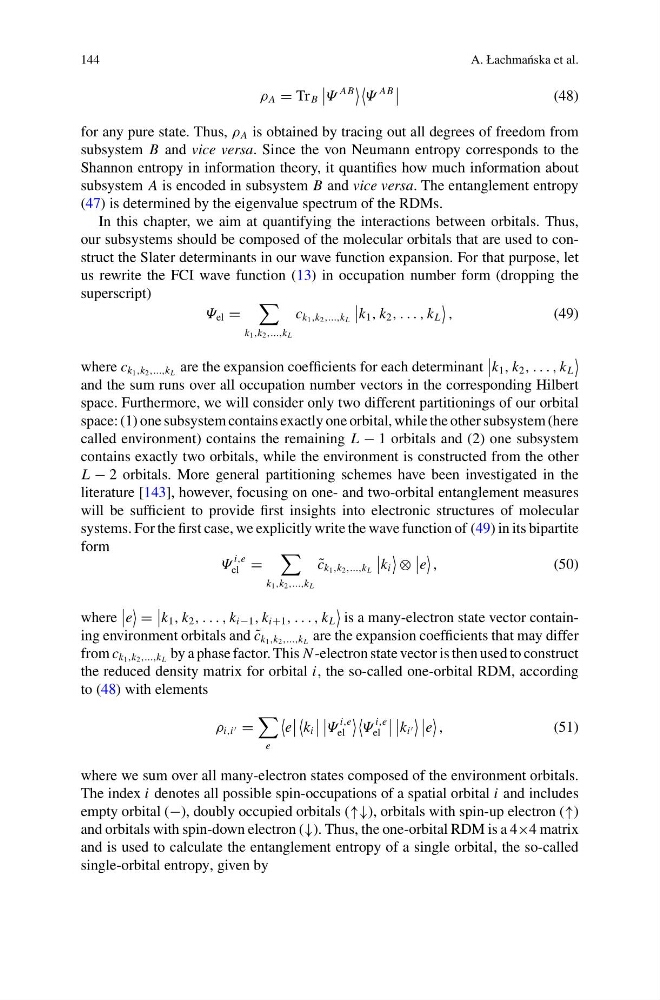
for any pure state. Thus, ρ A is obtained by tracing out all degrees of freedom from
subsystem B and vice versa. Since the von Neumann entropy corresponds to the
Shannon entropy in information theory, it quantifies how much information about
subsystem A is encoded in subsystem B and vice versa. The entanglement entropy
(47) is determined by the eigenvalue spectrum of the RDMs.
In this chapter, we aim at quantifying the interactions between orbitals. Thus,
our subsystems should be composed of the molecular orbitals that are used to construct the Slater determinants in our wave function expansion. For that purpose, let
us rewrite the FCI wave function (13) in occupation number form (dropping the
superscript)
Ψ el =
k 1 ,k 2 ,...,k L
c k 1 ,k 2 ,...,k L
k 1 , k 2 , . . . , k L
,
(49)
where c k 1 ,k 2 ,...,k L are the expansion coefficients for each determinant
k 1 , k 2 , . . . , k L
and the sum runs over all occupation number vectors in the corresponding Hilbert
space. Furthermore, we will consider only two different partitionings of our orbital
space: (1) one subsystem contains exactly one orbital, while the other subsystem (here
called environment) contains the remaining L − 1 orbitals and (2) one subsystem
contains exactly two orbitals, while the environment is constructed from the other
L − 2 orbitals. More general partitioning schemes have been investigated in the
literature [143], however, focusing on one- and two-orbital entanglement measures
will be sufficient to provide first insights into electronic structures of molecular
systems. For the first case, we explicitly write the wave function of (49) in its bipartite
form
Ψ
i,e
el =
k 1 ,k 2 ,...,k L
˜
c k 1 ,k 2 ,...,k L
k i
⊗
e
,
(50)
where
e
=
k 1 , k 2 , . . . , k i−1 , k i+1 , . . . , k L
is a many-electron state vector containing environment orbitals and ˜
c k 1 ,k 2 ,...,k L are the expansion coefficients that may differ
from c k 1 ,k 2 ,...,k L by a phase factor. This N -electron state vector is then used to construct
the reduced density matrix for orbital i, the so-called one-orbital RDM, according
to (48) with elements
ρ i,i =
e
e
k i
Ψ
i,e
el
Ψ
i,e
el
k i
e
,
(51)
where we sum over all many-electron states composed of the environment orbitals.
The index i denotes all possible spin-occupations of a spatial orbital i and includes
empty orbital (−), doubly occupied orbitals (↑↓), orbitals with spin-up electron (↑)
and orbitals with spin-down electron (↓). Thus, the one-orbital RDM is a 4×4 matrix
and is used to calculate the entanglement entropy of a single orbital, the so-called
single-orbital entropy, given by
A. Łachma´ nska et al.
ρ A = Tr B
Ψ
AB
Ψ
AB
(48)
for any pure state. Thus, ρ A is obtained by tracing out all degrees of freedom from
subsystem B and vice versa. Since the von Neumann entropy corresponds to the
Shannon entropy in information theory, it quantifies how much information about
subsystem A is encoded in subsystem B and vice versa. The entanglement entropy
(47) is determined by the eigenvalue spectrum of the RDMs.
In this chapter, we aim at quantifying the interactions between orbitals. Thus,
our subsystems should be composed of the molecular orbitals that are used to construct the Slater determinants in our wave function expansion. For that purpose, let
us rewrite the FCI wave function (13) in occupation number form (dropping the
superscript)
Ψ el =
k 1 ,k 2 ,...,k L
c k 1 ,k 2 ,...,k L
k 1 , k 2 , . . . , k L
,
(49)
where c k 1 ,k 2 ,...,k L are the expansion coefficients for each determinant
k 1 , k 2 , . . . , k L
and the sum runs over all occupation number vectors in the corresponding Hilbert
space. Furthermore, we will consider only two different partitionings of our orbital
space: (1) one subsystem contains exactly one orbital, while the other subsystem (here
called environment) contains the remaining L − 1 orbitals and (2) one subsystem
contains exactly two orbitals, while the environment is constructed from the other
L − 2 orbitals. More general partitioning schemes have been investigated in the
literature [143], however, focusing on one- and two-orbital entanglement measures
will be sufficient to provide first insights into electronic structures of molecular
systems. For the first case, we explicitly write the wave function of (49) in its bipartite
form
Ψ
i,e
el =
k 1 ,k 2 ,...,k L
˜
c k 1 ,k 2 ,...,k L
k i
⊗
e
,
(50)
where
e
=
k 1 , k 2 , . . . , k i−1 , k i+1 , . . . , k L
is a many-electron state vector containing environment orbitals and ˜
c k 1 ,k 2 ,...,k L are the expansion coefficients that may differ
from c k 1 ,k 2 ,...,k L by a phase factor. This N -electron state vector is then used to construct
the reduced density matrix for orbital i, the so-called one-orbital RDM, according
to (48) with elements
ρ i,i =
e
e
k i
Ψ
i,e
el
Ψ
i,e
el
k i
e
,
(51)
where we sum over all many-electron states composed of the environment orbitals.
The index i denotes all possible spin-occupations of a spatial orbital i and includes
empty orbital (−), doubly occupied orbitals (↑↓), orbitals with spin-up electron (↑)
and orbitals with spin-down electron (↓). Thus, the one-orbital RDM is a 4×4 matrix
and is used to calculate the entanglement entropy of a single orbital, the so-called
single-orbital entropy, given by