

136
A. Łachma´ nska et al.
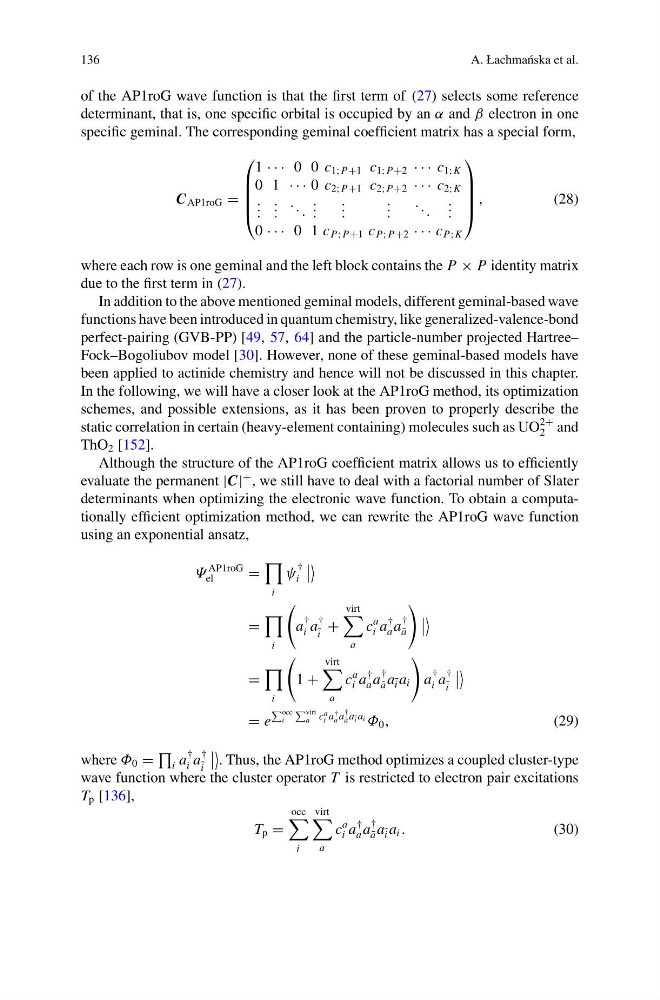
of the AP1roG wave function is that the first term of (27) selects some reference
determinant, that is, one specific orbital is occupied by an α and β electron in one
specific geminal. The corresponding geminal coefficient matrix has a special form,
C AP1roG =
⎛
⎜
⎜
⎜
⎝
1 · · · 0 0 c 1;P+1 c 1;P+2 · · · c 1;K
0 1 · · · 0 c 2;P+1 c 2;P+2 · · · c 2;K
. . .
. . .
. . .
. . .
. . .
. . .
. . .
. . .
0 · · · 0 1 c P;P+1 c P;P+2 · · · c P;K
⎞
⎟
⎟
⎟
⎠
,
(28)
where each row is one geminal and the left block contains the P × P identity matrix
due to the first term in (27).
In addition to the above mentioned geminal models, different geminal-based wave
functions have been introduced in quantum chemistry, like generalized-valence-bond
perfect-pairing (GVB-PP) [49, 57, 64] and the particle-number projected Hartree–
Fock–Bogoliubov model [30]. However, none of these geminal-based models have
been applied to actinide chemistry and hence will not be discussed in this chapter.
In the following, we will have a closer look at the AP1roG method, its optimization
schemes, and possible extensions, as it has been proven to properly describe the
static correlation in certain (heavy-element containing) molecules such as UO
2+
2 and
ThO 2 [152].
Although the structure of the AP1roG coefficient matrix allows us to efficiently
evaluate the permanent |C|
+ , we still have to deal with a factorial number of Slater
determinants when optimizing the electronic wave function. To obtain a computationally efficient optimization method, we can rewrite the AP1roG wave function
using an exponential ansatz,
Ψ
AP1roG
el
=
i
ψ
†
i
=
i
a
†
i a
†
¯
i
+
virt
a
c
a
i a
†
a a
†
¯
a
=
i
1 +
virt
a
c
a
i a
†
a a
†
¯
a a¯ i a i
a
†
i a
†
¯
i
= e
occ
i
virt
a c
a
i a
†
a a
†
¯
a a¯ i a i Φ 0 ,
(29)
where Φ 0 =
i a
†
i a
†
¯
i
. Thus, the AP1roG method optimizes a coupled cluster-type
wave function where the cluster operator T is restricted to electron pair excitations
T p [136],
T p =
occ
i
virt
a
c
a
i a
†
a a
†
¯
a a¯ i a i .
(30)
A. Łachma´ nska et al.
of the AP1roG wave function is that the first term of (27) selects some reference
determinant, that is, one specific orbital is occupied by an α and β electron in one
specific geminal. The corresponding geminal coefficient matrix has a special form,
C AP1roG =
⎛
⎜
⎜
⎜
⎝
1 · · · 0 0 c 1;P+1 c 1;P+2 · · · c 1;K
0 1 · · · 0 c 2;P+1 c 2;P+2 · · · c 2;K
. . .
. . .
. . .
. . .
. . .
. . .
. . .
. . .
0 · · · 0 1 c P;P+1 c P;P+2 · · · c P;K
⎞
⎟
⎟
⎟
⎠
,
(28)
where each row is one geminal and the left block contains the P × P identity matrix
due to the first term in (27).
In addition to the above mentioned geminal models, different geminal-based wave
functions have been introduced in quantum chemistry, like generalized-valence-bond
perfect-pairing (GVB-PP) [49, 57, 64] and the particle-number projected Hartree–
Fock–Bogoliubov model [30]. However, none of these geminal-based models have
been applied to actinide chemistry and hence will not be discussed in this chapter.
In the following, we will have a closer look at the AP1roG method, its optimization
schemes, and possible extensions, as it has been proven to properly describe the
static correlation in certain (heavy-element containing) molecules such as UO
2+
2 and
ThO 2 [152].
Although the structure of the AP1roG coefficient matrix allows us to efficiently
evaluate the permanent |C|
+ , we still have to deal with a factorial number of Slater
determinants when optimizing the electronic wave function. To obtain a computationally efficient optimization method, we can rewrite the AP1roG wave function
using an exponential ansatz,
Ψ
AP1roG
el
=
i
ψ
†
i
=
i
a
†
i a
†
¯
i
+
virt
a
c
a
i a
†
a a
†
¯
a
=
i
1 +
virt
a
c
a
i a
†
a a
†
¯
a a¯ i a i
a
†
i a
†
¯
i
= e
occ
i
virt
a c
a
i a
†
a a
†
¯
a a¯ i a i Φ 0 ,
(29)
where Φ 0 =
i a
†
i a
†
¯
i
. Thus, the AP1roG method optimizes a coupled cluster-type
wave function where the cluster operator T is restricted to electron pair excitations
T p [136],
T p =
occ
i
virt
a
c
a
i a
†
a a
†
¯
a a¯ i a i .
(30)