

New Strategies in Modeling Electronic Structures and Properties …
135
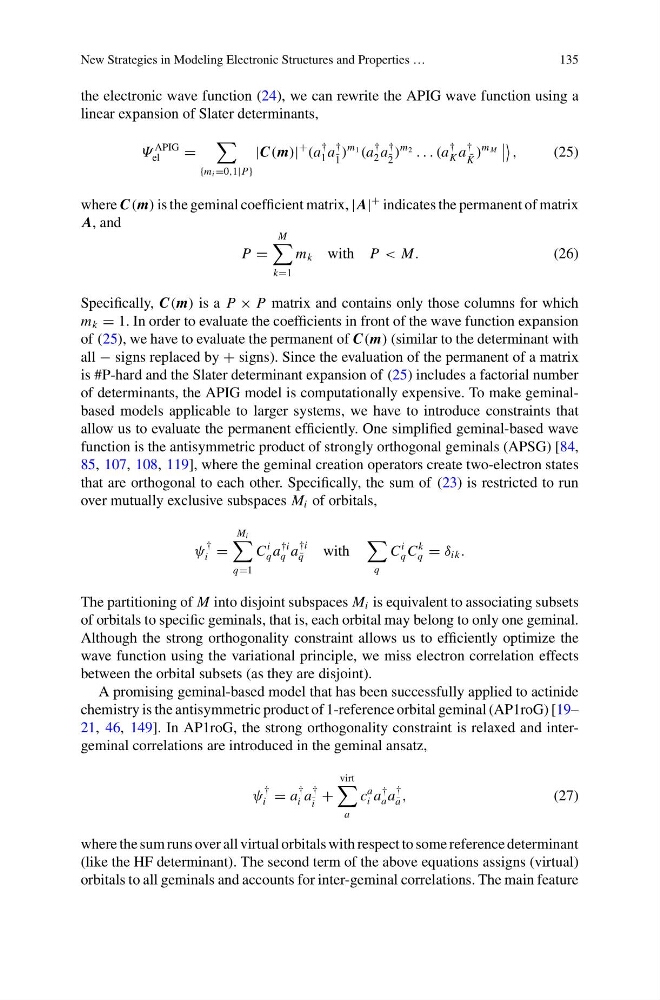
the electronic wave function (24), we can rewrite the APIG wave function using a
linear expansion of Slater determinants,
Ψ
APIG
el
=
{m i =0,1|P}
|C(m)|
+
(a
†
1 a
†
¯
1
)
m 1 (a
†
2 a
†
¯
2
)
m 2 . . . (a
†
K a
†
¯
K
)
m M
,
(25)
where C(m) is the geminal coefficient matrix, | A|
+ indicates the permanent of matrix
A, and
P =
M
k=1
m k with P < M.
(26)
Specifically, C(m) is a P × P matrix and contains only those columns for which
m k = 1. In order to evaluate the coefficients in front of the wave function expansion
of (25), we have to evaluate the permanent of C(m) (similar to the determinant with
all − signs replaced by + signs). Since the evaluation of the permanent of a matrix
is #P-hard and the Slater determinant expansion of (25) includes a factorial number
of determinants, the APIG model is computationally expensive. To make geminalbased models applicable to larger systems, we have to introduce constraints that
allow us to evaluate the permanent efficiently. One simplified geminal-based wave
function is the antisymmetric product of strongly orthogonal geminals (APSG) [84,
85, 107, 108, 119], where the geminal creation operators create two-electron states
that are orthogonal to each other. Specifically, the sum of (23) is restricted to run
over mutually exclusive subspaces M i of orbitals,
ψ
†
i =
M i
q=1
C
i
q a
†i
q a
†i
¯
q
with
q
C
i
q C
k
q = δ ik .
The partitioning of M into disjoint subspaces M i is equivalent to associating subsets
of orbitals to specific geminals, that is, each orbital may belong to only one geminal.
Although the strong orthogonality constraint allows us to efficiently optimize the
wave function using the variational principle, we miss electron correlation effects
between the orbital subsets (as they are disjoint).
A promising geminal-based model that has been successfully applied to actinide
chemistry is the antisymmetric product of 1-reference orbital geminal (AP1roG) [19–
21, 46, 149]. In AP1roG, the strong orthogonality constraint is relaxed and intergeminal correlations are introduced in the geminal ansatz,
ψ
†
i = a
†
i a
†
¯
i
+
virt
a
c
a
i a
†
a a
†
¯
a ,
(27)
where the sum runs over all virtual orbitals with respect to some reference determinant
(like the HF determinant). The second term of the above equations assigns (virtual)
orbitals to all geminals and accounts for inter-geminal correlations. The main feature
135
the electronic wave function (24), we can rewrite the APIG wave function using a
linear expansion of Slater determinants,
Ψ
APIG
el
=
{m i =0,1|P}
|C(m)|
+
(a
†
1 a
†
¯
1
)
m 1 (a
†
2 a
†
¯
2
)
m 2 . . . (a
†
K a
†
¯
K
)
m M
,
(25)
where C(m) is the geminal coefficient matrix, | A|
+ indicates the permanent of matrix
A, and
P =
M
k=1
m k with P < M.
(26)
Specifically, C(m) is a P × P matrix and contains only those columns for which
m k = 1. In order to evaluate the coefficients in front of the wave function expansion
of (25), we have to evaluate the permanent of C(m) (similar to the determinant with
all − signs replaced by + signs). Since the evaluation of the permanent of a matrix
is #P-hard and the Slater determinant expansion of (25) includes a factorial number
of determinants, the APIG model is computationally expensive. To make geminalbased models applicable to larger systems, we have to introduce constraints that
allow us to evaluate the permanent efficiently. One simplified geminal-based wave
function is the antisymmetric product of strongly orthogonal geminals (APSG) [84,
85, 107, 108, 119], where the geminal creation operators create two-electron states
that are orthogonal to each other. Specifically, the sum of (23) is restricted to run
over mutually exclusive subspaces M i of orbitals,
ψ
†
i =
M i
q=1
C
i
q a
†i
q a
†i
¯
q
with
q
C
i
q C
k
q = δ ik .
The partitioning of M into disjoint subspaces M i is equivalent to associating subsets
of orbitals to specific geminals, that is, each orbital may belong to only one geminal.
Although the strong orthogonality constraint allows us to efficiently optimize the
wave function using the variational principle, we miss electron correlation effects
between the orbital subsets (as they are disjoint).
A promising geminal-based model that has been successfully applied to actinide
chemistry is the antisymmetric product of 1-reference orbital geminal (AP1roG) [19–
21, 46, 149]. In AP1roG, the strong orthogonality constraint is relaxed and intergeminal correlations are introduced in the geminal ansatz,
ψ
†
i = a
†
i a
†
¯
i
+
virt
a
c
a
i a
†
a a
†
¯
a ,
(27)
where the sum runs over all virtual orbitals with respect to some reference determinant
(like the HF determinant). The second term of the above equations assigns (virtual)
orbitals to all geminals and accounts for inter-geminal correlations. The main feature