

New Strategies in Modeling Electronic Structures and Properties …
137
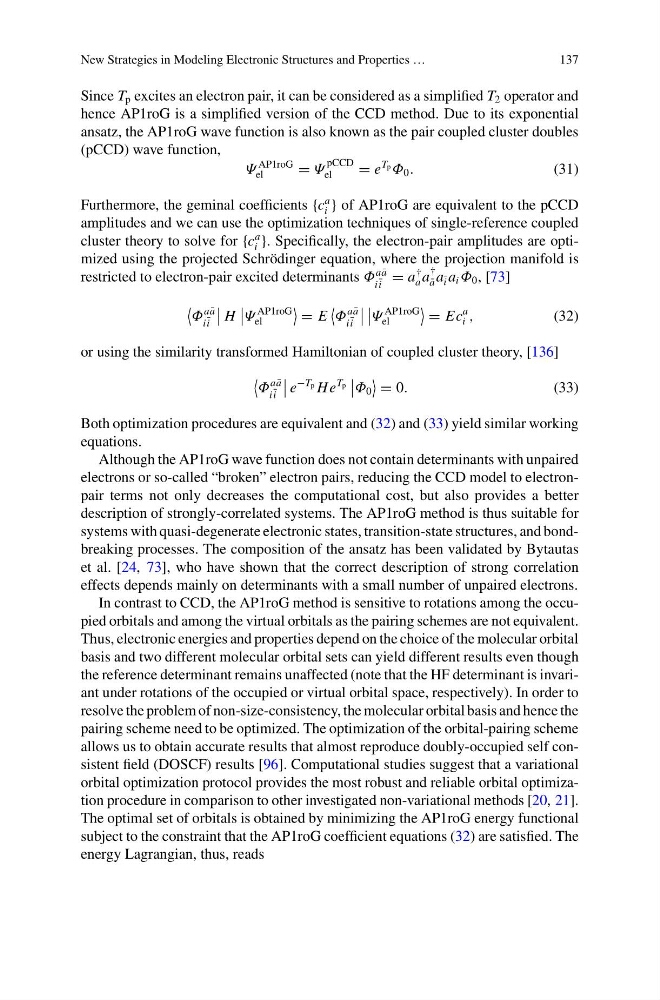
Since T p excites an electron pair, it can be considered as a simplified T 2 operator and
hence AP1roG is a simplified version of the CCD method. Due to its exponential
ansatz, the AP1roG wave function is also known as the pair coupled cluster doubles
(pCCD) wave function,
Ψ
AP1roG
el
= Ψ
pCCD
el
= e
T p Φ 0 .
(31)
Furthermore, the geminal coefficients {c
a
i } of AP1roG are equivalent to the pCCD
amplitudes and we can use the optimization techniques of single-reference coupled
cluster theory to solve for {c
a
i }. Specifically, the electron-pair amplitudes are optimized using the projected Schrödinger equation, where the projection manifold is
restricted to electron-pair excited determinants Φ
a ¯
a
i ¯
i
= a
†
a a
†
¯
a a¯ i a i Φ 0 , [73]
Φ
a ¯
a
i ¯
i
H
Ψ
AP1roG
el
= E
Φ
a ¯
a
i ¯
i
Ψ
AP1roG
el
= Ec
a
i ,
(32)
or using the similarity transformed Hamiltonian of coupled cluster theory, [136]
Φ
a ¯
a
i ¯
i
e
−T p He
T p
Φ 0
= 0.
(33)
Both optimization procedures are equivalent and (32) and (33) yield similar working
equations.
Although the AP1roG wave function does not contain determinants with unpaired
electrons or so-called “broken” electron pairs, reducing the CCD model to electronpair terms not only decreases the computational cost, but also provides a better
description of strongly-correlated systems. The AP1roG method is thus suitable for
systems with quasi-degenerate electronic states, transition-state structures, and bondbreaking processes. The composition of the ansatz has been validated by Bytautas
et al. [24, 73], who have shown that the correct description of strong correlation
effects depends mainly on determinants with a small number of unpaired electrons.
In contrast to CCD, the AP1roG method is sensitive to rotations among the occupied orbitals and among the virtual orbitals as the pairing schemes are not equivalent.
Thus, electronic energies and properties depend on the choice of the molecular orbital
basis and two different molecular orbital sets can yield different results even though
the reference determinant remains unaffected (note that the HF determinant is invariant under rotations of the occupied or virtual orbital space, respectively). In order to
resolve the problem of non-size-consistency, the molecular orbital basis and hence the
pairing scheme need to be optimized. The optimization of the orbital-pairing scheme
allows us to obtain accurate results that almost reproduce doubly-occupied self consistent field (DOSCF) results [96]. Computational studies suggest that a variational
orbital optimization protocol provides the most robust and reliable orbital optimization procedure in comparison to other investigated non-variational methods [20, 21].
The optimal set of orbitals is obtained by minimizing the AP1roG energy functional
subject to the constraint that the AP1roG coefficient equations (32) are satisfied. The
energy Lagrangian, thus, reads
137
Since T p excites an electron pair, it can be considered as a simplified T 2 operator and
hence AP1roG is a simplified version of the CCD method. Due to its exponential
ansatz, the AP1roG wave function is also known as the pair coupled cluster doubles
(pCCD) wave function,
Ψ
AP1roG
el
= Ψ
pCCD
el
= e
T p Φ 0 .
(31)
Furthermore, the geminal coefficients {c
a
i } of AP1roG are equivalent to the pCCD
amplitudes and we can use the optimization techniques of single-reference coupled
cluster theory to solve for {c
a
i }. Specifically, the electron-pair amplitudes are optimized using the projected Schrödinger equation, where the projection manifold is
restricted to electron-pair excited determinants Φ
a ¯
a
i ¯
i
= a
†
a a
†
¯
a a¯ i a i Φ 0 , [73]
Φ
a ¯
a
i ¯
i
H
Ψ
AP1roG
el
= E
Φ
a ¯
a
i ¯
i
Ψ
AP1roG
el
= Ec
a
i ,
(32)
or using the similarity transformed Hamiltonian of coupled cluster theory, [136]
Φ
a ¯
a
i ¯
i
e
−T p He
T p
Φ 0
= 0.
(33)
Both optimization procedures are equivalent and (32) and (33) yield similar working
equations.
Although the AP1roG wave function does not contain determinants with unpaired
electrons or so-called “broken” electron pairs, reducing the CCD model to electronpair terms not only decreases the computational cost, but also provides a better
description of strongly-correlated systems. The AP1roG method is thus suitable for
systems with quasi-degenerate electronic states, transition-state structures, and bondbreaking processes. The composition of the ansatz has been validated by Bytautas
et al. [24, 73], who have shown that the correct description of strong correlation
effects depends mainly on determinants with a small number of unpaired electrons.
In contrast to CCD, the AP1roG method is sensitive to rotations among the occupied orbitals and among the virtual orbitals as the pairing schemes are not equivalent.
Thus, electronic energies and properties depend on the choice of the molecular orbital
basis and two different molecular orbital sets can yield different results even though
the reference determinant remains unaffected (note that the HF determinant is invariant under rotations of the occupied or virtual orbital space, respectively). In order to
resolve the problem of non-size-consistency, the molecular orbital basis and hence the
pairing scheme need to be optimized. The optimization of the orbital-pairing scheme
allows us to obtain accurate results that almost reproduce doubly-occupied self consistent field (DOSCF) results [96]. Computational studies suggest that a variational
orbital optimization protocol provides the most robust and reliable orbital optimization procedure in comparison to other investigated non-variational methods [20, 21].
The optimal set of orbitals is obtained by minimizing the AP1roG energy functional
subject to the constraint that the AP1roG coefficient equations (32) are satisfied. The
energy Lagrangian, thus, reads