

132
A. Łachma´ nska et al.
procedures might be ineffective as actinide complexes feature many quasi-degenerate
orbitals and it remains ambiguous which metal and ligand orbitals have to be included
in the active space. Novel approaches based on quantum information theory allow
us to identify the chemically most important orbitals and can be applied to develop
a black-box like selection procedure of active spaces for MCSCF-type calculations.
Such an approach will be discussed in Sect. 3.2.11. The CASSCF method removes
the problem of (quasi-)degeneracies and allows us to model static correlation effects.
However, it does not account for dynamical correlation effects attributed to electron
excitations beyond the active space orbitals. CASSCF, thus, provides a spin-adapted
zero-order wave function, where dynamical and core-valence electron correlation
can be added using various a posteriori corrections such as complete-active-space
second-order perturbation theory (CASPT2) [3, 4] or multi-reference configurationinteraction (MRCI) [115].
3.2.5 The Density Matrix Renormalization Group
The density matrix renormalization group (DMRG) [25, 77, 90, 91, 99, 131, 142,
166, 170] algorithm represents a computationally efficient variant of MCSCF theory
where the evaluation of the electronic energy scales only polynomially with system
size. Due to its low computational scaling, the DMRG protocol allows us to approach
the FCI limit of an N -particle Hilbert space constructed from L orbitals for large
molecules, where FCI calculations are computationally unfeasible. In contrast to
conventional ab initio methods, DMRG optimizes a special type of quantum states,
so-called matrix product states (MPS), that allow us to efficiently reparameterize the
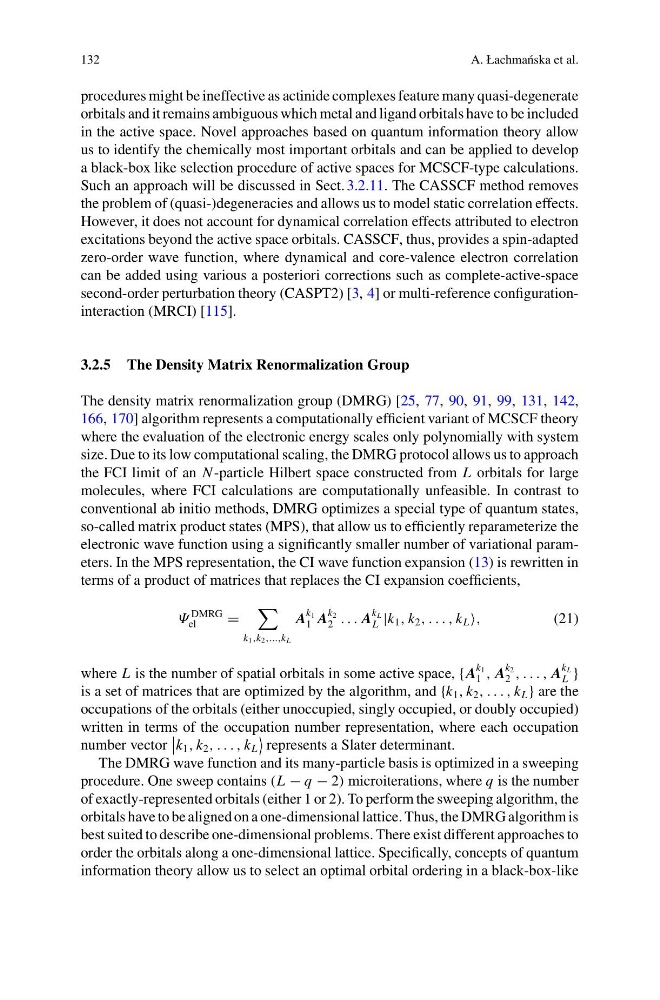
electronic wave function using a significantly smaller number of variational parameters. In the MPS representation, the CI wave function expansion (13) is rewritten in
terms of a product of matrices that replaces the CI expansion coefficients,
Ψ
DMRG
el
=
k 1 ,k 2 ,...,k L
A
k 1
1 A
k 2
2 . . . A
k L
L |k 1 , k 2 , . . . , k L ,
(21)
where L is the number of spatial orbitals in some active space, { A
k 1
1 , A
k 2
2 , . . . , A
k L
L }
is a set of matrices that are optimized by the algorithm, and {k 1 , k 2 , . . . , k L } are the
occupations of the orbitals (either unoccupied, singly occupied, or doubly occupied)
written in terms of the occupation number representation, where each occupation
number vector
k 1 , k 2 , . . . , k L
represents a Slater determinant.
The DMRG wave function and its many-particle basis is optimized in a sweeping
procedure. One sweep contains (L − q − 2) microiterations, where q is the number
of exactly-represented orbitals (either 1 or 2). To perform the sweeping algorithm, the
orbitals have to be aligned on a one-dimensional lattice. Thus, the DMRG algorithm is
best suited to describe one-dimensional problems. There exist different approaches to
order the orbitals along a one-dimensional lattice. Specifically, concepts of quantum
information theory allow us to select an optimal orbital ordering in a black-box-like
A. Łachma´ nska et al.
procedures might be ineffective as actinide complexes feature many quasi-degenerate
orbitals and it remains ambiguous which metal and ligand orbitals have to be included
in the active space. Novel approaches based on quantum information theory allow
us to identify the chemically most important orbitals and can be applied to develop
a black-box like selection procedure of active spaces for MCSCF-type calculations.
Such an approach will be discussed in Sect. 3.2.11. The CASSCF method removes
the problem of (quasi-)degeneracies and allows us to model static correlation effects.
However, it does not account for dynamical correlation effects attributed to electron
excitations beyond the active space orbitals. CASSCF, thus, provides a spin-adapted
zero-order wave function, where dynamical and core-valence electron correlation
can be added using various a posteriori corrections such as complete-active-space
second-order perturbation theory (CASPT2) [3, 4] or multi-reference configurationinteraction (MRCI) [115].
3.2.5 The Density Matrix Renormalization Group
The density matrix renormalization group (DMRG) [25, 77, 90, 91, 99, 131, 142,
166, 170] algorithm represents a computationally efficient variant of MCSCF theory
where the evaluation of the electronic energy scales only polynomially with system
size. Due to its low computational scaling, the DMRG protocol allows us to approach
the FCI limit of an N -particle Hilbert space constructed from L orbitals for large
molecules, where FCI calculations are computationally unfeasible. In contrast to
conventional ab initio methods, DMRG optimizes a special type of quantum states,
so-called matrix product states (MPS), that allow us to efficiently reparameterize the
electronic wave function using a significantly smaller number of variational parameters. In the MPS representation, the CI wave function expansion (13) is rewritten in
terms of a product of matrices that replaces the CI expansion coefficients,
Ψ
DMRG
el
=
k 1 ,k 2 ,...,k L
A
k 1
1 A
k 2
2 . . . A
k L
L |k 1 , k 2 , . . . , k L ,
(21)
where L is the number of spatial orbitals in some active space, { A
k 1
1 , A
k 2
2 , . . . , A
k L
L }
is a set of matrices that are optimized by the algorithm, and {k 1 , k 2 , . . . , k L } are the
occupations of the orbitals (either unoccupied, singly occupied, or doubly occupied)
written in terms of the occupation number representation, where each occupation
number vector
k 1 , k 2 , . . . , k L
represents a Slater determinant.
The DMRG wave function and its many-particle basis is optimized in a sweeping
procedure. One sweep contains (L − q − 2) microiterations, where q is the number
of exactly-represented orbitals (either 1 or 2). To perform the sweeping algorithm, the
orbitals have to be aligned on a one-dimensional lattice. Thus, the DMRG algorithm is
best suited to describe one-dimensional problems. There exist different approaches to
order the orbitals along a one-dimensional lattice. Specifically, concepts of quantum
information theory allow us to select an optimal orbital ordering in a black-box-like