

New Strategies in Modeling Electronic Structures and Properties …
131
that allow us to model strongly-correlated quantum states within a single-reference
framework. Examples are spin-flip CC [80] and pair-CCD [136].
3.2.4 Multi-reference Complete Active Space Self-consistent Field
Theory
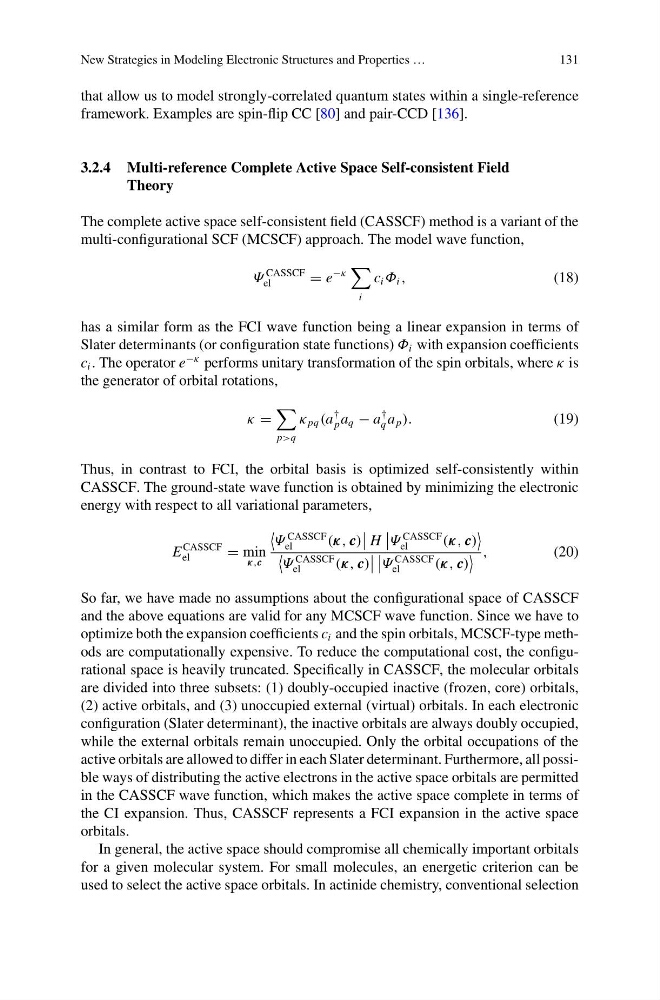
The complete active space self-consistent field (CASSCF) method is a variant of the
multi-configurational SCF (MCSCF) approach. The model wave function,
Ψ
CASSCF
el
= e
−κ
i
c i Φ i ,
(18)
has a similar form as the FCI wave function being a linear expansion in terms of
Slater determinants (or configuration state functions) Φ i with expansion coefficients
c i . The operator e
−κ performs unitary transformation of the spin orbitals, where κ is
the generator of orbital rotations,
κ =
p>q
κ pq (a
†
p a q − a
†
q a p ).
(19)
Thus, in contrast to FCI, the orbital basis is optimized self-consistently within
CASSCF. The ground-state wave function is obtained by minimizing the electronic
energy with respect to all variational parameters,
E
CASSCF
el
= min
κ,c
Ψ
CASSCF
el
(κ, c)
H
Ψ
CASSCF
el
(κ, c)
Ψ
CASSCF
el
(κ, c)
Ψ
CASSCF
el
(κ, c)
,
(20)
So far, we have made no assumptions about the configurational space of CASSCF
and the above equations are valid for any MCSCF wave function. Since we have to
optimize both the expansion coefficients c i and the spin orbitals, MCSCF-type methods are computationally expensive. To reduce the computational cost, the configurational space is heavily truncated. Specifically in CASSCF, the molecular orbitals
are divided into three subsets: (1) doubly-occupied inactive (frozen, core) orbitals,
(2) active orbitals, and (3) unoccupied external (virtual) orbitals. In each electronic
configuration (Slater determinant), the inactive orbitals are always doubly occupied,
while the external orbitals remain unoccupied. Only the orbital occupations of the
active orbitals are allowed to differ in each Slater determinant. Furthermore, all possible ways of distributing the active electrons in the active space orbitals are permitted
in the CASSCF wave function, which makes the active space complete in terms of
the CI expansion. Thus, CASSCF represents a FCI expansion in the active space
orbitals.
In general, the active space should compromise all chemically important orbitals
for a given molecular system. For small molecules, an energetic criterion can be
used to select the active space orbitals. In actinide chemistry, conventional selection
131
that allow us to model strongly-correlated quantum states within a single-reference
framework. Examples are spin-flip CC [80] and pair-CCD [136].
3.2.4 Multi-reference Complete Active Space Self-consistent Field
Theory
The complete active space self-consistent field (CASSCF) method is a variant of the
multi-configurational SCF (MCSCF) approach. The model wave function,
Ψ
CASSCF
el
= e
−κ
i
c i Φ i ,
(18)
has a similar form as the FCI wave function being a linear expansion in terms of
Slater determinants (or configuration state functions) Φ i with expansion coefficients
c i . The operator e
−κ performs unitary transformation of the spin orbitals, where κ is
the generator of orbital rotations,
κ =
p>q
κ pq (a
†
p a q − a
†
q a p ).
(19)
Thus, in contrast to FCI, the orbital basis is optimized self-consistently within
CASSCF. The ground-state wave function is obtained by minimizing the electronic
energy with respect to all variational parameters,
E
CASSCF
el
= min
κ,c
Ψ
CASSCF
el
(κ, c)
H
Ψ
CASSCF
el
(κ, c)
Ψ
CASSCF
el
(κ, c)
Ψ
CASSCF
el
(κ, c)
,
(20)
So far, we have made no assumptions about the configurational space of CASSCF
and the above equations are valid for any MCSCF wave function. Since we have to
optimize both the expansion coefficients c i and the spin orbitals, MCSCF-type methods are computationally expensive. To reduce the computational cost, the configurational space is heavily truncated. Specifically in CASSCF, the molecular orbitals
are divided into three subsets: (1) doubly-occupied inactive (frozen, core) orbitals,
(2) active orbitals, and (3) unoccupied external (virtual) orbitals. In each electronic
configuration (Slater determinant), the inactive orbitals are always doubly occupied,
while the external orbitals remain unoccupied. Only the orbital occupations of the
active orbitals are allowed to differ in each Slater determinant. Furthermore, all possible ways of distributing the active electrons in the active space orbitals are permitted
in the CASSCF wave function, which makes the active space complete in terms of
the CI expansion. Thus, CASSCF represents a FCI expansion in the active space
orbitals.
In general, the active space should compromise all chemically important orbitals
for a given molecular system. For small molecules, an energetic criterion can be
used to select the active space orbitals. In actinide chemistry, conventional selection