

New Strategies in Modeling Electronic Structures and Properties …
129
we obtain the so-called Full Configuration Interaction expansion (for a given finite
basis with K orbitals), where c k are some expansion coefficients.
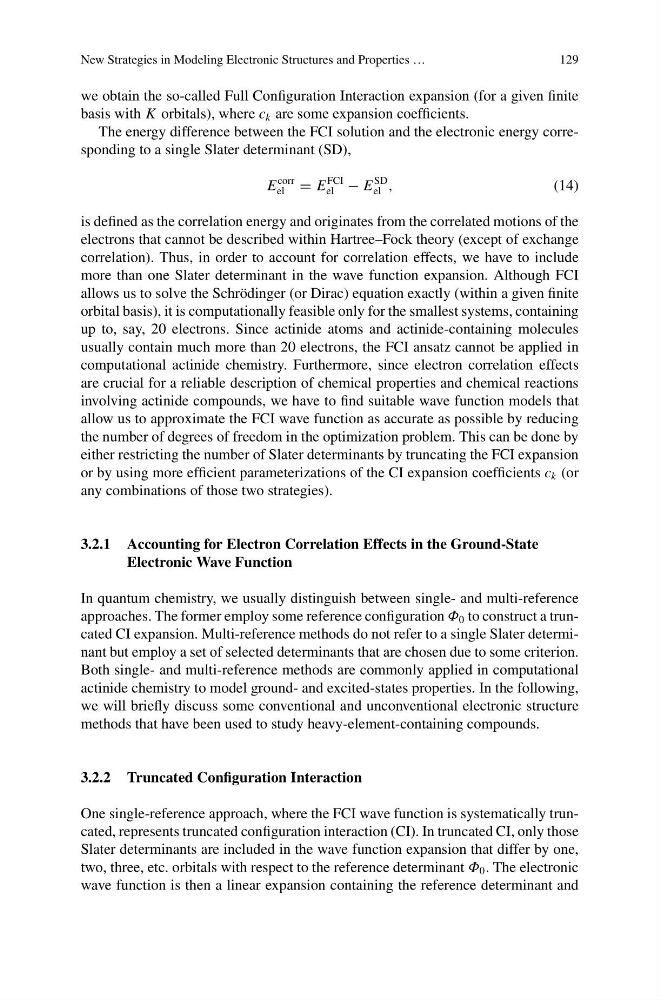
The energy difference between the FCI solution and the electronic energy corresponding to a single Slater determinant (SD),
E
corr
el = E
FCI
el − E
SD
el ,
(14)
is defined as the correlation energy and originates from the correlated motions of the
electrons that cannot be described within Hartree–Fock theory (except of exchange
correlation). Thus, in order to account for correlation effects, we have to include
more than one Slater determinant in the wave function expansion. Although FCI
allows us to solve the Schrödinger (or Dirac) equation exactly (within a given finite
orbital basis), it is computationally feasible only for the smallest systems, containing
up to, say, 20 electrons. Since actinide atoms and actinide-containing molecules
usually contain much more than 20 electrons, the FCI ansatz cannot be applied in
computational actinide chemistry. Furthermore, since electron correlation effects
are crucial for a reliable description of chemical properties and chemical reactions
involving actinide compounds, we have to find suitable wave function models that
allow us to approximate the FCI wave function as accurate as possible by reducing
the number of degrees of freedom in the optimization problem. This can be done by
either restricting the number of Slater determinants by truncating the FCI expansion
or by using more efficient parameterizations of the CI expansion coefficients c k (or
any combinations of those two strategies).
3.2.1 Accounting for Electron Correlation Effects in the Ground-State
Electronic Wave Function
In quantum chemistry, we usually distinguish between single- and multi-reference
approaches. The former employ some reference configuration Φ 0 to construct a truncated CI expansion. Multi-reference methods do not refer to a single Slater determinant but employ a set of selected determinants that are chosen due to some criterion.
Both single- and multi-reference methods are commonly applied in computational
actinide chemistry to model ground- and excited-states properties. In the following,
we will briefly discuss some conventional and unconventional electronic structure
methods that have been used to study heavy-element-containing compounds.
3.2.2 Truncated Configuration Interaction
One single-reference approach, where the FCI wave function is systematically truncated, represents truncated configuration interaction (CI). In truncated CI, only those
Slater determinants are included in the wave function expansion that differ by one,
two, three, etc. orbitals with respect to the reference determinant Φ 0 . The electronic
wave function is then a linear expansion containing the reference determinant and
129
we obtain the so-called Full Configuration Interaction expansion (for a given finite
basis with K orbitals), where c k are some expansion coefficients.
The energy difference between the FCI solution and the electronic energy corresponding to a single Slater determinant (SD),
E
corr
el = E
FCI
el − E
SD
el ,
(14)
is defined as the correlation energy and originates from the correlated motions of the
electrons that cannot be described within Hartree–Fock theory (except of exchange
correlation). Thus, in order to account for correlation effects, we have to include
more than one Slater determinant in the wave function expansion. Although FCI
allows us to solve the Schrödinger (or Dirac) equation exactly (within a given finite
orbital basis), it is computationally feasible only for the smallest systems, containing
up to, say, 20 electrons. Since actinide atoms and actinide-containing molecules
usually contain much more than 20 electrons, the FCI ansatz cannot be applied in
computational actinide chemistry. Furthermore, since electron correlation effects
are crucial for a reliable description of chemical properties and chemical reactions
involving actinide compounds, we have to find suitable wave function models that
allow us to approximate the FCI wave function as accurate as possible by reducing
the number of degrees of freedom in the optimization problem. This can be done by
either restricting the number of Slater determinants by truncating the FCI expansion
or by using more efficient parameterizations of the CI expansion coefficients c k (or
any combinations of those two strategies).
3.2.1 Accounting for Electron Correlation Effects in the Ground-State
Electronic Wave Function
In quantum chemistry, we usually distinguish between single- and multi-reference
approaches. The former employ some reference configuration Φ 0 to construct a truncated CI expansion. Multi-reference methods do not refer to a single Slater determinant but employ a set of selected determinants that are chosen due to some criterion.
Both single- and multi-reference methods are commonly applied in computational
actinide chemistry to model ground- and excited-states properties. In the following,
we will briefly discuss some conventional and unconventional electronic structure
methods that have been used to study heavy-element-containing compounds.
3.2.2 Truncated Configuration Interaction
One single-reference approach, where the FCI wave function is systematically truncated, represents truncated configuration interaction (CI). In truncated CI, only those
Slater determinants are included in the wave function expansion that differ by one,
two, three, etc. orbitals with respect to the reference determinant Φ 0 . The electronic
wave function is then a linear expansion containing the reference determinant and