

128
A. Łachma´ nska et al.
computationally inexpensive and fast to compute, RECPs provide reliable results if
spin-orbit coupling is negligible. Spin–orbit corrections can be added a posteriori on
top of RECP [37, 168].
3.2 Solving the Electronic Problem
Since the Schrödinger or Dirac equation cannot be solved exactly for many-electron
systems, many approximate methods have been introduced to quantum chemistry
that aim at solving the electronic problem as accurately as possible. The simplest—
and probably the most important—model is the molecular orbital approximation,
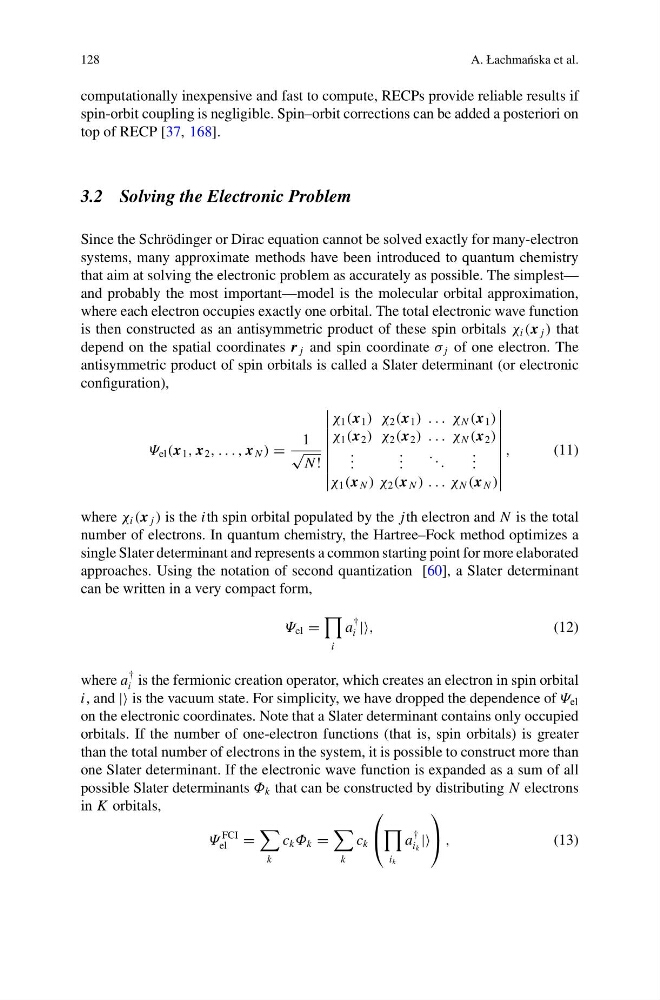
where each electron occupies exactly one orbital. The total electronic wave function
is then constructed as an antisymmetric product of these spin orbitals χ i (x j ) that
depend on the spatial coordinates r j and spin coordinate σ j of one electron. The
antisymmetric product of spin orbitals is called a Slater determinant (or electronic
configuration),
Ψ el (x 1 , x 2 , . . . , x N ) =
1
√
N !
χ 1 (x 1 ) χ 2 (x 1 ) . . . χ N (x 1 )
χ 1 (x 2 ) χ 2 (x 2 ) . . . χ N (x 2 )
. . .
. . .
. . .
. . .
χ 1 (x N ) χ 2 (x N ) . . . χ N (x N )
,
(11)
where χ i (x j ) is the ith spin orbital populated by the jth electron and N is the total
number of electrons. In quantum chemistry, the Hartree–Fock method optimizes a
single Slater determinant and represents a common starting point for more elaborated
approaches. Using the notation of second quantization [60], a Slater determinant
can be written in a very compact form,
Ψ el =
i
a
†
i ||,
(12)
where a
†
i is the fermionic creation operator, which creates an electron in spin orbital
i, and || is the vacuum state. For simplicity, we have dropped the dependence of Ψ el
on the electronic coordinates. Note that a Slater determinant contains only occupied
orbitals. If the number of one-electron functions (that is, spin orbitals) is greater
than the total number of electrons in the system, it is possible to construct more than
one Slater determinant. If the electronic wave function is expanded as a sum of all
possible Slater determinants Φ k that can be constructed by distributing N electrons
in K orbitals,
Ψ
FCI
el
=
k
c k Φ k =
k
c k
⎛
⎝
i k
a
†
i k
||
⎞
⎠ ,
(13)
A. Łachma´ nska et al.
computationally inexpensive and fast to compute, RECPs provide reliable results if
spin-orbit coupling is negligible. Spin–orbit corrections can be added a posteriori on
top of RECP [37, 168].
3.2 Solving the Electronic Problem
Since the Schrödinger or Dirac equation cannot be solved exactly for many-electron
systems, many approximate methods have been introduced to quantum chemistry
that aim at solving the electronic problem as accurately as possible. The simplest—
and probably the most important—model is the molecular orbital approximation,
where each electron occupies exactly one orbital. The total electronic wave function
is then constructed as an antisymmetric product of these spin orbitals χ i (x j ) that
depend on the spatial coordinates r j and spin coordinate σ j of one electron. The
antisymmetric product of spin orbitals is called a Slater determinant (or electronic
configuration),
Ψ el (x 1 , x 2 , . . . , x N ) =
1
√
N !
χ 1 (x 1 ) χ 2 (x 1 ) . . . χ N (x 1 )
χ 1 (x 2 ) χ 2 (x 2 ) . . . χ N (x 2 )
. . .
. . .
. . .
. . .
χ 1 (x N ) χ 2 (x N ) . . . χ N (x N )
,
(11)
where χ i (x j ) is the ith spin orbital populated by the jth electron and N is the total
number of electrons. In quantum chemistry, the Hartree–Fock method optimizes a
single Slater determinant and represents a common starting point for more elaborated
approaches. Using the notation of second quantization [60], a Slater determinant
can be written in a very compact form,
Ψ el =
i
a
†
i ||,
(12)
where a
†
i is the fermionic creation operator, which creates an electron in spin orbital
i, and || is the vacuum state. For simplicity, we have dropped the dependence of Ψ el
on the electronic coordinates. Note that a Slater determinant contains only occupied
orbitals. If the number of one-electron functions (that is, spin orbitals) is greater
than the total number of electrons in the system, it is possible to construct more than
one Slater determinant. If the electronic wave function is expanded as a sum of all
possible Slater determinants Φ k that can be constructed by distributing N electrons
in K orbitals,
Ψ
FCI
el
=
k
c k Φ k =
k
c k
⎛
⎝
i k
a
†
i k
||
⎞
⎠ ,
(13)