

New Strategies in Modeling Electronic Structures and Properties …
125
H fp ψ(x) =
c
3
n=1
α n p n + βc
2
ψ(x) = Eψ(x),
(3)
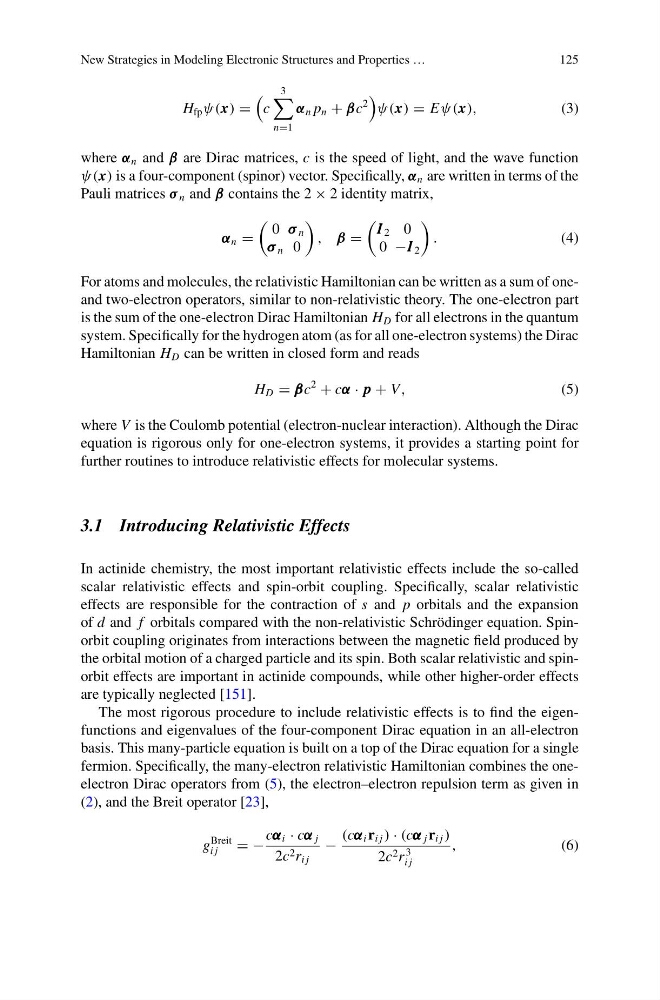
where α n and β are Dirac matrices, c is the speed of light, and the wave function
ψ(x) is a four-component (spinor) vector. Specifically, α n are written in terms of the
Pauli matrices σ n and β contains the 2 × 2 identity matrix,
α α α n =
0 σ σ σ n
σ σ σ n 0
, β β β =
I I I 2 0
0 −I I I 2
.
(4)
For atoms and molecules, the relativistic Hamiltonian can be written as a sum of oneand two-electron operators, similar to non-relativistic theory. The one-electron part
is the sum of the one-electron Dirac Hamiltonian H D for all electrons in the quantum
system. Specifically for the hydrogen atom (as for all one-electron systems) the Dirac
Hamiltonian H D can be written in closed form and reads
H D = β β βc
2
+ cα α α · p p p + V,
(5)
where V is the Coulomb potential (electron-nuclear interaction). Although the Dirac
equation is rigorous only for one-electron systems, it provides a starting point for
further routines to introduce relativistic effects for molecular systems.
3.1 Introducing Relativistic Effects
In actinide chemistry, the most important relativistic effects include the so-called
scalar relativistic effects and spin-orbit coupling. Specifically, scalar relativistic
effects are responsible for the contraction of s and p orbitals and the expansion
of d and f orbitals compared with the non-relativistic Schrödinger equation. Spinorbit coupling originates from interactions between the magnetic field produced by
the orbital motion of a charged particle and its spin. Both scalar relativistic and spinorbit effects are important in actinide compounds, while other higher-order effects
are typically neglected [151].
The most rigorous procedure to include relativistic effects is to find the eigenfunctions and eigenvalues of the four-component Dirac equation in an all-electron
basis. This many-particle equation is built on a top of the Dirac equation for a single
fermion. Specifically, the many-electron relativistic Hamiltonian combines the oneelectron Dirac operators from (5), the electron–electron repulsion term as given in
(2), and the Breit operator [23],
g
Breit
i j
= −
cα α α i · cα α α j
2c 2 r i j
−
(cα α α i r i j ) · (cα α α j r i j )
2c 2 r
3
i j
,
(6)
125
H fp ψ(x) =
c
3
n=1
α n p n + βc
2
ψ(x) = Eψ(x),
(3)
where α n and β are Dirac matrices, c is the speed of light, and the wave function
ψ(x) is a four-component (spinor) vector. Specifically, α n are written in terms of the
Pauli matrices σ n and β contains the 2 × 2 identity matrix,
α α α n =
0 σ σ σ n
σ σ σ n 0
, β β β =
I I I 2 0
0 −I I I 2
.
(4)
For atoms and molecules, the relativistic Hamiltonian can be written as a sum of oneand two-electron operators, similar to non-relativistic theory. The one-electron part
is the sum of the one-electron Dirac Hamiltonian H D for all electrons in the quantum
system. Specifically for the hydrogen atom (as for all one-electron systems) the Dirac
Hamiltonian H D can be written in closed form and reads
H D = β β βc
2
+ cα α α · p p p + V,
(5)
where V is the Coulomb potential (electron-nuclear interaction). Although the Dirac
equation is rigorous only for one-electron systems, it provides a starting point for
further routines to introduce relativistic effects for molecular systems.
3.1 Introducing Relativistic Effects
In actinide chemistry, the most important relativistic effects include the so-called
scalar relativistic effects and spin-orbit coupling. Specifically, scalar relativistic
effects are responsible for the contraction of s and p orbitals and the expansion
of d and f orbitals compared with the non-relativistic Schrödinger equation. Spinorbit coupling originates from interactions between the magnetic field produced by
the orbital motion of a charged particle and its spin. Both scalar relativistic and spinorbit effects are important in actinide compounds, while other higher-order effects
are typically neglected [151].
The most rigorous procedure to include relativistic effects is to find the eigenfunctions and eigenvalues of the four-component Dirac equation in an all-electron
basis. This many-particle equation is built on a top of the Dirac equation for a single
fermion. Specifically, the many-electron relativistic Hamiltonian combines the oneelectron Dirac operators from (5), the electron–electron repulsion term as given in
(2), and the Breit operator [23],
g
Breit
i j
= −
cα α α i · cα α α j
2c 2 r i j
−
(cα α α i r i j ) · (cα α α j r i j )
2c 2 r
3
i j
,
(6)