

124
A. Łachma´ nska et al.
tronic configurations resulting from the energetic proximity of the actinide valence
5f, 6d, and 7s orbitals. Such calculations are usually rather expensive. Hence, various approximations have been introduced in quantum chemistry that allow us to
efficiently treat (quasi-)degeneracies.
3 Electronic Structure Methods in Quantum Chemistry
In the standard formulation of quantum chemistry, the quantum state of atoms
and molecules consisting of N electrons and M nuclei is described by the total
wave function Ψ (x, R), which depends on the spatial and spin coordinates x ≡
{x 1 , x 2 , ..., x N } of all electrons as well as on the spatial coordinates of all nuclei
R ≡ {R 1 , R 2 , ..., R M }. In quantum chemistry, we are usually interested in the electronic part of the wave function at a given molecular geometry, for instance the
equilibrium structure. Within the so-called Born-Oppenheimer approximation, the
total wave function is then written as a product of a nuclear part and an electronic
part. In particular, the electronic part of the total wave function Ψ el (x; R) depends on
all electronic coordinates, while the positions of the nuclei remain fixed and enter the
wave function as parameters. In non-relativistic quantum chemistry, the electronic
wave function is obtained by solving the time-independent, electronic Schrödinger
equation
H el Ψ el (x; R) = E el Ψ el (x; R),
(1)
where H el denotes the Hamiltonian of the system, whose eigenvalues E el are the
electronic energies. Typically, the non-relativistic electronic Hamiltonian H el of a
molecular system containing N electrons and M nuclei is given in Hartree atomic
units ( = m e = 4πε 0 = 1) and reads
H el = −
N
i=1
1
2
∇
2
i −
N
i=1
M
J =1
Z J
r i J
+
N
i=1
N
j>i
1
r i j
,
(2)
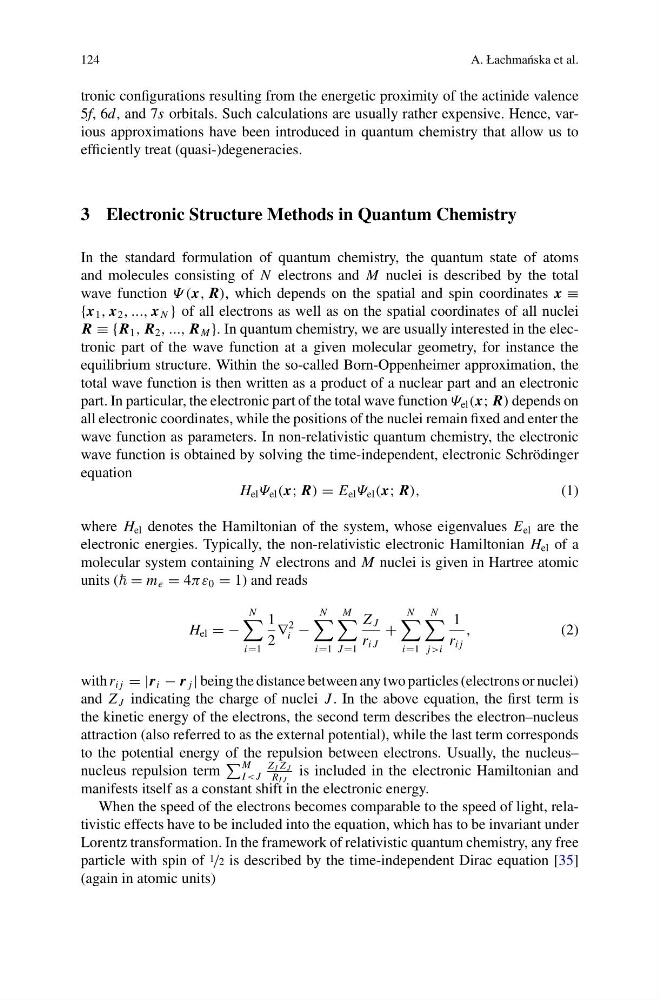
with r i j = |r i − r j | being the distance between any two particles (electrons or nuclei)
and Z J indicating the charge of nuclei J . In the above equation, the first term is
the kinetic energy of the electrons, the second term describes the electron–nucleus
attraction (also referred to as the external potential), while the last term corresponds
to the potential energy of the repulsion between electrons. Usually, the nucleus–
nucleus repulsion term
M
I
R I J
is included in the electronic Hamiltonian and
manifests itself as a constant shift in the electronic energy.
When the speed of the electrons becomes comparable to the speed of light, relativistic effects have to be included into the equation, which has to be invariant under
Lorentz transformation. In the framework of relativistic quantum chemistry, any free
particle with spin of 1 /2 is described by the time-independent Dirac equation [35]
(again in atomic units)
A. Łachma´ nska et al.
tronic configurations resulting from the energetic proximity of the actinide valence
5f, 6d, and 7s orbitals. Such calculations are usually rather expensive. Hence, various approximations have been introduced in quantum chemistry that allow us to
efficiently treat (quasi-)degeneracies.
3 Electronic Structure Methods in Quantum Chemistry
In the standard formulation of quantum chemistry, the quantum state of atoms
and molecules consisting of N electrons and M nuclei is described by the total
wave function Ψ (x, R), which depends on the spatial and spin coordinates x ≡
{x 1 , x 2 , ..., x N } of all electrons as well as on the spatial coordinates of all nuclei
R ≡ {R 1 , R 2 , ..., R M }. In quantum chemistry, we are usually interested in the electronic part of the wave function at a given molecular geometry, for instance the
equilibrium structure. Within the so-called Born-Oppenheimer approximation, the
total wave function is then written as a product of a nuclear part and an electronic
part. In particular, the electronic part of the total wave function Ψ el (x; R) depends on
all electronic coordinates, while the positions of the nuclei remain fixed and enter the
wave function as parameters. In non-relativistic quantum chemistry, the electronic
wave function is obtained by solving the time-independent, electronic Schrödinger
equation
H el Ψ el (x; R) = E el Ψ el (x; R),
(1)
where H el denotes the Hamiltonian of the system, whose eigenvalues E el are the
electronic energies. Typically, the non-relativistic electronic Hamiltonian H el of a
molecular system containing N electrons and M nuclei is given in Hartree atomic
units ( = m e = 4πε 0 = 1) and reads
H el = −
N
i=1
1
2
∇
2
i −
N
i=1
M
J =1
Z J
r i J
+
N
i=1
N
j>i
1
r i j
,
(2)
with r i j = |r i − r j | being the distance between any two particles (electrons or nuclei)
and Z J indicating the charge of nuclei J . In the above equation, the first term is
the kinetic energy of the electrons, the second term describes the electron–nucleus
attraction (also referred to as the external potential), while the last term corresponds
to the potential energy of the repulsion between electrons. Usually, the nucleus–
nucleus repulsion term
M
I
R I J
is included in the electronic Hamiltonian and
manifests itself as a constant shift in the electronic energy.
When the speed of the electrons becomes comparable to the speed of light, relativistic effects have to be included into the equation, which has to be invariant under
Lorentz transformation. In the framework of relativistic quantum chemistry, any free
particle with spin of 1 /2 is described by the time-independent Dirac equation [35]
(again in atomic units)