

126
A. Łachma´ nska et al.
(or the simplified Gaunt operator g
Gaunt
i j
= −
cα α α i ·cα α α j
c 2 r i j
[48]) that mimics the retardation
of the potentials due to the finite speed of light. Although the corresponding equation is Lorentz-invariant only approximately, it describes relativistic effects most
accurately. The drawback of the so-called Dirac–Coulomb–Breit Hamiltonian is the
large computational cost, which makes this approach computationally infeasible
for molecules with a large number of electrons. In practical applications the fourcomponent Dirac–Coulomb Hamiltonian is used at the SCF level and the correlated
calculations are performed within the so-called “no-pair” approximation, where projection operators remove any Slater determinant containing negative-energy orbitals
from the Dirac–Coulomb Hamiltonian [129]. In this approach both one- and twoelectron contributions to spin–orbit coupling are accounted for. It is possible to further
reduce the computational cost and approximate the “full” spin–orbit operator using
either atomic or molecular mean field theories [133].
Computationally less expensive methods work within a two-component framework, where the small component of the Dirac equation is eliminated. However, this
decoupling is not straightforward for many-electron systems and a number of routines
have been developed during the past decades to transform the four-component form
of the many-particle Dirac equation into an equation with at most two components
[9, 153]. One popular approach includes the so-called regular approximations. The
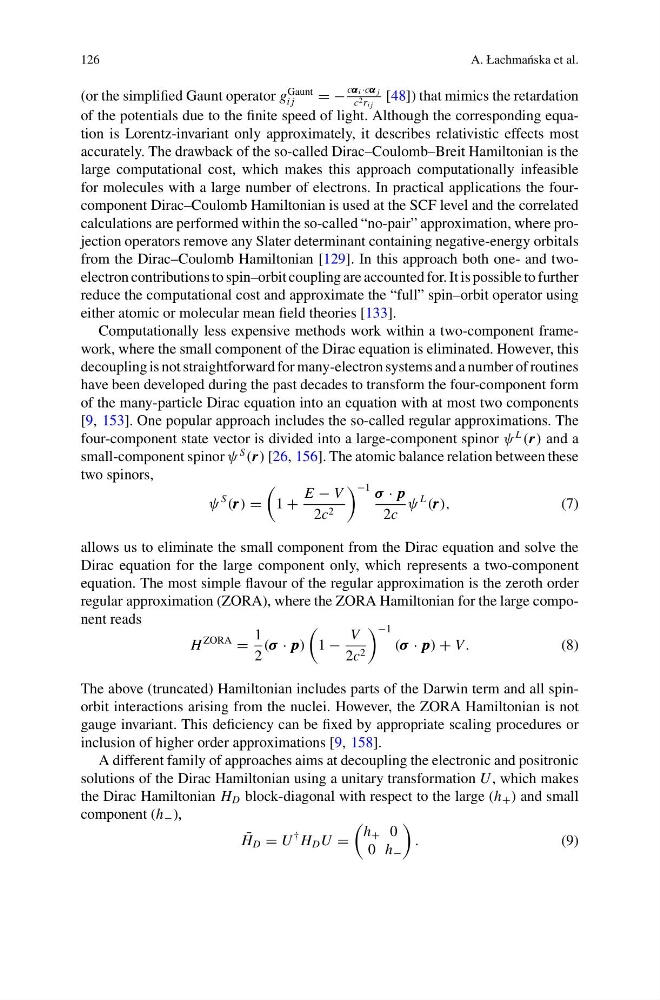
four-component state vector is divided into a large-component spinor ψ
L
(r) and a
small-component spinor ψ
S
(r) [26, 156]. The atomic balance relation between these
two spinors,
ψ
S
(r r r ) =
1 +
E − V
2c 2
−1 σ σ σ · p p p
2c
ψ
L
(r r r ),
(7)
allows us to eliminate the small component from the Dirac equation and solve the
Dirac equation for the large component only, which represents a two-component
equation. The most simple flavour of the regular approximation is the zeroth order
regular approximation (ZORA), where the ZORA Hamiltonian for the large component reads
H
ZORA
=
1
2
(σ σ σ · p p p)
1 −
V
2c 2
−1
(σ σ σ · p p p) + V.
(8)
The above (truncated) Hamiltonian includes parts of the Darwin term and all spinorbit interactions arising from the nuclei. However, the ZORA Hamiltonian is not
gauge invariant. This deficiency can be fixed by appropriate scaling procedures or
inclusion of higher order approximations [9, 158].
A different family of approaches aims at decoupling the electronic and positronic
solutions of the Dirac Hamiltonian using a unitary transformation U , which makes
the Dirac Hamiltonian H D block-diagonal with respect to the large (h + ) and small
component (h − ),
¯
H D = U
† H D U =
h + 0
0 h −
.
(9)
A. Łachma´ nska et al.
(or the simplified Gaunt operator g
Gaunt
i j
= −
cα α α i ·cα α α j
c 2 r i j
[48]) that mimics the retardation
of the potentials due to the finite speed of light. Although the corresponding equation is Lorentz-invariant only approximately, it describes relativistic effects most
accurately. The drawback of the so-called Dirac–Coulomb–Breit Hamiltonian is the
large computational cost, which makes this approach computationally infeasible
for molecules with a large number of electrons. In practical applications the fourcomponent Dirac–Coulomb Hamiltonian is used at the SCF level and the correlated
calculations are performed within the so-called “no-pair” approximation, where projection operators remove any Slater determinant containing negative-energy orbitals
from the Dirac–Coulomb Hamiltonian [129]. In this approach both one- and twoelectron contributions to spin–orbit coupling are accounted for. It is possible to further
reduce the computational cost and approximate the “full” spin–orbit operator using
either atomic or molecular mean field theories [133].
Computationally less expensive methods work within a two-component framework, where the small component of the Dirac equation is eliminated. However, this
decoupling is not straightforward for many-electron systems and a number of routines
have been developed during the past decades to transform the four-component form
of the many-particle Dirac equation into an equation with at most two components
[9, 153]. One popular approach includes the so-called regular approximations. The
four-component state vector is divided into a large-component spinor ψ
L
(r) and a
small-component spinor ψ
S
(r) [26, 156]. The atomic balance relation between these
two spinors,
ψ
S
(r r r ) =
1 +
E − V
2c 2
−1 σ σ σ · p p p
2c
ψ
L
(r r r ),
(7)
allows us to eliminate the small component from the Dirac equation and solve the
Dirac equation for the large component only, which represents a two-component
equation. The most simple flavour of the regular approximation is the zeroth order
regular approximation (ZORA), where the ZORA Hamiltonian for the large component reads
H
ZORA
=
1
2
(σ σ σ · p p p)
1 −
V
2c 2
−1
(σ σ σ · p p p) + V.
(8)
The above (truncated) Hamiltonian includes parts of the Darwin term and all spinorbit interactions arising from the nuclei. However, the ZORA Hamiltonian is not
gauge invariant. This deficiency can be fixed by appropriate scaling procedures or
inclusion of higher order approximations [9, 158].
A different family of approaches aims at decoupling the electronic and positronic
solutions of the Dirac Hamiltonian using a unitary transformation U , which makes
the Dirac Hamiltonian H D block-diagonal with respect to the large (h + ) and small
component (h − ),
¯
H D = U
† H D U =
h + 0
0 h −
.
(9)