

4.1 Traceability and the Comparability of Results
41
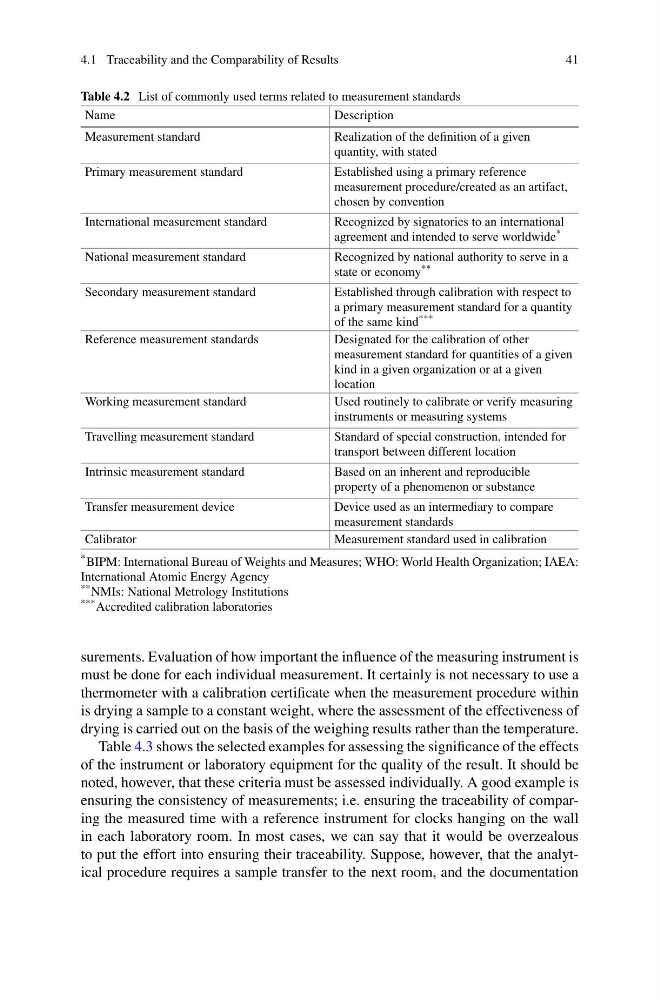
Table 4.2 List of commonly used terms related to measurement standards
Name
Description
Measurement standard
Realization of the definition of a given
quantity, with stated
Primary measurement standard
Established using a primary reference
measurement procedure/created as an artifact,
chosen by convention
International measurement standard
Recognized by signatories to an international
agreement and intended to serve worldwide *
National measurement standard
Recognized by national authority to serve in a
state or economy **
Secondary measurement standard
Established through calibration with respect to
a primary measurement standard for a quantity
of the same kind ***
Reference measurement standards
Designated for the calibration of other
measurement standard for quantities of a given
kind in a given organization or at a given
location
Working measurement standard
Used routinely to calibrate or verify measuring
instruments or measuring systems
Travelling measurement standard
Standard of special construction, intended for
transport between different location
Intrinsic measurement standard
Based on an inherent and reproducible
property of a phenomenon or substance
Transfer measurement device
Device used as an intermediary to compare
measurement standards
Calibrator
Measurement standard used in calibration
* BIPM: International Bureau of Weights and Measures; WHO: World Health Organization; IAEA:
International Atomic Energy Agency
** NMIs: National Metrology Institutions
*** Accredited calibration laboratories
surements. Evaluation of how important the influence of the measuring instrument is
must be done for each individual measurement. It certainly is not necessary to use a
thermometer with a calibration certificate when the measurement procedure within
is drying a sample to a constant weight, where the assessment of the effectiveness of
drying is carried out on the basis of the weighing results rather than the temperature.
Table 4.3 shows the selected examples for assessing the significance of the effects
of the instrument or laboratory equipment for the quality of the result. It should be
noted, however, that these criteria must be assessed individually. A good example is
ensuring the consistency of measurements; i.e. ensuring the traceability of comparing the measured time with a reference instrument for clocks hanging on the wall
in each laboratory room. In most cases, we can say that it would be overzealous
to put the effort into ensuring their traceability. Suppose, however, that the analytical procedure requires a sample transfer to the next room, and the documentation
41
Table 4.2 List of commonly used terms related to measurement standards
Name
Description
Measurement standard
Realization of the definition of a given
quantity, with stated
Primary measurement standard
Established using a primary reference
measurement procedure/created as an artifact,
chosen by convention
International measurement standard
Recognized by signatories to an international
agreement and intended to serve worldwide *
National measurement standard
Recognized by national authority to serve in a
state or economy **
Secondary measurement standard
Established through calibration with respect to
a primary measurement standard for a quantity
of the same kind ***
Reference measurement standards
Designated for the calibration of other
measurement standard for quantities of a given
kind in a given organization or at a given
location
Working measurement standard
Used routinely to calibrate or verify measuring
instruments or measuring systems
Travelling measurement standard
Standard of special construction, intended for
transport between different location
Intrinsic measurement standard
Based on an inherent and reproducible
property of a phenomenon or substance
Transfer measurement device
Device used as an intermediary to compare
measurement standards
Calibrator
Measurement standard used in calibration
* BIPM: International Bureau of Weights and Measures; WHO: World Health Organization; IAEA:
International Atomic Energy Agency
** NMIs: National Metrology Institutions
*** Accredited calibration laboratories
surements. Evaluation of how important the influence of the measuring instrument is
must be done for each individual measurement. It certainly is not necessary to use a
thermometer with a calibration certificate when the measurement procedure within
is drying a sample to a constant weight, where the assessment of the effectiveness of
drying is carried out on the basis of the weighing results rather than the temperature.
Table 4.3 shows the selected examples for assessing the significance of the effects
of the instrument or laboratory equipment for the quality of the result. It should be
noted, however, that these criteria must be assessed individually. A good example is
ensuring the consistency of measurements; i.e. ensuring the traceability of comparing the measured time with a reference instrument for clocks hanging on the wall
in each laboratory room. In most cases, we can say that it would be overzealous
to put the effort into ensuring their traceability. Suppose, however, that the analytical procedure requires a sample transfer to the next room, and the documentation