

40
4 Metrological Traceability
Definition of measurement units
International standards
National standards
Reference standards
Working standards
Utility
measuring
devices
BIPM, NMI
Research laboratories
NMI or designate institutions
NMI, accreditated
calibration laboratories
NMI, accredited
calibration laboratories
Uncertainty
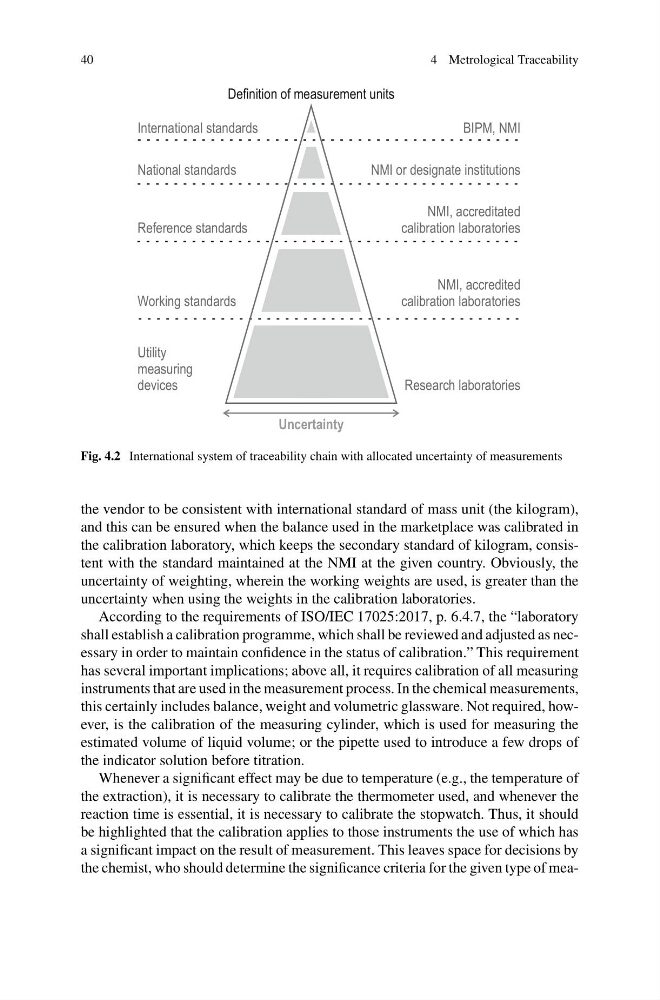
Fig. 4.2 International system of traceability chain with allocated uncertainty of measurements
the vendor to be consistent with international standard of mass unit (the kilogram),
and this can be ensured when the balance used in the marketplace was calibrated in
the calibration laboratory, which keeps the secondary standard of kilogram, consistent with the standard maintained at the NMI at the given country. Obviously, the
uncertainty of weighting, wherein the working weights are used, is greater than the
uncertainty when using the weights in the calibration laboratories.
According to the requirements of ISO/IEC 17025:2017, p. 6.4.7, the “laboratory
shall establish a calibration programme, which shall be reviewed and adjusted as necessary in order to maintain confidence in the status of calibration.” This requirement
has several important implications; above all, it requires calibration of all measuring
instruments that are used in the measurement process. In the chemical measurements,
this certainly includes balance, weight and volumetric glassware. Not required, however, is the calibration of the measuring cylinder, which is used for measuring the
estimated volume of liquid volume; or the pipette used to introduce a few drops of
the indicator solution before titration.
Whenever a significant effect may be due to temperature (e.g., the temperature of
the extraction), it is necessary to calibrate the thermometer used, and whenever the
reaction time is essential, it is necessary to calibrate the stopwatch. Thus, it should
be highlighted that the calibration applies to those instruments the use of which has
a significant impact on the result of measurement. This leaves space for decisions by
the chemist, who should determine the significance criteria for the given type of mea-
4 Metrological Traceability
Definition of measurement units
International standards
National standards
Reference standards
Working standards
Utility
measuring
devices
BIPM, NMI
Research laboratories
NMI or designate institutions
NMI, accreditated
calibration laboratories
NMI, accredited
calibration laboratories
Uncertainty
Fig. 4.2 International system of traceability chain with allocated uncertainty of measurements
the vendor to be consistent with international standard of mass unit (the kilogram),
and this can be ensured when the balance used in the marketplace was calibrated in
the calibration laboratory, which keeps the secondary standard of kilogram, consistent with the standard maintained at the NMI at the given country. Obviously, the
uncertainty of weighting, wherein the working weights are used, is greater than the
uncertainty when using the weights in the calibration laboratories.
According to the requirements of ISO/IEC 17025:2017, p. 6.4.7, the “laboratory
shall establish a calibration programme, which shall be reviewed and adjusted as necessary in order to maintain confidence in the status of calibration.” This requirement
has several important implications; above all, it requires calibration of all measuring
instruments that are used in the measurement process. In the chemical measurements,
this certainly includes balance, weight and volumetric glassware. Not required, however, is the calibration of the measuring cylinder, which is used for measuring the
estimated volume of liquid volume; or the pipette used to introduce a few drops of
the indicator solution before titration.
Whenever a significant effect may be due to temperature (e.g., the temperature of
the extraction), it is necessary to calibrate the thermometer used, and whenever the
reaction time is essential, it is necessary to calibrate the stopwatch. Thus, it should
be highlighted that the calibration applies to those instruments the use of which has
a significant impact on the result of measurement. This leaves space for decisions by
the chemist, who should determine the significance criteria for the given type of mea-