

86
6 Feynman Diagrams
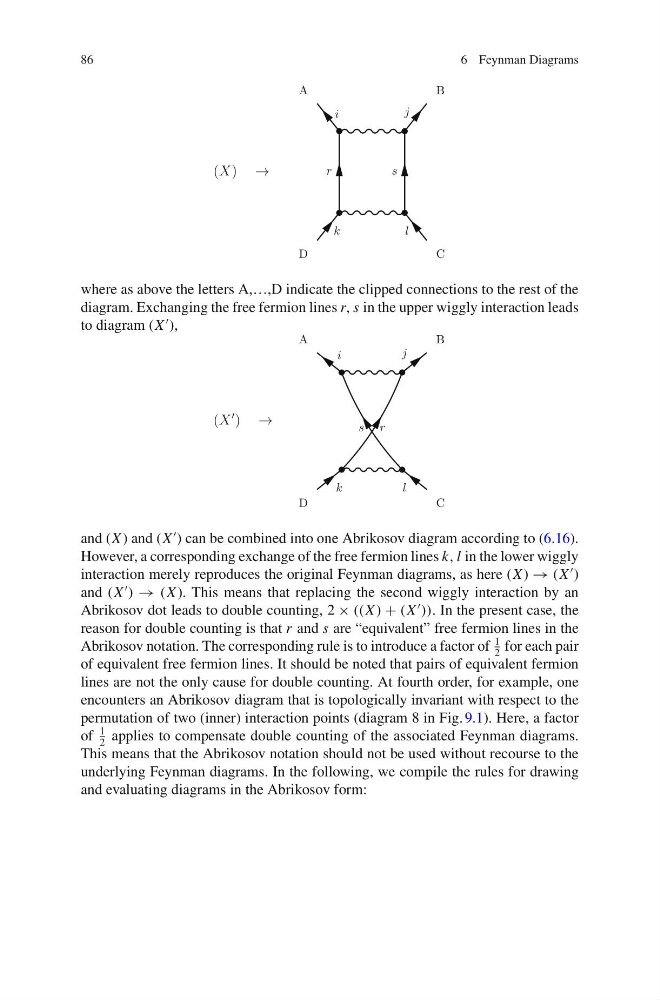
where as above the letters A,…,D indicate the clipped connections to the rest of the
diagram. Exchanging the free fermion lines r, s in the upper wiggly interaction leads
to diagram (X
),
and (X ) and (X
) can be combined into one Abrikosov diagram according to (6.16).
However, a corresponding exchange of the free fermion lines k, l in the lower wiggly
interaction merely reproduces the original Feynman diagrams, as here (X ) → (X
)
and (X
) → (X ). This means that replacing the second wiggly interaction by an
Abrikosov dot leads to double counting, 2 × ((X ) + (X
)). In the present case, the
reason for double counting is that r and s are “equivalent” free fermion lines in the
Abrikosov notation. The corresponding rule is to introduce a factor of
1
2
for each pair
of equivalent free fermion lines. It should be noted that pairs of equivalent fermion
lines are not the only cause for double counting. At fourth order, for example, one
encounters an Abrikosov diagram that is topologically invariant with respect to the
permutation of two (inner) interaction points (diagram 8 in Fig. 9.1). Here, a factor
of
1
2
applies to compensate double counting of the associated Feynman diagrams.
This means that the Abrikosov notation should not be used without recourse to the
underlying Feynman diagrams. In the following, we compile the rules for drawing
and evaluating diagrams in the Abrikosov form:
6 Feynman Diagrams
where as above the letters A,…,D indicate the clipped connections to the rest of the
diagram. Exchanging the free fermion lines r, s in the upper wiggly interaction leads
to diagram (X
),
and (X ) and (X
) can be combined into one Abrikosov diagram according to (6.16).
However, a corresponding exchange of the free fermion lines k, l in the lower wiggly
interaction merely reproduces the original Feynman diagrams, as here (X ) → (X
)
and (X
) → (X ). This means that replacing the second wiggly interaction by an
Abrikosov dot leads to double counting, 2 × ((X ) + (X
)). In the present case, the
reason for double counting is that r and s are “equivalent” free fermion lines in the
Abrikosov notation. The corresponding rule is to introduce a factor of
1
2
for each pair
of equivalent free fermion lines. It should be noted that pairs of equivalent fermion
lines are not the only cause for double counting. At fourth order, for example, one
encounters an Abrikosov diagram that is topologically invariant with respect to the
permutation of two (inner) interaction points (diagram 8 in Fig. 9.1). Here, a factor
of
1
2
applies to compensate double counting of the associated Feynman diagrams.
This means that the Abrikosov notation should not be used without recourse to the
underlying Feynman diagrams. In the following, we compile the rules for drawing
and evaluating diagrams in the Abrikosov form: