

5.2 Zeroth- and First-Order Feynman Diagrams
69
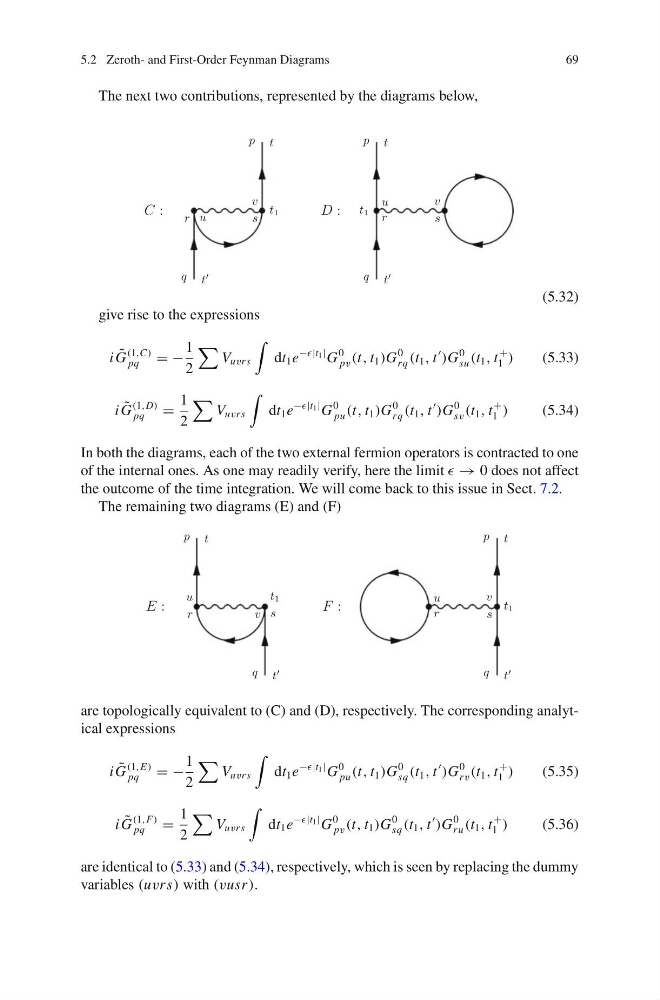
The next two contributions, represented by the diagrams below,
(5.32)
give rise to the expressions
i ˜
G
(1,C)
pq
= −
1
2
V uvrs
dt 1 e
−|t 1 | G
0
pv (t, t 1 )G
0
rq (t 1 , t
)G
0
su (t 1 , t
+
1 )
(5.33)
i ˜
G
(1,D)
pq
=
1
2
V uvrs
dt 1 e
−|t 1 | G
0
pu (t, t 1 )G
0
rq (t 1 , t
)G
0
sv (t 1 , t
+
1 )
(5.34)
In both the diagrams, each of the two external fermion operators is contracted to one
of the internal ones. As one may readily verify, here the limit → 0 does not affect
the outcome of the time integration. We will come back to this issue in Sect. 7.2.
The remaining two diagrams (E) and (F)
are topologically equivalent to (C) and (D), respectively. The corresponding analytical expressions
i ˜
G
(1,E)
pq
= −
1
2
V uvrs
dt 1 e
−|t 1 | G
0
pu (t, t 1 )G
0
sq (t 1 , t
)G
0
r v (t 1 , t
+
1 )
(5.35)
i ˜
G
(1,F)
pq
=
1
2
V uvrs
dt 1 e
−|t 1 | G
0
pv (t, t 1 )G
0
sq (t 1 , t
)G
0
ru (t 1 , t
+
1 )
(5.36)
are identical to (5.33) and (5.34), respectively, which is seen by replacing the dummy
variables (uvrs) with (vusr).
69
The next two contributions, represented by the diagrams below,
(5.32)
give rise to the expressions
i ˜
G
(1,C)
pq
= −
1
2
V uvrs
dt 1 e
−|t 1 | G
0
pv (t, t 1 )G
0
rq (t 1 , t
)G
0
su (t 1 , t
+
1 )
(5.33)
i ˜
G
(1,D)
pq
=
1
2
V uvrs
dt 1 e
−|t 1 | G
0
pu (t, t 1 )G
0
rq (t 1 , t
)G
0
sv (t 1 , t
+
1 )
(5.34)
In both the diagrams, each of the two external fermion operators is contracted to one
of the internal ones. As one may readily verify, here the limit → 0 does not affect
the outcome of the time integration. We will come back to this issue in Sect. 7.2.
The remaining two diagrams (E) and (F)
are topologically equivalent to (C) and (D), respectively. The corresponding analytical expressions
i ˜
G
(1,E)
pq
= −
1
2
V uvrs
dt 1 e
−|t 1 | G
0
pu (t, t 1 )G
0
sq (t 1 , t
)G
0
r v (t 1 , t
+
1 )
(5.35)
i ˜
G
(1,F)
pq
=
1
2
V uvrs
dt 1 e
−|t 1 | G
0
pv (t, t 1 )G
0
sq (t 1 , t
)G
0
ru (t 1 , t
+
1 )
(5.36)
are identical to (5.33) and (5.34), respectively, which is seen by replacing the dummy
variables (uvrs) with (vusr).