

68
5 Introducing Diagrams
Here τ > 0 and t
+
1 is used as a short-hand notation for the limit t 1 + τ → t 1 . We
summarize this result in the following remark.
Remark 1:
In generalization of the relation (5.14), contractions at equal times are given by
c s (t 1 )
c
†
v (t 1 )
= i G
0
sv (t 1 , t
+
1 )
(5.28)
Now the full analytical expression for diagram (A) can be written as
i ˜
G
(1,A)
pq
= (−i)
1
2
V uvrs
dt 1 e
−|t 1 | i G
0
ru (t 1 , t
+
1 )i G
0
sv (t 1 , t
+
1 ) i G
0
pq (t, t
) (5.29)
Relating this expression to diagram (A), we note that it involves summations running over the “internal” one-particle indices, u, v, r, s, and time integration over
the “internal” time t 1 . The phase factors can be combined to give −i
4
= −1. The
time integration in (5.29) reduces to an integral of the adiabatic switching function,
dt 1 e
−|t 1 |
=
2
, being obviously singular in the limit → 0. This outcome is characteristic for contributions such as ˜
G
(1,A)
pq , where the diagram (and the corresponding
analytical expression) consists of two “unlinked” multiplicative parts.
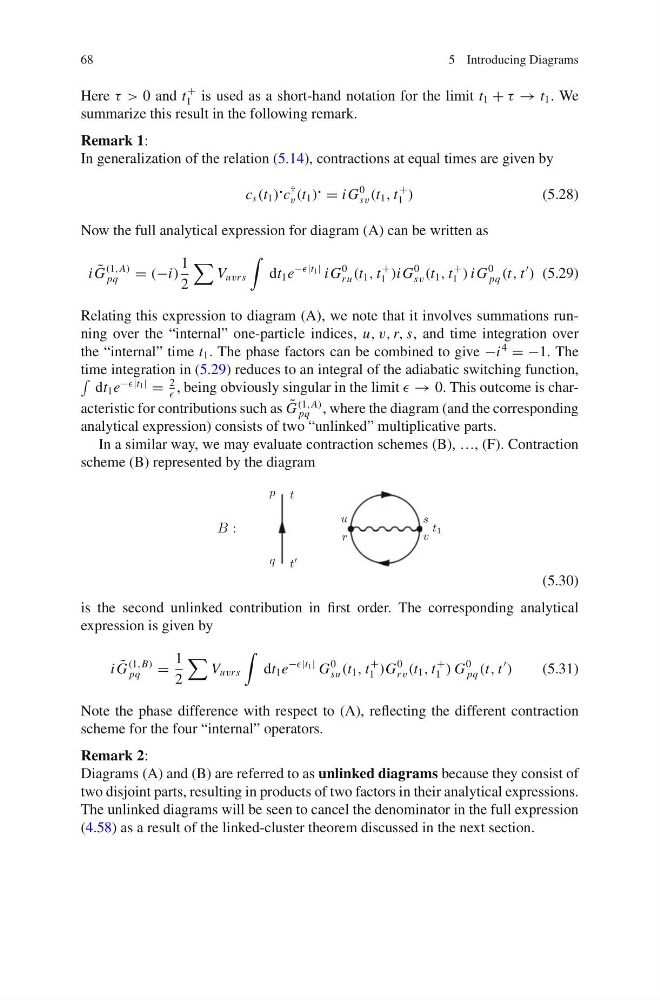
In a similar way, we may evaluate contraction schemes (B), …, (F). Contraction
scheme (B) represented by the diagram
(5.30)
is the second unlinked contribution in first order. The corresponding analytical
expression is given by
i ˜
G
(1,B)
pq
=
1
2
V uvrs
dt 1 e
−|t 1 | G
0
su (t 1 , t
+
1 )G
0
r v (t 1 , t
+
1 ) G
0
pq (t, t
)
(5.31)
Note the phase difference with respect to (A), reflecting the different contraction
scheme for the four “internal” operators.
Remark 2:
Diagrams (A) and (B) are referred to as unlinked diagrams because they consist of
two disjoint parts, resulting in products of two factors in their analytical expressions.
The unlinked diagrams will be seen to cancel the denominator in the full expression
(4.58) as a result of the linked-cluster theorem discussed in the next section.
5 Introducing Diagrams
Here τ > 0 and t
+
1 is used as a short-hand notation for the limit t 1 + τ → t 1 . We
summarize this result in the following remark.
Remark 1:
In generalization of the relation (5.14), contractions at equal times are given by
c s (t 1 )
c
†
v (t 1 )
= i G
0
sv (t 1 , t
+
1 )
(5.28)
Now the full analytical expression for diagram (A) can be written as
i ˜
G
(1,A)
pq
= (−i)
1
2
V uvrs
dt 1 e
−|t 1 | i G
0
ru (t 1 , t
+
1 )i G
0
sv (t 1 , t
+
1 ) i G
0
pq (t, t
) (5.29)
Relating this expression to diagram (A), we note that it involves summations running over the “internal” one-particle indices, u, v, r, s, and time integration over
the “internal” time t 1 . The phase factors can be combined to give −i
4
= −1. The
time integration in (5.29) reduces to an integral of the adiabatic switching function,
dt 1 e
−|t 1 |
=
2
, being obviously singular in the limit → 0. This outcome is characteristic for contributions such as ˜
G
(1,A)
pq , where the diagram (and the corresponding
analytical expression) consists of two “unlinked” multiplicative parts.
In a similar way, we may evaluate contraction schemes (B), …, (F). Contraction
scheme (B) represented by the diagram
(5.30)
is the second unlinked contribution in first order. The corresponding analytical
expression is given by
i ˜
G
(1,B)
pq
=
1
2
V uvrs
dt 1 e
−|t 1 | G
0
su (t 1 , t
+
1 )G
0
r v (t 1 , t
+
1 ) G
0
pq (t, t
)
(5.31)
Note the phase difference with respect to (A), reflecting the different contraction
scheme for the four “internal” operators.
Remark 2:
Diagrams (A) and (B) are referred to as unlinked diagrams because they consist of
two disjoint parts, resulting in products of two factors in their analytical expressions.
The unlinked diagrams will be seen to cancel the denominator in the full expression
(4.58) as a result of the linked-cluster theorem discussed in the next section.