

5.2 Zeroth- and First-Order Feynman Diagrams
67
the indices in the interaction line can be memorized as being left out, right out, left
in, right in.
The ˆ
T T T product of the Coulomb part in i ˜
G
(1)
pq consists of three creation operators,
c
†
u , c
†
v , c
†
q , and three destruction operators, c r , c s , c p . According to the relations (5.13,
5.14), there are 3! = 6 distinct non-vanishing contraction schemes, (A), (B),…,(F),
which we shall consider successively in the following.
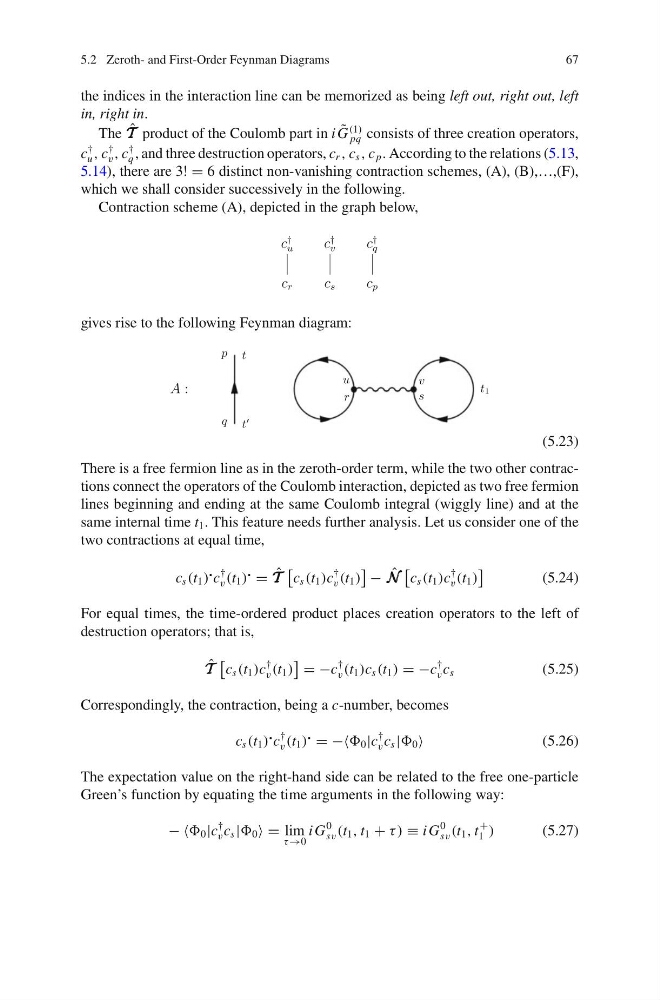
Contraction scheme (A), depicted in the graph below,
gives rise to the following Feynman diagram:
(5.23)
There is a free fermion line as in the zeroth-order term, while the two other contractions connect the operators of the Coulomb interaction, depicted as two free fermion
lines beginning and ending at the same Coulomb integral (wiggly line) and at the
same internal time t 1 . This feature needs further analysis. Let us consider one of the
two contractions at equal time,
c s (t 1 )
c
†
v (t 1 )
= ˆ
T T T
c s (t 1 )c
†
v (t 1 )
− ˆ
N N N
c s (t 1 )c
†
v (t 1 )
(5.24)
For equal times, the time-ordered product places creation operators to the left of
destruction operators; that is,
ˆ
T T T
c s (t 1 )c
†
v (t 1 )
= −c
†
v (t 1 )c s (t 1 ) = −c
†
v c s
(5.25)
Correspondingly, the contraction, being a c-number, becomes
c s (t 1 )
c
†
v (t 1 )
= −− 0 |c
†
v c s | 0
(5.26)
The expectation value on the right-hand side can be related to the free one-particle
Green’s function by equating the time arguments in the following way:
− − 0 |c
†
v c s | 0 = lim
τ →0
i G
0
sv (t 1 , t 1 + τ ) ≡ i G
0
sv (t 1 , t
+
1 )
(5.27)
67
the indices in the interaction line can be memorized as being left out, right out, left
in, right in.
The ˆ
T T T product of the Coulomb part in i ˜
G
(1)
pq consists of three creation operators,
c
†
u , c
†
v , c
†
q , and three destruction operators, c r , c s , c p . According to the relations (5.13,
5.14), there are 3! = 6 distinct non-vanishing contraction schemes, (A), (B),…,(F),
which we shall consider successively in the following.
Contraction scheme (A), depicted in the graph below,
gives rise to the following Feynman diagram:
(5.23)
There is a free fermion line as in the zeroth-order term, while the two other contractions connect the operators of the Coulomb interaction, depicted as two free fermion
lines beginning and ending at the same Coulomb integral (wiggly line) and at the
same internal time t 1 . This feature needs further analysis. Let us consider one of the
two contractions at equal time,
c s (t 1 )
c
†
v (t 1 )
= ˆ
T T T
c s (t 1 )c
†
v (t 1 )
− ˆ
N N N
c s (t 1 )c
†
v (t 1 )
(5.24)
For equal times, the time-ordered product places creation operators to the left of
destruction operators; that is,
ˆ
T T T
c s (t 1 )c
†
v (t 1 )
= −c
†
v (t 1 )c s (t 1 ) = −c
†
v c s
(5.25)
Correspondingly, the contraction, being a c-number, becomes
c s (t 1 )
c
†
v (t 1 )
= −− 0 |c
†
v c s | 0
(5.26)
The expectation value on the right-hand side can be related to the free one-particle
Green’s function by equating the time arguments in the following way:
− − 0 |c
†
v c s | 0 = lim
τ →0
i G
0
sv (t 1 , t 1 + τ ) ≡ i G
0
sv (t 1 , t
+
1 )
(5.27)