

58
4 Perturbation Theory for the Electron Propagator
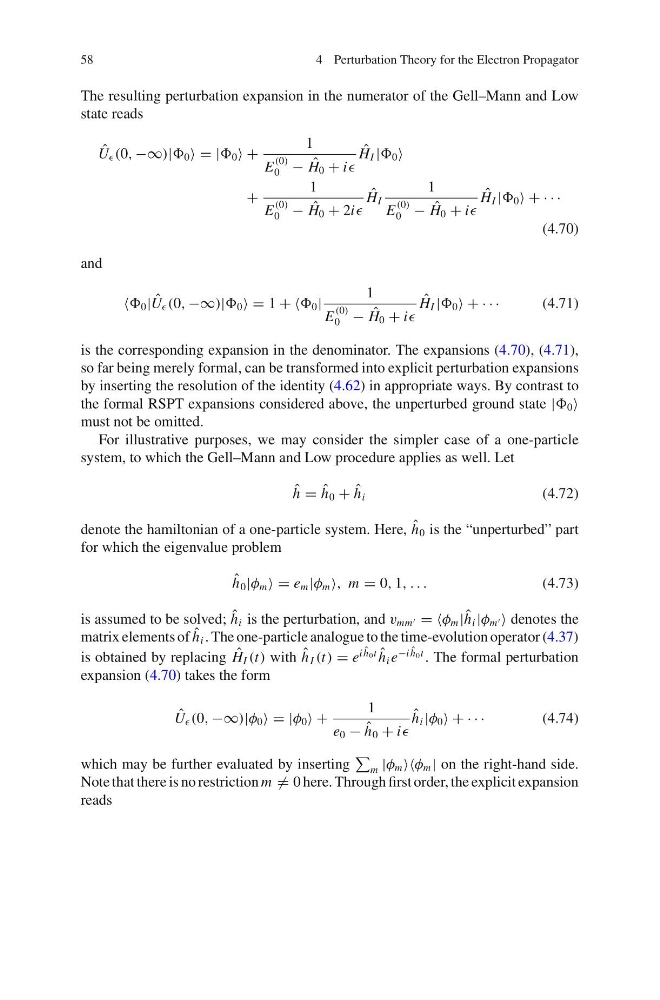
The resulting perturbation expansion in the numerator of the Gell–Mann and Low
state reads
ˆ
U (0, −∞)| 0 = | 0 +
1
E
(0)
0 − ˆ
H 0 + i
ˆ
H I | 0
+
1
E
(0)
0 − ˆ
H 0 + 2i
ˆ
H I
1
E
(0)
0 − ˆ
H 0 + i
ˆ
H I | 0 + · · ·
(4.70)
and
0 | ˆ
U (0, −∞)| 0 = 1 + + 0 |
1
E
(0)
0 − ˆ
H 0 + i
ˆ
H I | 0 + · · ·
(4.71)
is the corresponding expansion in the denominator. The expansions (4.70), (4.71),
so far being merely formal, can be transformed into explicit perturbation expansions
by inserting the resolution of the identity (4.62) in appropriate ways. By contrast to
the formal RSPT expansions considered above, the unperturbed ground state | 0
must not be omitted.
For illustrative purposes, we may consider the simpler case of a one-particle
system, to which the Gell–Mann and Low procedure applies as well. Let
ˆ
h = ˆ
h 0 + ˆ
h i
(4.72)
denote the hamiltonian of a one-particle system. Here, ˆ
h 0 is the “unperturbed” part
for which the eigenvalue problem
ˆ
h 0 |φ m = e m |φ m , m = 0, 1, . . .
(4.73)
is assumed to be solved; ˆ
h i is the perturbation, and v mm = =φ m | ˆ
h i |φ m denotes the
matrix elements of ˆ
h i . The one-particle analogue to the time-evolution operator (4.37)
is obtained by replacing ˆ
H I (t) with ˆ
h I (t) = e
i ˆ
h 0 t ˆ
h i e
−i ˆ
h 0 t . The formal perturbation
expansion (4.70) takes the form
ˆ
U (0, −∞)|φ 0 = |φ 0 +
1
e 0 − ˆ
h 0 + i
ˆ
h i |φ 0 + · · ·
(4.74)
which may be further evaluated by inserting
m |φ m φ m | on the right-hand side.
Note that there is no restriction m = 0 here. Through first order, the explicit expansion
reads
4 Perturbation Theory for the Electron Propagator
The resulting perturbation expansion in the numerator of the Gell–Mann and Low
state reads
ˆ
U (0, −∞)| 0 = | 0 +
1
E
(0)
0 − ˆ
H 0 + i
ˆ
H I | 0
+
1
E
(0)
0 − ˆ
H 0 + 2i
ˆ
H I
1
E
(0)
0 − ˆ
H 0 + i
ˆ
H I | 0 + · · ·
(4.70)
and
0 | ˆ
U (0, −∞)| 0 = 1 + + 0 |
1
E
(0)
0 − ˆ
H 0 + i
ˆ
H I | 0 + · · ·
(4.71)
is the corresponding expansion in the denominator. The expansions (4.70), (4.71),
so far being merely formal, can be transformed into explicit perturbation expansions
by inserting the resolution of the identity (4.62) in appropriate ways. By contrast to
the formal RSPT expansions considered above, the unperturbed ground state | 0
must not be omitted.
For illustrative purposes, we may consider the simpler case of a one-particle
system, to which the Gell–Mann and Low procedure applies as well. Let
ˆ
h = ˆ
h 0 + ˆ
h i
(4.72)
denote the hamiltonian of a one-particle system. Here, ˆ
h 0 is the “unperturbed” part
for which the eigenvalue problem
ˆ
h 0 |φ m = e m |φ m , m = 0, 1, . . .
(4.73)
is assumed to be solved; ˆ
h i is the perturbation, and v mm = =φ m | ˆ
h i |φ m denotes the
matrix elements of ˆ
h i . The one-particle analogue to the time-evolution operator (4.37)
is obtained by replacing ˆ
H I (t) with ˆ
h I (t) = e
i ˆ
h 0 t ˆ
h i e
−i ˆ
h 0 t . The formal perturbation
expansion (4.70) takes the form
ˆ
U (0, −∞)|φ 0 = |φ 0 +
1
e 0 − ˆ
h 0 + i
ˆ
h i |φ 0 + · · ·
(4.74)
which may be further evaluated by inserting
m |φ m φ m | on the right-hand side.
Note that there is no restriction m = 0 here. Through first order, the explicit expansion
reads