

4.4 Comparison with Rayleigh–Schrödinger Perturbation Theory
57
Since
ˆ
H I (t j ) = e
i ˆ
H 0 t j ˆ
H I e
−i ˆ
H 0 t j
(4.66)
the product of two successive time-dependent interaction operators with time arguments t j , t j , j
= j + 1, becomes
ˆ
H I (t j ) ˆ
H I (t j ) = e
i ˆ
H 0 t j ˆ
H I e
−i ˆ
H 0 (t j −t j ) ˆ
H I e
−i ˆ
H 0 t j
(4.67)
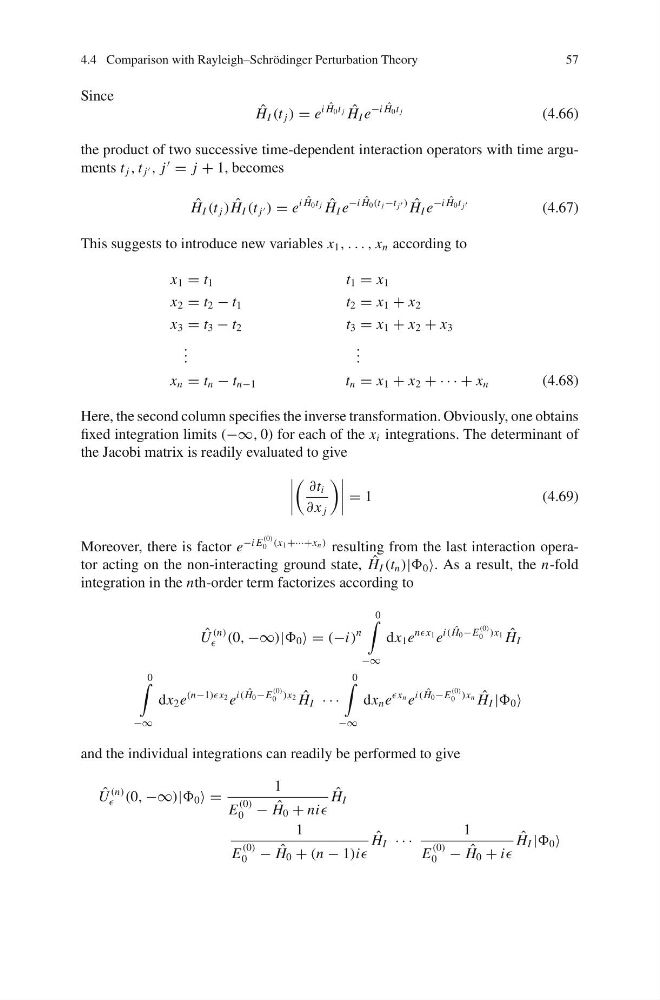
This suggests to introduce new variables x 1 , . . . , x n according to
x 1 = t 1
t 1 = x 1
x 2 = t 2 − t 1
t 2 = x 1 + x 2
x 3 = t 3 − t 2
t 3 = x 1 + x 2 + x 3
. . .
. . .
x n = t n − t n−1
t n = x 1 + x 2 + · · · + x n
(4.68)
Here, the second column specifies the inverse transformation. Obviously, one obtains
fixed integration limits (−∞, 0) for each of the x i integrations. The determinant of
the Jacobi matrix is readily evaluated to give
∂t i
∂ x j
= 1
(4.69)
Moreover, there is factor e
−i E
(0)
0 (x 1 +···+x n ) resulting from the last interaction operator acting on the non-interacting ground state, ˆ
H I (t n )| 0 . As a result, the n-fold
integration in the nth-order term factorizes according to
ˆ
U
(n)
(0, −∞)| 0 = (−i)
n
0
−∞
dx 1 e
nx 1 e
i( ˆ
H 0 −E
(0)
0 )x 1 ˆ
H I
0
−∞
dx 2 e
(n−1))x 2 e
i( ˆ
H 0 −E
(0)
0 )x 2 ˆ
H I · · ·
0
−∞
dx n e
x n e
i( ˆ
H 0 −E
(0)
0 )x n ˆ
H I | 0
and the individual integrations can readily be performed to give
ˆ
U
(n)
(0, −∞)| 0 =
1
E
(0)
0 − ˆ
H 0 + ni
ˆ
H I
1
E
(0)
0 − ˆ
H 0 + (n − 1)i
ˆ
H I · · ·
1
E
(0)
0 − ˆ
H 0 + i
ˆ
H I | 0
57
Since
ˆ
H I (t j ) = e
i ˆ
H 0 t j ˆ
H I e
−i ˆ
H 0 t j
(4.66)
the product of two successive time-dependent interaction operators with time arguments t j , t j , j
= j + 1, becomes
ˆ
H I (t j ) ˆ
H I (t j ) = e
i ˆ
H 0 t j ˆ
H I e
−i ˆ
H 0 (t j −t j ) ˆ
H I e
−i ˆ
H 0 t j
(4.67)
This suggests to introduce new variables x 1 , . . . , x n according to
x 1 = t 1
t 1 = x 1
x 2 = t 2 − t 1
t 2 = x 1 + x 2
x 3 = t 3 − t 2
t 3 = x 1 + x 2 + x 3
. . .
. . .
x n = t n − t n−1
t n = x 1 + x 2 + · · · + x n
(4.68)
Here, the second column specifies the inverse transformation. Obviously, one obtains
fixed integration limits (−∞, 0) for each of the x i integrations. The determinant of
the Jacobi matrix is readily evaluated to give
∂t i
∂ x j
= 1
(4.69)
Moreover, there is factor e
−i E
(0)
0 (x 1 +···+x n ) resulting from the last interaction operator acting on the non-interacting ground state, ˆ
H I (t n )| 0 . As a result, the n-fold
integration in the nth-order term factorizes according to
ˆ
U
(n)
(0, −∞)| 0 = (−i)
n
0
−∞
dx 1 e
nx 1 e
i( ˆ
H 0 −E
(0)
0 )x 1 ˆ
H I
0
−∞
dx 2 e
(n−1))x 2 e
i( ˆ
H 0 −E
(0)
0 )x 2 ˆ
H I · · ·
0
−∞
dx n e
x n e
i( ˆ
H 0 −E
(0)
0 )x n ˆ
H I | 0
and the individual integrations can readily be performed to give
ˆ
U
(n)
(0, −∞)| 0 =
1
E
(0)
0 − ˆ
H 0 + ni
ˆ
H I
1
E
(0)
0 − ˆ
H 0 + (n − 1)i
ˆ
H I · · ·
1
E
(0)
0 − ˆ
H 0 + i
ˆ
H I | 0