

4.4 Comparison with Rayleigh–Schrödinger Perturbation Theory
59
ˆ
U (0, −∞)|φ 0 = |φ 0 +
m
v m0
e 0 − e m + i
|φ m + . . .
= |φ 0 +
v 00
i
|φ 0 +
m =0
v m0
e 0 − e m + i
|φ m + . . .
(4.75)
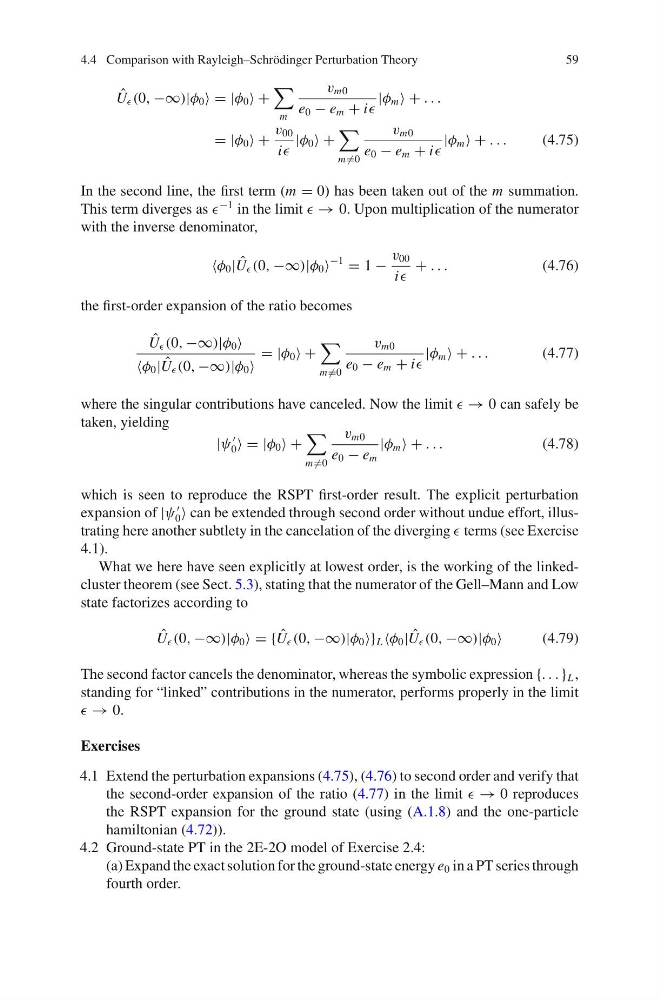
In the second line, the first term (m = 0) has been taken out of the m summation.
This term diverges as
−1 in the limit → 0. Upon multiplication of the numerator
with the inverse denominator,
φ 0 | ˆ
U (0, −∞)|φ 0
−1
= 1 −
v 00
i
+ . . .
(4.76)
the first-order expansion of the ratio becomes
ˆ
U (0, −∞)|φ 0
φ 0 | ˆ
U (0, −∞)|φ 0
= |φ 0 +
m =0
v m0
e 0 − e m + i
|φ m + . . .
(4.77)
where the singular contributions have canceled. Now the limit → 0 can safely be
taken, yielding
|ψ
0 = |φ 0 +
m =0
v m0
e 0 − e m
|φ m + . . .
(4.78)
which is seen to reproduce the RSPT first-order result. The explicit perturbation
expansion of |ψ
0 can be extended through second order without undue effort, illustrating here another subtlety in the cancelation of the diverging terms (see Exercise
4.1).
What we here have seen explicitly at lowest order, is the working of the linkedcluster theorem (see Sect. 5.3), stating that the numerator of the Gell–Mann and Low
state factorizes according to
ˆ
U (0, −∞)|φ 0 = { ˆ
U (0, −∞)|φ 0 } L φ 0 | ˆ
U (0, −∞)|φ 0
(4.79)
The second factor cancels the denominator, whereas the symbolic expression {. . . } L ,
standing for “linked” contributions in the numerator, performs properly in the limit
→ 0.
Exercises
4.1 Extend the perturbation expansions (4.75), (4.76) to second order and verify that
the second-order expansion of the ratio (4.77) in the limit → 0 reproduces
the RSPT expansion for the ground state (using (A.1.8) and the one-particle
hamiltonian (4.72)).
4.2 Ground-state PT in the 2E-2O model of Exercise 2.4:
(a) Expand the exact solution for the ground-state energy e 0 in a PT series through
fourth order.
59
ˆ
U (0, −∞)|φ 0 = |φ 0 +
m
v m0
e 0 − e m + i
|φ m + . . .
= |φ 0 +
v 00
i
|φ 0 +
m =0
v m0
e 0 − e m + i
|φ m + . . .
(4.75)
In the second line, the first term (m = 0) has been taken out of the m summation.
This term diverges as
−1 in the limit → 0. Upon multiplication of the numerator
with the inverse denominator,
φ 0 | ˆ
U (0, −∞)|φ 0
−1
= 1 −
v 00
i
+ . . .
(4.76)
the first-order expansion of the ratio becomes
ˆ
U (0, −∞)|φ 0
φ 0 | ˆ
U (0, −∞)|φ 0
= |φ 0 +
m =0
v m0
e 0 − e m + i
|φ m + . . .
(4.77)
where the singular contributions have canceled. Now the limit → 0 can safely be
taken, yielding
|ψ
0 = |φ 0 +
m =0
v m0
e 0 − e m
|φ m + . . .
(4.78)
which is seen to reproduce the RSPT first-order result. The explicit perturbation
expansion of |ψ
0 can be extended through second order without undue effort, illustrating here another subtlety in the cancelation of the diverging terms (see Exercise
4.1).
What we here have seen explicitly at lowest order, is the working of the linkedcluster theorem (see Sect. 5.3), stating that the numerator of the Gell–Mann and Low
state factorizes according to
ˆ
U (0, −∞)|φ 0 = { ˆ
U (0, −∞)|φ 0 } L φ 0 | ˆ
U (0, −∞)|φ 0
(4.79)
The second factor cancels the denominator, whereas the symbolic expression {. . . } L ,
standing for “linked” contributions in the numerator, performs properly in the limit
→ 0.
Exercises
4.1 Extend the perturbation expansions (4.75), (4.76) to second order and verify that
the second-order expansion of the ratio (4.77) in the limit → 0 reproduces
the RSPT expansion for the ground state (using (A.1.8) and the one-particle
hamiltonian (4.72)).
4.2 Ground-state PT in the 2E-2O model of Exercise 2.4:
(a) Expand the exact solution for the ground-state energy e 0 in a PT series through
fourth order.