

4.2 The Gell-Mann and Low Theorem
51
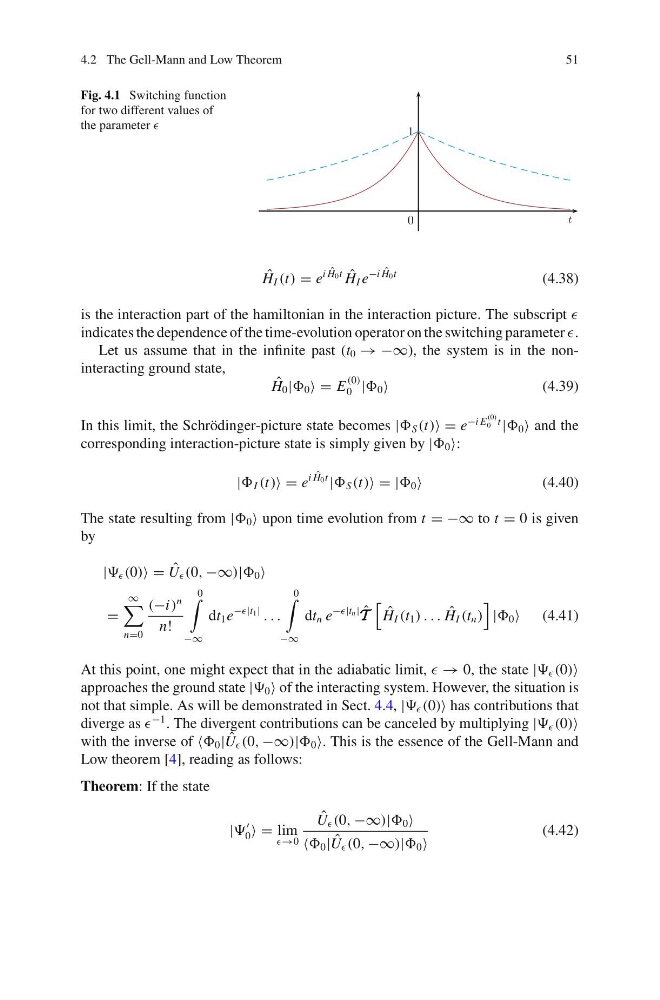
Fig. 4.1 Switching function
for two different values of
the parameter
ˆ
H I (t) = e
i ˆ
H 0 t ˆ
H I e
−i ˆ
H 0 t
(4.38)
is the interaction part of the hamiltonian in the interaction picture. The subscript
indicates the dependence of the time-evolution operator on the switching parameter .
Let us assume that in the infinite past (t 0 → −∞), the system is in the noninteracting ground state,
ˆ
H 0 | 0 = E
(0)
0 | 0
(4.39)
In this limit, the Schrödinger-picture state becomes | S (t) = e
−i E
(0)
0 t
| 0 and the
corresponding interaction-picture state is simply given by | 0 :
| I (t) = e
i ˆ
H 0 t
| S (t) = | 0
(4.40)
The state resulting from | 0 upon time evolution from t = −∞ to t = 0 is given
by
| (0) = ˆ
U (0, −∞)| 0
=
∞
n=0
(−i)
n
n!
0
−∞
dt 1 e
−|t 1 |
. . .
0
−∞
dt n e
−|t n | ˆ
T T T
ˆ
H I (t 1 ) . . . ˆ
H I (t n )
| 0 (4.41)
At this point, one might expect that in the adiabatic limit, → 0, the state | (0)
approaches the ground state | 0 of the interacting system. However, the situation is
not that simple. As will be demonstrated in Sect. 4.4, | (0) has contributions that
diverge as
−1 . The divergent contributions can be canceled by multiplying | (0)
with the inverse of 0 | ˆ
U (0, −∞)| 0 . This is the essence of the Gell-Mann and
Low theorem [4], reading as follows:
Theorem: If the state
|
0 = lim
→0
ˆ
U (0, −∞)| 0
0 | ˆ
U (0, −∞)| 0
(4.42)
51
Fig. 4.1 Switching function
for two different values of
the parameter
ˆ
H I (t) = e
i ˆ
H 0 t ˆ
H I e
−i ˆ
H 0 t
(4.38)
is the interaction part of the hamiltonian in the interaction picture. The subscript
indicates the dependence of the time-evolution operator on the switching parameter .
Let us assume that in the infinite past (t 0 → −∞), the system is in the noninteracting ground state,
ˆ
H 0 | 0 = E
(0)
0 | 0
(4.39)
In this limit, the Schrödinger-picture state becomes | S (t) = e
−i E
(0)
0 t
| 0 and the
corresponding interaction-picture state is simply given by | 0 :
| I (t) = e
i ˆ
H 0 t
| S (t) = | 0
(4.40)
The state resulting from | 0 upon time evolution from t = −∞ to t = 0 is given
by
| (0) = ˆ
U (0, −∞)| 0
=
∞
n=0
(−i)
n
n!
0
−∞
dt 1 e
−|t 1 |
. . .
0
−∞
dt n e
−|t n | ˆ
T T T
ˆ
H I (t 1 ) . . . ˆ
H I (t n )
| 0 (4.41)
At this point, one might expect that in the adiabatic limit, → 0, the state | (0)
approaches the ground state | 0 of the interacting system. However, the situation is
not that simple. As will be demonstrated in Sect. 4.4, | (0) has contributions that
diverge as
−1 . The divergent contributions can be canceled by multiplying | (0)
with the inverse of 0 | ˆ
U (0, −∞)| 0 . This is the essence of the Gell-Mann and
Low theorem [4], reading as follows:
Theorem: If the state
|
0 = lim
→0
ˆ
U (0, −∞)| 0
0 | ˆ
U (0, −∞)| 0
(4.42)