

50
4 Perturbation Theory for the Electron Propagator
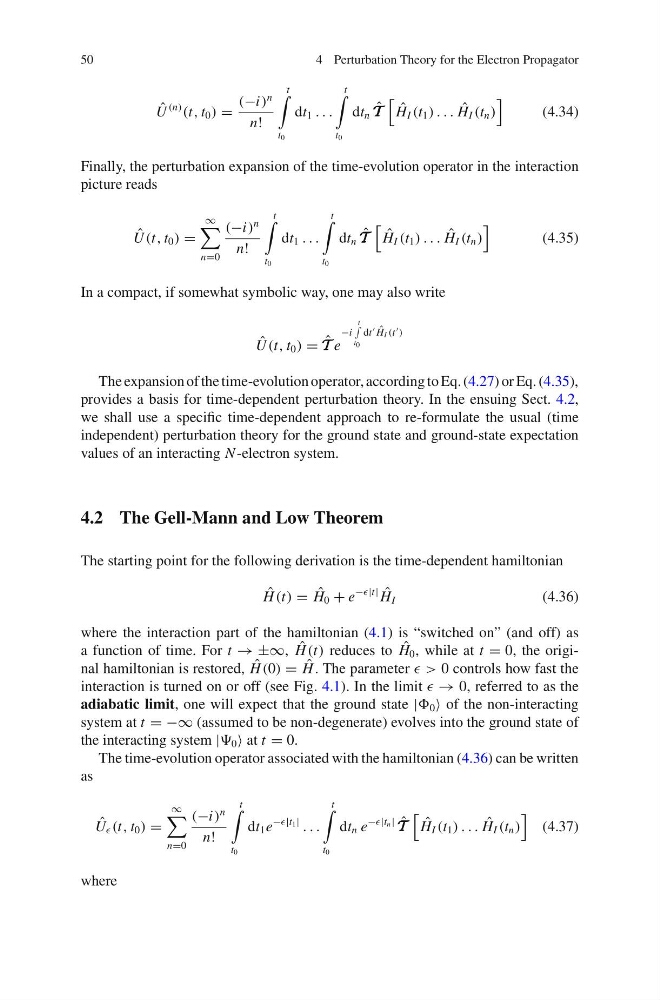
ˆ
U
(n)
(t, t 0 ) =
(−i)
n
n!
t
t 0
dt 1 . . .
t
t 0
dt n ˆ
T T T
ˆ
H I (t 1 ) . . . ˆ
H I (t n )
(4.34)
Finally, the perturbation expansion of the time-evolution operator in the interaction
picture reads
ˆ
U (t, t 0 ) =
∞
n=0
(−i)
n
n!
t
t 0
dt 1 . . .
t
t 0
dt n ˆ
T T T
ˆ
H I (t 1 ) . . . ˆ
H I (t n )
(4.35)
In a compact, if somewhat symbolic way, one may also write
ˆ
U (t, t 0 ) = ˆ
T T T e
−i
t
t 0
dt
ˆ
H I (t
)
The expansion of the time-evolution operator, according to Eq. (4.27) or Eq. (4.35),
provides a basis for time-dependent perturbation theory. In the ensuing Sect. 4.2,
we shall use a specific time-dependent approach to re-formulate the usual (time
independent) perturbation theory for the ground state and ground-state expectation
values of an interacting N -electron system.
4.2 The Gell-Mann and Low Theorem
The starting point for the following derivation is the time-dependent hamiltonian
ˆ
H (t) = ˆ
H 0 + e
−|t| ˆ
H I
(4.36)
where the interaction part of the hamiltonian (4.1) is “switched on” (and off) as
a function of time. For t → ±∞, ˆ
H (t) reduces to ˆ
H 0 , while at t = 0, the original hamiltonian is restored, ˆ
H (0) = ˆ
H . The parameter > 0 controls how fast the
interaction is turned on or off (see Fig. 4.1). In the limit → 0, referred to as the
adiabatic limit, one will expect that the ground state | 0 of the non-interacting
system at t = −∞ (assumed to be non-degenerate) evolves into the ground state of
the interacting system | 0 at t = 0.
The time-evolution operator associated with the hamiltonian (4.36) can be written
as
ˆ
U (t, t 0 ) =
∞
n=0
(−i)
n
n!
t
t 0
dt 1 e
−|t 1 |
. . .
t
t 0
dt n e
−|t n | ˆ
T T T
ˆ
H I (t 1 ) . . . ˆ
H I (t n )
(4.37)
where
4 Perturbation Theory for the Electron Propagator
ˆ
U
(n)
(t, t 0 ) =
(−i)
n
n!
t
t 0
dt 1 . . .
t
t 0
dt n ˆ
T T T
ˆ
H I (t 1 ) . . . ˆ
H I (t n )
(4.34)
Finally, the perturbation expansion of the time-evolution operator in the interaction
picture reads
ˆ
U (t, t 0 ) =
∞
n=0
(−i)
n
n!
t
t 0
dt 1 . . .
t
t 0
dt n ˆ
T T T
ˆ
H I (t 1 ) . . . ˆ
H I (t n )
(4.35)
In a compact, if somewhat symbolic way, one may also write
ˆ
U (t, t 0 ) = ˆ
T T T e
−i
t
t 0
dt
ˆ
H I (t
)
The expansion of the time-evolution operator, according to Eq. (4.27) or Eq. (4.35),
provides a basis for time-dependent perturbation theory. In the ensuing Sect. 4.2,
we shall use a specific time-dependent approach to re-formulate the usual (time
independent) perturbation theory for the ground state and ground-state expectation
values of an interacting N -electron system.
4.2 The Gell-Mann and Low Theorem
The starting point for the following derivation is the time-dependent hamiltonian
ˆ
H (t) = ˆ
H 0 + e
−|t| ˆ
H I
(4.36)
where the interaction part of the hamiltonian (4.1) is “switched on” (and off) as
a function of time. For t → ±∞, ˆ
H (t) reduces to ˆ
H 0 , while at t = 0, the original hamiltonian is restored, ˆ
H (0) = ˆ
H . The parameter > 0 controls how fast the
interaction is turned on or off (see Fig. 4.1). In the limit → 0, referred to as the
adiabatic limit, one will expect that the ground state | 0 of the non-interacting
system at t = −∞ (assumed to be non-degenerate) evolves into the ground state of
the interacting system | 0 at t = 0.
The time-evolution operator associated with the hamiltonian (4.36) can be written
as
ˆ
U (t, t 0 ) =
∞
n=0
(−i)
n
n!
t
t 0
dt 1 e
−|t 1 |
. . .
t
t 0
dt n e
−|t n | ˆ
T T T
ˆ
H I (t 1 ) . . . ˆ
H I (t n )
(4.37)
where