

4.1 Time-Development Operator in the Interaction Picture
49
ˆ
U
(n)
(t, t 0 ) = (−i)
n
t
t 0
dt 1
t 1
t 0
dt 2 . . .
t n−1
t 0
dt n ˆ
H I (t 1 ) ˆ
H I (t 2 ) . . . ˆ
H I (t n )
(4.28)
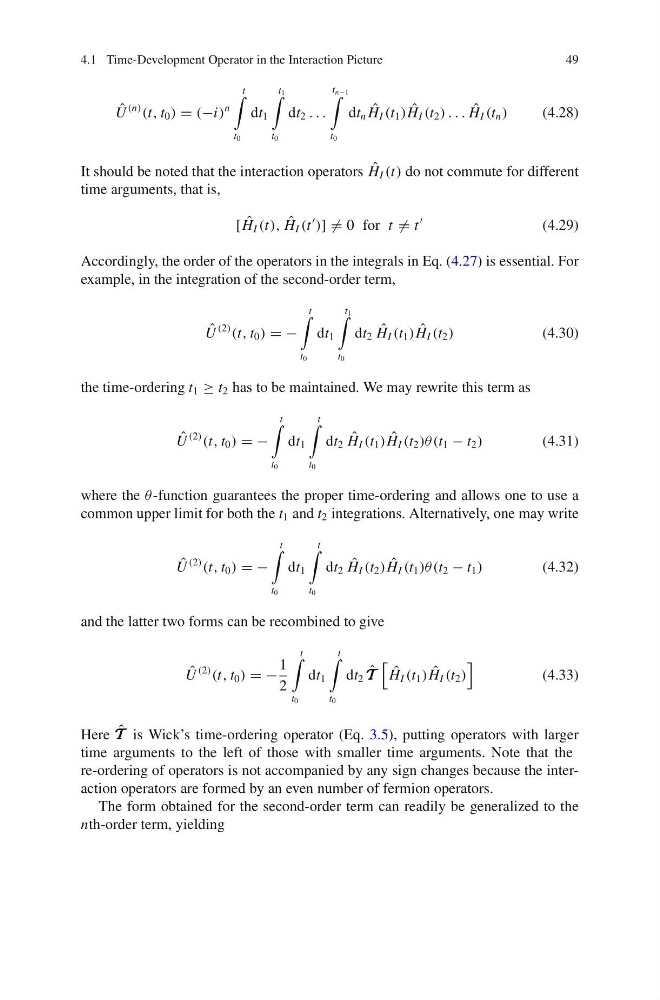
It should be noted that the interaction operators ˆ
H I (t) do not commute for different
time arguments, that is,
[ ˆ
H I (t), ˆ
H I (t
)] = 0 for t = t
(4.29)
Accordingly, the order of the operators in the integrals in Eq. (4.27) is essential. For
example, in the integration of the second-order term,
ˆ
U
(2)
(t, t 0 ) = −
t
t 0
dt 1
t 1
t 0
dt 2 ˆ
H I (t 1 ) ˆ
H I (t 2 )
(4.30)
the time-ordering t 1 ≥ t 2 has to be maintained. We may rewrite this term as
ˆ
U
(2)
(t, t 0 ) = −
t
t 0
dt 1
t
t 0
dt 2 ˆ
H I (t 1 ) ˆ
H I (t 2 )θ (t 1 − t 2 )
(4.31)
where the θ -function guarantees the proper time-ordering and allows one to use a
common upper limit for both the t 1 and t 2 integrations. Alternatively, one may write
ˆ
U
(2)
(t, t 0 ) = −
t
t 0
dt 1
t
t 0
dt 2 ˆ
H I (t 2 ) ˆ
H I (t 1 )θ (t 2 − t 1 )
(4.32)
and the latter two forms can be recombined to give
ˆ
U
(2)
(t, t 0 ) = −
1
2
t
t 0
dt 1
t
t 0
dt 2 ˆ
T T T
ˆ
H I (t 1 ) ˆ
H I (t 2 )
(4.33)
Here ˆ
T T T is Wick’s time-ordering operator (Eq. 3.5), putting operators with larger
time arguments to the left of those with smaller time arguments. Note that the
re-ordering of operators is not accompanied by any sign changes because the interaction operators are formed by an even number of fermion operators.
The form obtained for the second-order term can readily be generalized to the
nth-order term, yielding
49
ˆ
U
(n)
(t, t 0 ) = (−i)
n
t
t 0
dt 1
t 1
t 0
dt 2 . . .
t n−1
t 0
dt n ˆ
H I (t 1 ) ˆ
H I (t 2 ) . . . ˆ
H I (t n )
(4.28)
It should be noted that the interaction operators ˆ
H I (t) do not commute for different
time arguments, that is,
[ ˆ
H I (t), ˆ
H I (t
)] = 0 for t = t
(4.29)
Accordingly, the order of the operators in the integrals in Eq. (4.27) is essential. For
example, in the integration of the second-order term,
ˆ
U
(2)
(t, t 0 ) = −
t
t 0
dt 1
t 1
t 0
dt 2 ˆ
H I (t 1 ) ˆ
H I (t 2 )
(4.30)
the time-ordering t 1 ≥ t 2 has to be maintained. We may rewrite this term as
ˆ
U
(2)
(t, t 0 ) = −
t
t 0
dt 1
t
t 0
dt 2 ˆ
H I (t 1 ) ˆ
H I (t 2 )θ (t 1 − t 2 )
(4.31)
where the θ -function guarantees the proper time-ordering and allows one to use a
common upper limit for both the t 1 and t 2 integrations. Alternatively, one may write
ˆ
U
(2)
(t, t 0 ) = −
t
t 0
dt 1
t
t 0
dt 2 ˆ
H I (t 2 ) ˆ
H I (t 1 )θ (t 2 − t 1 )
(4.32)
and the latter two forms can be recombined to give
ˆ
U
(2)
(t, t 0 ) = −
1
2
t
t 0
dt 1
t
t 0
dt 2 ˆ
T T T
ˆ
H I (t 1 ) ˆ
H I (t 2 )
(4.33)
Here ˆ
T T T is Wick’s time-ordering operator (Eq. 3.5), putting operators with larger
time arguments to the left of those with smaller time arguments. Note that the
re-ordering of operators is not accompanied by any sign changes because the interaction operators are formed by an even number of fermion operators.
The form obtained for the second-order term can readily be generalized to the
nth-order term, yielding