

52
4 Perturbation Theory for the Electron Propagator
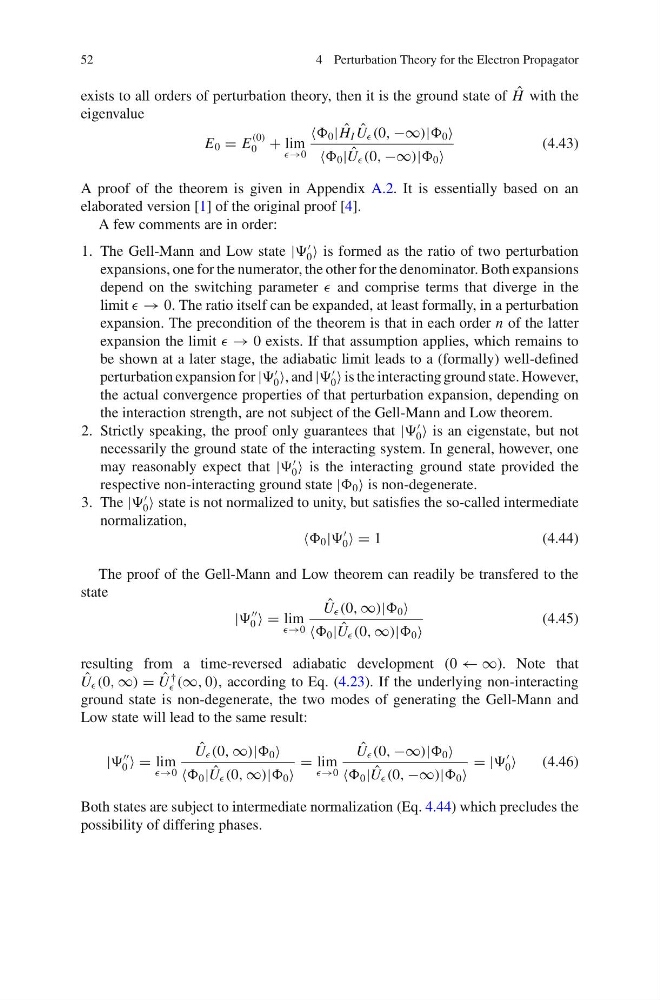
exists to all orders of perturbation theory, then it is the ground state of ˆ
H with the
eigenvalue
E 0 = E
(0)
0 + lim
→0
0 | ˆ
H I ˆ
U (0, −∞)| 0
0 | ˆ
U (0, −∞)| 0
(4.43)
A proof of the theorem is given in Appendix A.2. It is essentially based on an
elaborated version [1] of the original proof [4].
A few comments are in order:
1. The Gell-Mann and Low state |
0 is formed as the ratio of two perturbation
expansions, one for the numerator, the other for the denominator. Both expansions
depend on the switching parameter and comprise terms that diverge in the
limit → 0. The ratio itself can be expanded, at least formally, in a perturbation
expansion. The precondition of the theorem is that in each order n of the latter
expansion the limit → 0 exists. If that assumption applies, which remains to
be shown at a later stage, the adiabatic limit leads to a (formally) well-defined
perturbation expansion for |
0 , and |
0 is the interacting ground state. However,
the actual convergence properties of that perturbation expansion, depending on
the interaction strength, are not subject of the Gell-Mann and Low theorem.
2. Strictly speaking, the proof only guarantees that |
0 is an eigenstate, but not
necessarily the ground state of the interacting system. In general, however, one
may reasonably expect that |
0 is the interacting ground state provided the
respective non-interacting ground state | 0 is non-degenerate.
3. The |
0 state is not normalized to unity, but satisfies the so-called intermediate
normalization,
0 |
0 = 1
(4.44)
The proof of the Gell-Mann and Low theorem can readily be transfered to the
state
|
0 = lim
→0
ˆ
U (0, ∞)| 0
0 | ˆ
U (0, ∞)| 0
(4.45)
resulting from a time-reversed adiabatic development (0 ← ∞). Note that
ˆ
U (0, ∞) = ˆ
U
†
(∞, 0), according to Eq. (4.23). If the underlying non-interacting
ground state is non-degenerate, the two modes of generating the Gell-Mann and
Low state will lead to the same result:
|
0 = lim
→0
ˆ
U (0, ∞)| 0
0 | ˆ
U (0, ∞)| 0
= lim
→0
ˆ
U (0, −∞)| 0
0 | ˆ
U (0, −∞)| 0
= |
0
(4.46)
Both states are subject to intermediate normalization (Eq. 4.44) which precludes the
possibility of differing phases.
4 Perturbation Theory for the Electron Propagator
exists to all orders of perturbation theory, then it is the ground state of ˆ
H with the
eigenvalue
E 0 = E
(0)
0 + lim
→0
0 | ˆ
H I ˆ
U (0, −∞)| 0
0 | ˆ
U (0, −∞)| 0
(4.43)
A proof of the theorem is given in Appendix A.2. It is essentially based on an
elaborated version [1] of the original proof [4].
A few comments are in order:
1. The Gell-Mann and Low state |
0 is formed as the ratio of two perturbation
expansions, one for the numerator, the other for the denominator. Both expansions
depend on the switching parameter and comprise terms that diverge in the
limit → 0. The ratio itself can be expanded, at least formally, in a perturbation
expansion. The precondition of the theorem is that in each order n of the latter
expansion the limit → 0 exists. If that assumption applies, which remains to
be shown at a later stage, the adiabatic limit leads to a (formally) well-defined
perturbation expansion for |
0 , and |
0 is the interacting ground state. However,
the actual convergence properties of that perturbation expansion, depending on
the interaction strength, are not subject of the Gell-Mann and Low theorem.
2. Strictly speaking, the proof only guarantees that |
0 is an eigenstate, but not
necessarily the ground state of the interacting system. In general, however, one
may reasonably expect that |
0 is the interacting ground state provided the
respective non-interacting ground state | 0 is non-degenerate.
3. The |
0 state is not normalized to unity, but satisfies the so-called intermediate
normalization,
0 |
0 = 1
(4.44)
The proof of the Gell-Mann and Low theorem can readily be transfered to the
state
|
0 = lim
→0
ˆ
U (0, ∞)| 0
0 | ˆ
U (0, ∞)| 0
(4.45)
resulting from a time-reversed adiabatic development (0 ← ∞). Note that
ˆ
U (0, ∞) = ˆ
U
†
(∞, 0), according to Eq. (4.23). If the underlying non-interacting
ground state is non-degenerate, the two modes of generating the Gell-Mann and
Low state will lead to the same result:
|
0 = lim
→0
ˆ
U (0, ∞)| 0
0 | ˆ
U (0, ∞)| 0
= lim
→0
ˆ
U (0, −∞)| 0
0 | ˆ
U (0, −∞)| 0
= |
0
(4.46)
Both states are subject to intermediate normalization (Eq. 4.44) which precludes the
possibility of differing phases.