

4.1 Time-Development Operator in the Interaction Picture
47
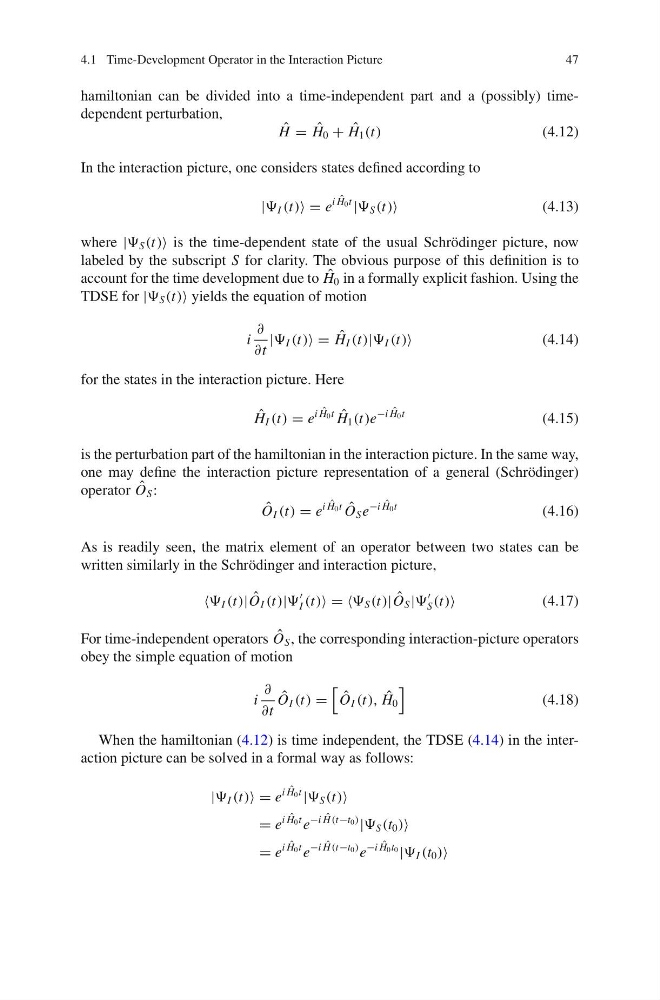
hamiltonian can be divided into a time-independent part and a (possibly) timedependent perturbation,
ˆ
H = ˆ
H 0 + ˆ
H 1 (t)
(4.12)
In the interaction picture, one considers states defined according to
| I (t) = e
i ˆ
H 0 t
| S (t)
(4.13)
where | S (t) is the time-dependent state of the usual Schrödinger picture, now
labeled by the subscript S for clarity. The obvious purpose of this definition is to
account for the time development due to ˆ
H 0 in a formally explicit fashion. Using the
TDSE for | S (t) yields the equation of motion
i
∂
∂t
| I (t) = ˆ
H I (t)| I (t)
(4.14)
for the states in the interaction picture. Here
ˆ
H I (t) = e
i ˆ
H 0 t ˆ
H 1 (t)e
−i ˆ
H 0 t
(4.15)
is the perturbation part of the hamiltonian in the interaction picture. In the same way,
one may define the interaction picture representation of a general (Schrödinger)
operator ˆ
O S :
ˆ
O I (t) = e
i ˆ
H 0 t ˆ
O S e
−i ˆ
H 0 t
(4.16)
As is readily seen, the matrix element of an operator between two states can be
written similarly in the Schrödinger and interaction picture,
I (t)| ˆ
O I (t)|
I (t) = = S (t)| ˆ
O S |
S (t)
(4.17)
For time-independent operators ˆ
O S , the corresponding interaction-picture operators
obey the simple equation of motion
i
∂
∂t
ˆ
O I (t) =
ˆ
O I (t), ˆ
H 0
(4.18)
When the hamiltonian (4.12) is time independent, the TDSE (4.14) in the interaction picture can be solved in a formal way as follows:
| I (t) = e
i ˆ
H 0 t
| S (t)
= e
i ˆ
H 0 t e
−i ˆ
H (t−t 0 )
| S (t 0 )
= e
i ˆ
H 0 t e
−i ˆ
H (t−t 0 ) e
−i ˆ
H 0 t 0 | I (t 0 )
47
hamiltonian can be divided into a time-independent part and a (possibly) timedependent perturbation,
ˆ
H = ˆ
H 0 + ˆ
H 1 (t)
(4.12)
In the interaction picture, one considers states defined according to
| I (t) = e
i ˆ
H 0 t
| S (t)
(4.13)
where | S (t) is the time-dependent state of the usual Schrödinger picture, now
labeled by the subscript S for clarity. The obvious purpose of this definition is to
account for the time development due to ˆ
H 0 in a formally explicit fashion. Using the
TDSE for | S (t) yields the equation of motion
i
∂
∂t
| I (t) = ˆ
H I (t)| I (t)
(4.14)
for the states in the interaction picture. Here
ˆ
H I (t) = e
i ˆ
H 0 t ˆ
H 1 (t)e
−i ˆ
H 0 t
(4.15)
is the perturbation part of the hamiltonian in the interaction picture. In the same way,
one may define the interaction picture representation of a general (Schrödinger)
operator ˆ
O S :
ˆ
O I (t) = e
i ˆ
H 0 t ˆ
O S e
−i ˆ
H 0 t
(4.16)
As is readily seen, the matrix element of an operator between two states can be
written similarly in the Schrödinger and interaction picture,
I (t)| ˆ
O I (t)|
I (t) = = S (t)| ˆ
O S |
S (t)
(4.17)
For time-independent operators ˆ
O S , the corresponding interaction-picture operators
obey the simple equation of motion
i
∂
∂t
ˆ
O I (t) =
ˆ
O I (t), ˆ
H 0
(4.18)
When the hamiltonian (4.12) is time independent, the TDSE (4.14) in the interaction picture can be solved in a formal way as follows:
| I (t) = e
i ˆ
H 0 t
| S (t)
= e
i ˆ
H 0 t e
−i ˆ
H (t−t 0 )
| S (t 0 )
= e
i ˆ
H 0 t e
−i ˆ
H (t−t 0 ) e
−i ˆ
H 0 t 0 | I (t 0 )